Oh yeah! I’d almost forgotten that we decided to splurge on a long weekend back in Italy. It was the August bank holiday in Ireland, so we used that Monday to bolster our weekend.
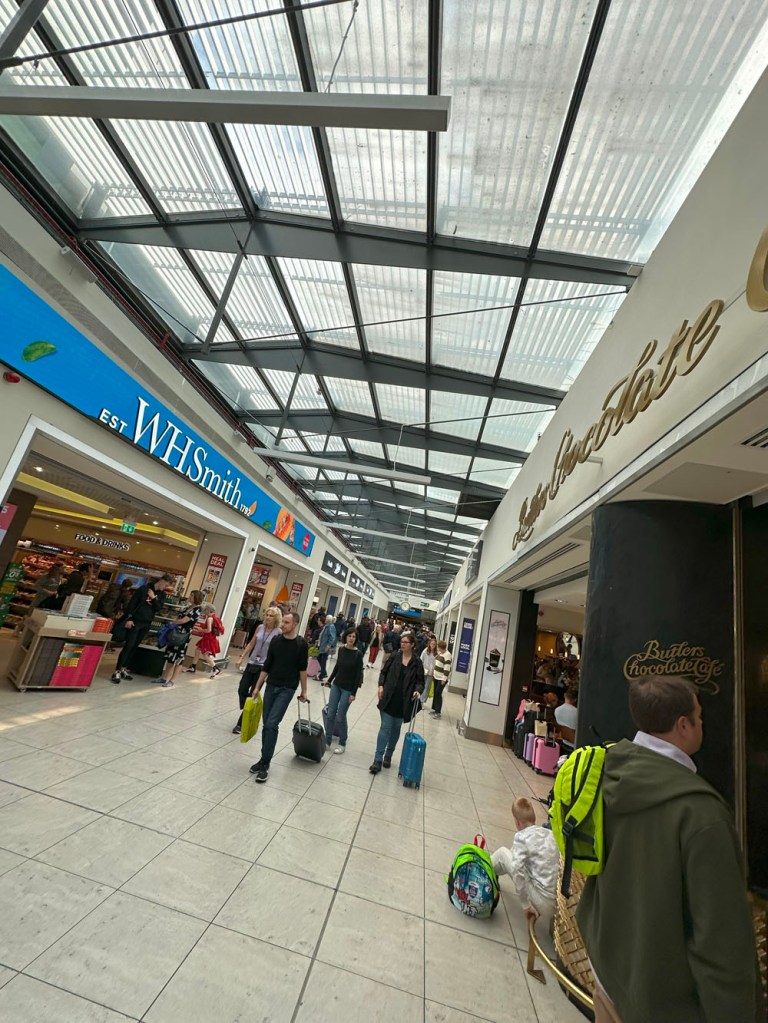
We flew out the Thursday evening, and arrived in Volterra half past midnight.
Friday, August 4th We did a lot this weekend to maximise the money-to-fun ratio, and so sleep may have suffered. We found ourselves on the go a lot. So, our first date was in Bagno Perla beach club in Castliglione della Pescaia (parking). We met our friend by the entrance to her apartment stupid early, and had a quick breakfast at L’Incontro. Then we walked to our rental and drove the ninety minutes to Castiglione – a lovely village on the coast (duh), with a rare old-town feel. It’s a bit of a walk from the carpark, but parking is tricky elsewhere in the town – plus at least the carpark leaves you close to the centre of the town itself, which was to be our target afterwards.
Unsurprisingly, we did beachy stuff at the beach. I stood among the waves in the warm water. The strand goes out about 30 or so meters before you have to worry about floating, and unlike many Tuscan beaches, the sand is silky smooth. I cannot swim. I cannot even float. I know people say they cannot swim but they can at least float or doggy-paddle. Not I. So it’s a big deal for me to get out there.
They have a restaurant at the beach club too… don’t expect anything haute – but it does it’s job more than adequately.
Back to the beach for a couple of hours. Our friend could stay there all day (thereby getting best value for money from the rental of seats/beds/parasols.
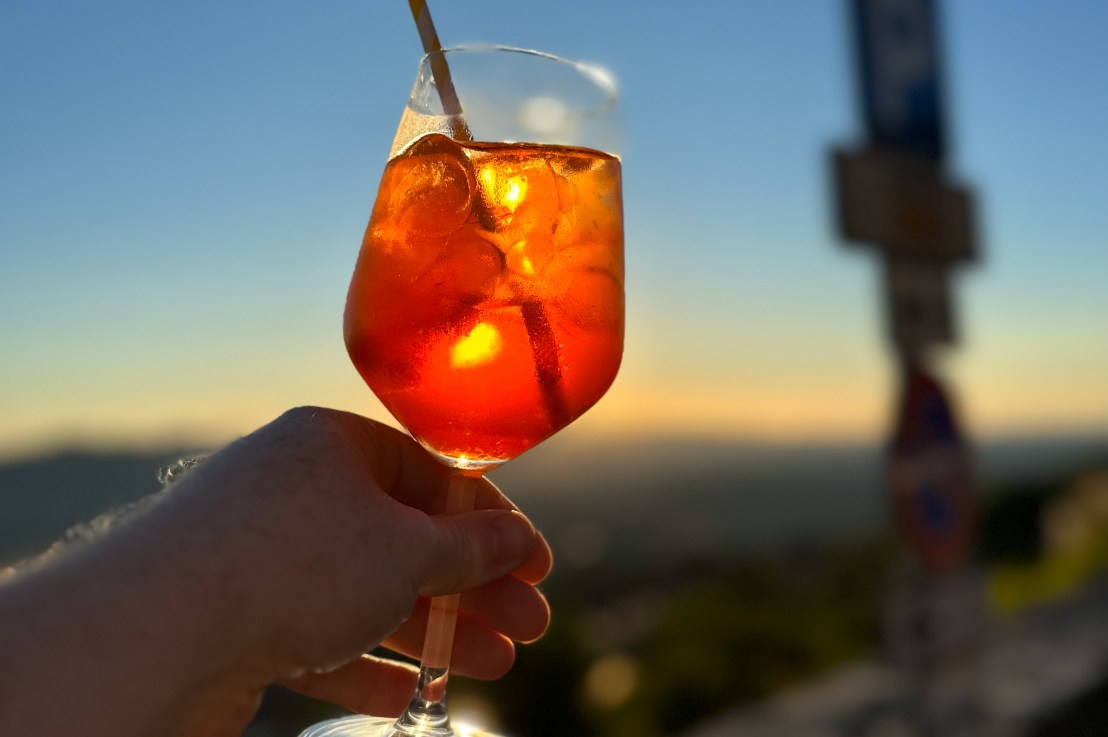
But Niamh and I have to do something else – something different after a while. We have no patience for just lying there. We walked back and had a wander about the town. Once done, we stopped off at a bar on the main street for a spritz… which was nice, but the service was a little south of friendly. While we were there, we were caught in the mother and father of all downpours! Leaving that establishment, we thought we’d check out the menu of an Irish bar there – we had no real intention of eating there, as we had our sights on a burger bar. The food wasn’t Irish really, but at least the beer was!
Downpour – check out the early part of the video towards the bottom of the blogYummy pints!
Afterwards it was off to the burger bar for a tasty treat. The bar has since moved to Florence, and rumour has it that it’s not as good as it was, so no names dropped here. The bar wasn’t opened yet, so we went into the hotel bar opposite, where a few locals were hanging out, and had another spritz.
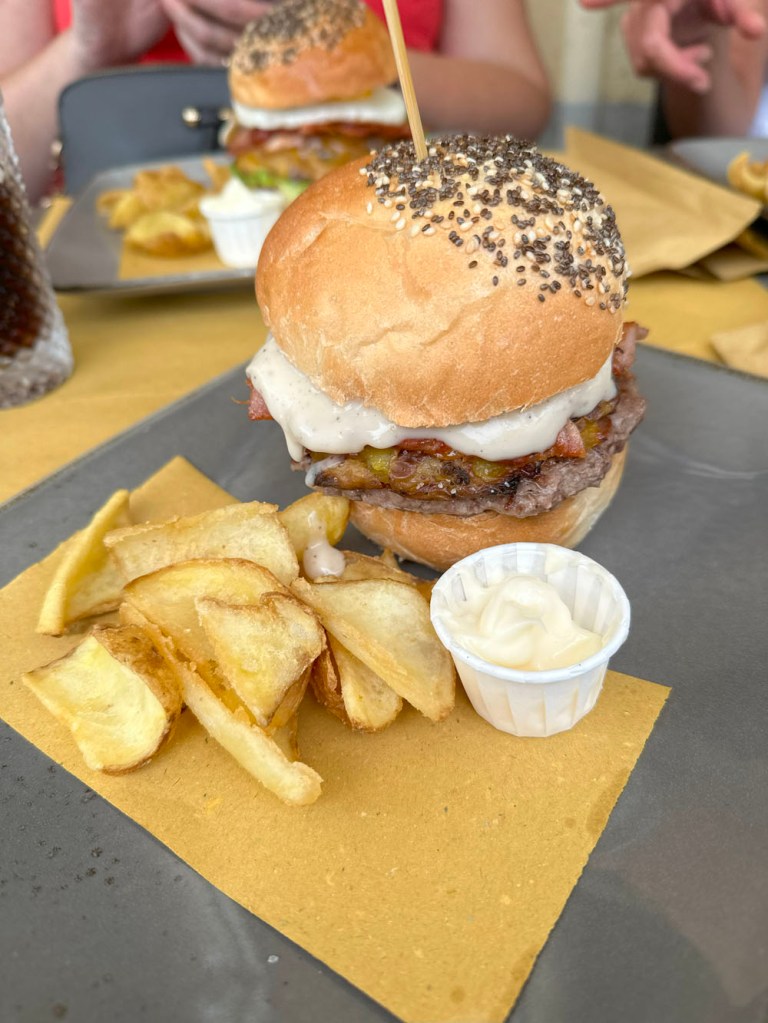
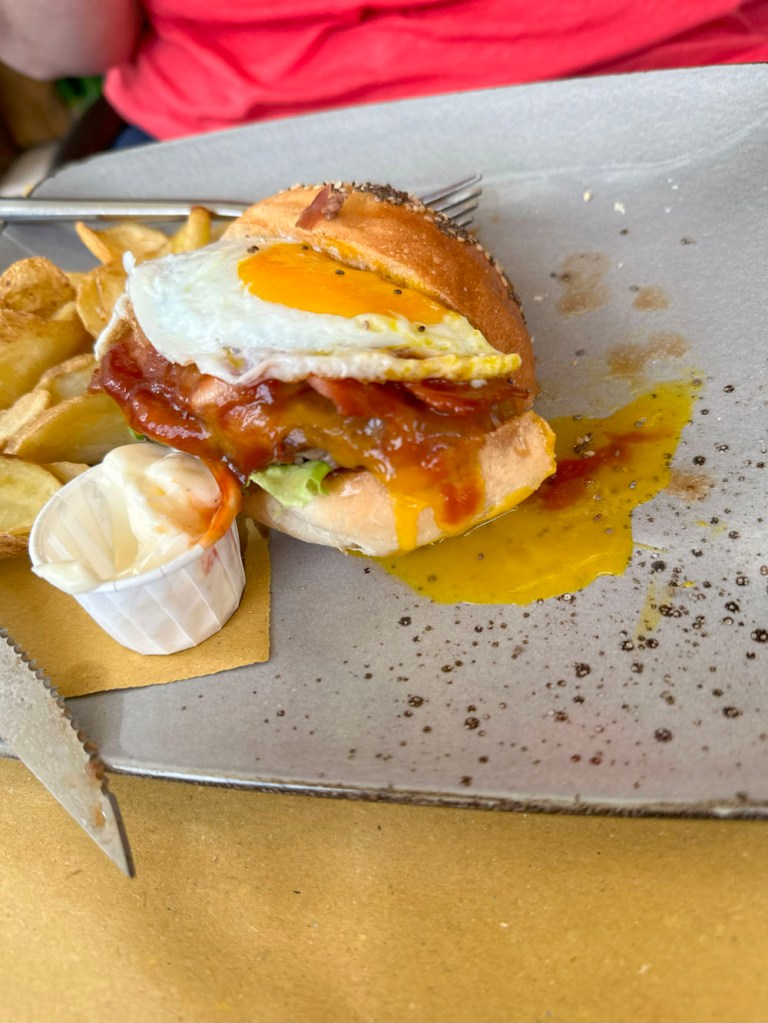
The burger bar opened and our friend reacquainted herself with the owner – we made our order and got our burgers. They were every bit as good as they looked!
Once done there, we (that is to say ‘I’) had the arduous task of driving us home. No staying overnight – we did that later in September, though.
I left the ladies off and parked at in the free area, as the resident’s carpark was full. Awesome times!
Saturday, August 5th A day of travelling and exploring was in store for us!
I did start the day with one of my trademarked walks, although I kept it brief and inside the walls.
Walked, breakfasted, showered and off we went. We’d harboured significant interest in the forested areas around the Val di Cornia recently, and headed off in that direction again this time. We wound our way through a metric ton of mini-valleys, and saw a town in the distance: Gerfalco. I didn’t see much in the way of anywhere to eat after an explore, though. Sorry, Gerfalco – maybe another time. Checking Google now, I see the Cirolo looks like it serves antipasti and sandwiches – so I’ll put it back on my map. But for now, it was on to the larger town on the other side of the valley: Montieri (parking).
I loved the street art at the car park!
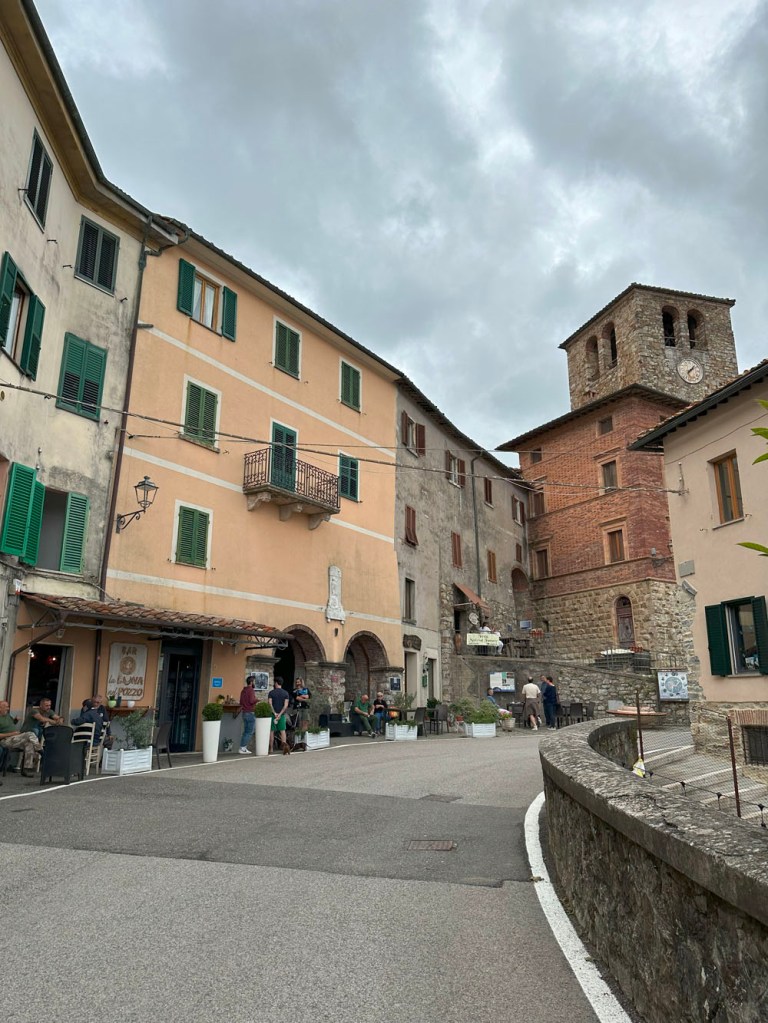
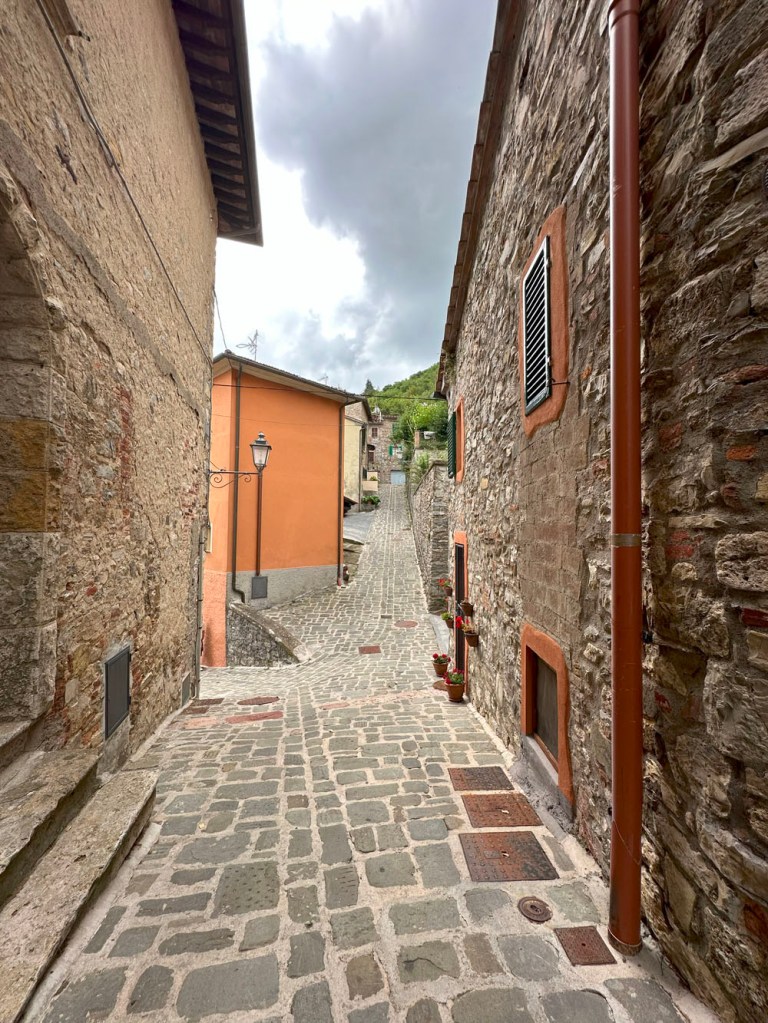
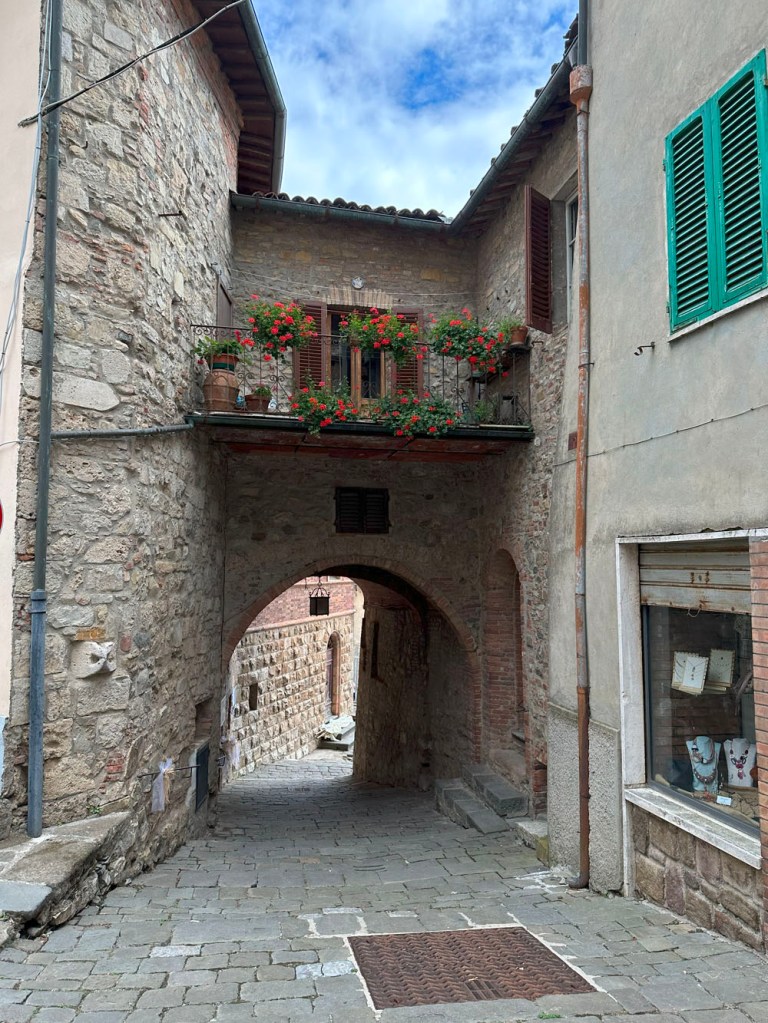
I got a good vibe from Montieri from the get-go. There are fab views into the forests below (check the video), and by the time we reached the heart of the town, we saw that the town seemed to have a good sense of community. There was a group of guys sitting in the curved main part of the town, all chatting, gossiping and generally enjoying each others’ company. There was a bar and a restaurant – only the former of which was open then. The restaurant was due to open, however, and so we spent the time going up and down Montieri’s hills, and exploring its nooks and crannies.
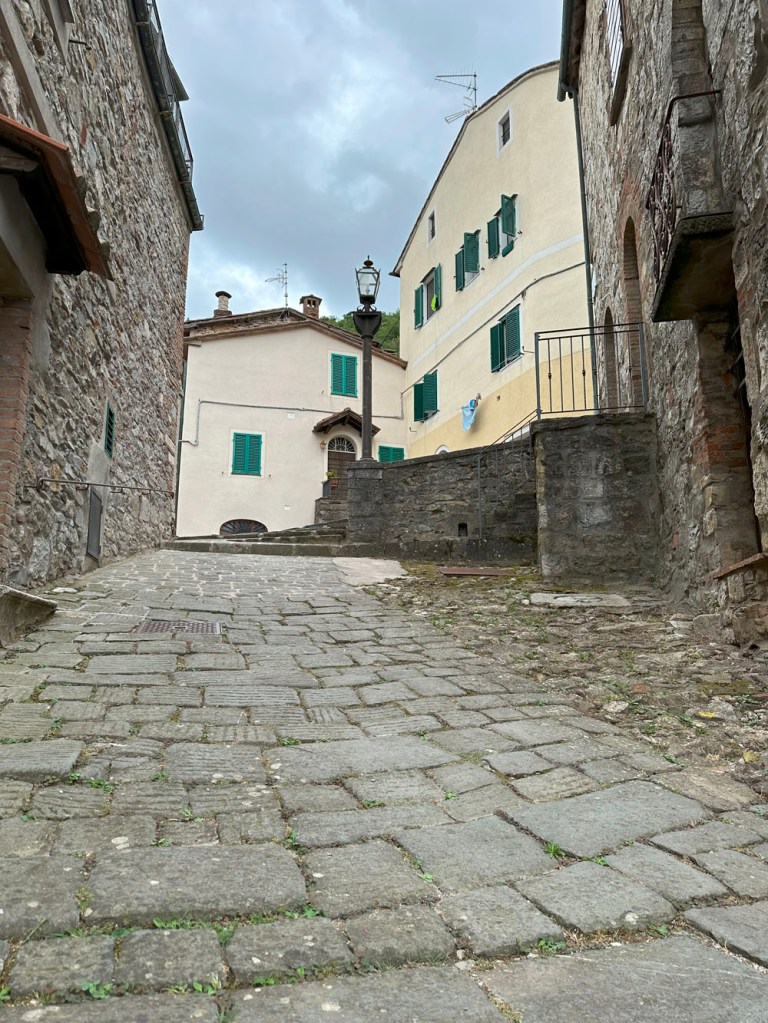
The one thing I will say that marks Montieri as being quite different to most other towns we’ve explored, is that it’s rather grey. So, rather than the amber of tufa, the houses were made of a different, more rugged stone. Even the flagstones on the roads and paths were different. Different is good, and so we enjoyed our time nosing around.
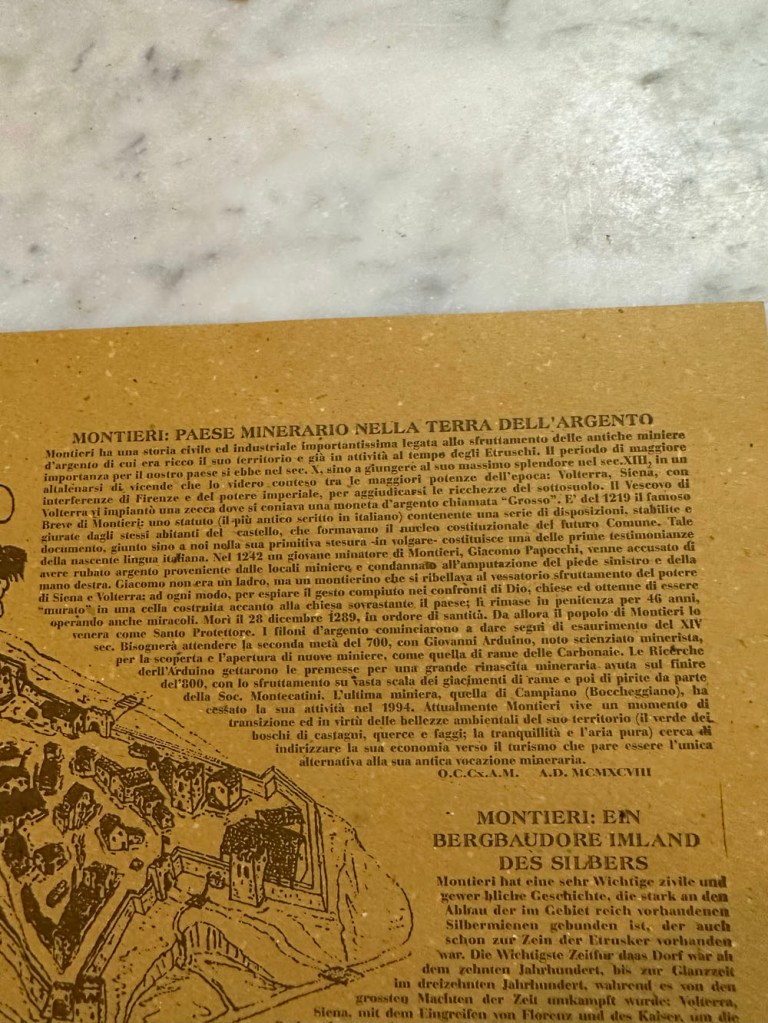
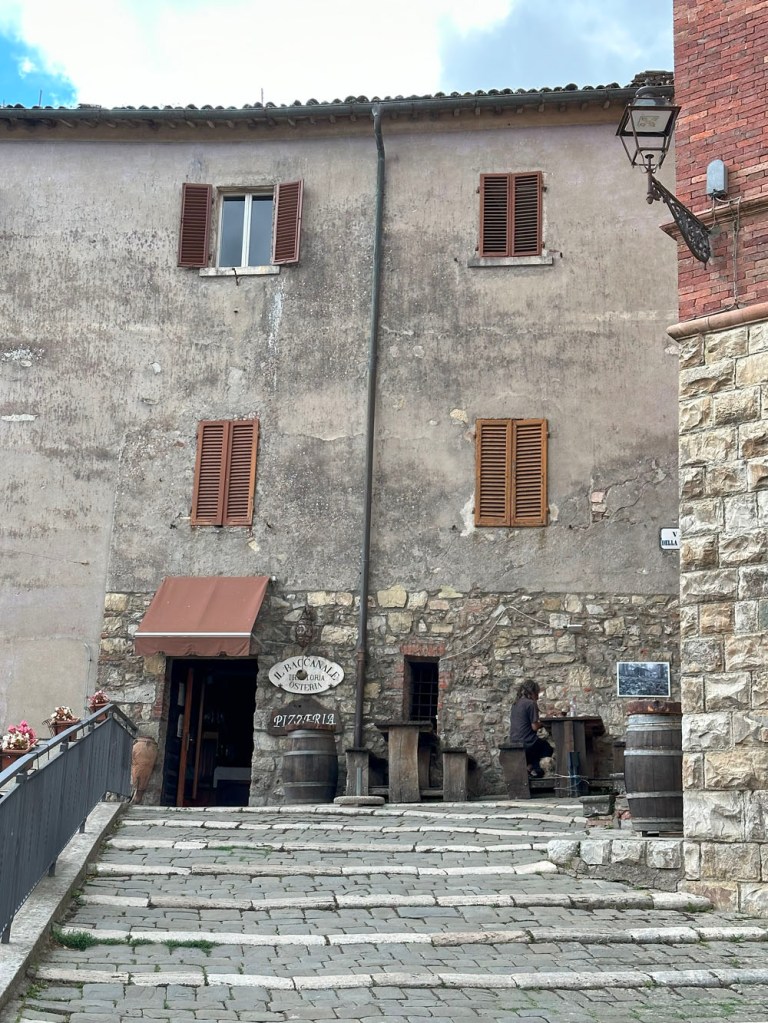
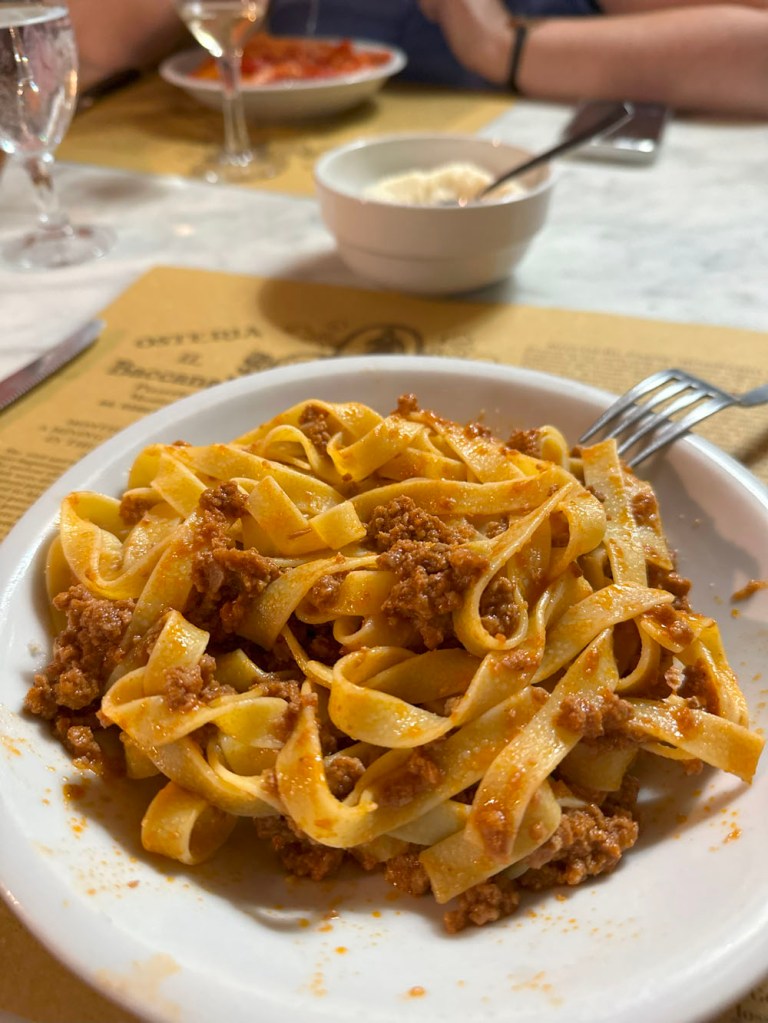
It was lunchtime, and exploring a hilltown can be hungry and tiring work, so it was off to a restaurant in the middle of town: Il Baccanale. Once inside, we were given placemats, giving a brief history of the town, which was a cool little feature. It told us that the silver of which the Volterran medieval currency (the ‘Grosso’) was made was mined nearby. If you attend Volterra’s annual Medieval Festivals, you can use the Grosso as currency at it, instead of Euros.
I don’t want to harp on about a placemat, but it was a super idea!
Niamh and I shared an antipasto plate, and followed it up with tagliatelle al ragu (Niamh) and a traditional Tuscan plate of sausages and beans (me). The food was nice, and the people lovely. Worth a spin if you’re in the area.
A bit more sauce with the beans would have been better
Once fed, it was time to move on and explore another wee town: Sovicille. It was a 45 minute drive from Montieri, but we nearly stopped at Chiusidino as there seemed to have been some sort of festival on. Unfortunately, there was simply nowhere to park and it was on to Sovicille. We parked, and walked about the town.
There were almost no people about, and so the town, as well as being small, was also incredibly quiet. It was certainly warmer than Montieri. It was pretty – especially the central square in which we stopped for a quick drink before finishing up. There was little else to it, to be honest, apart from a large building we were unsure as to whether it was a hotel, stately home or collection of apartment. A lovely setting, if not a particularly lively setting.
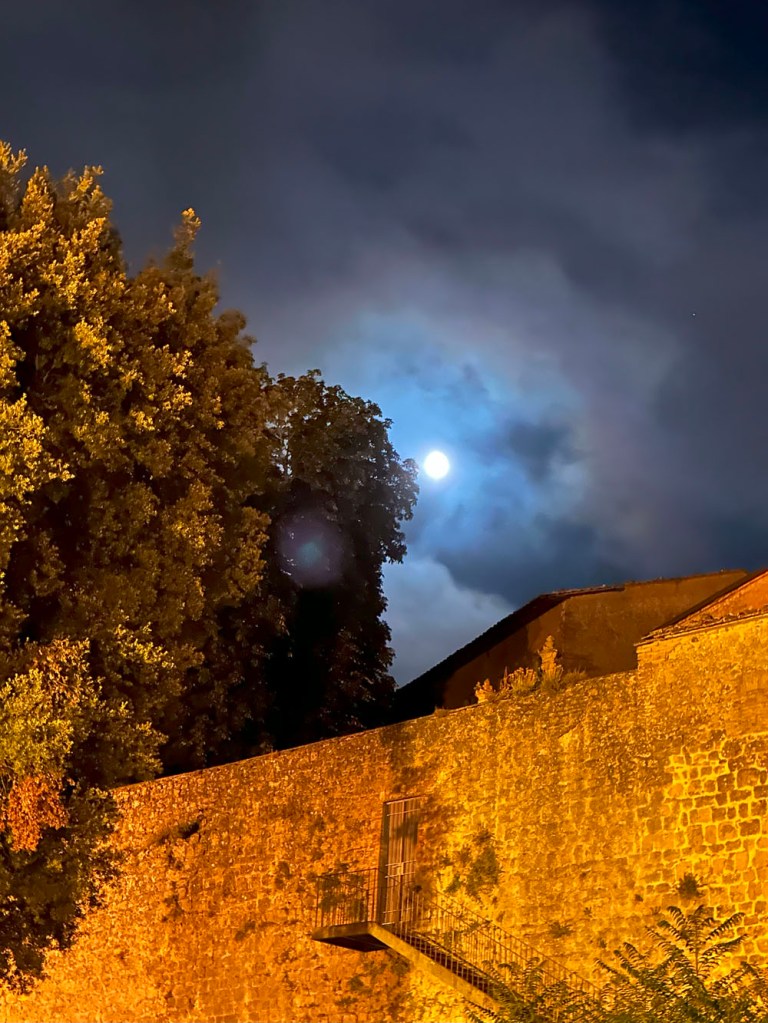
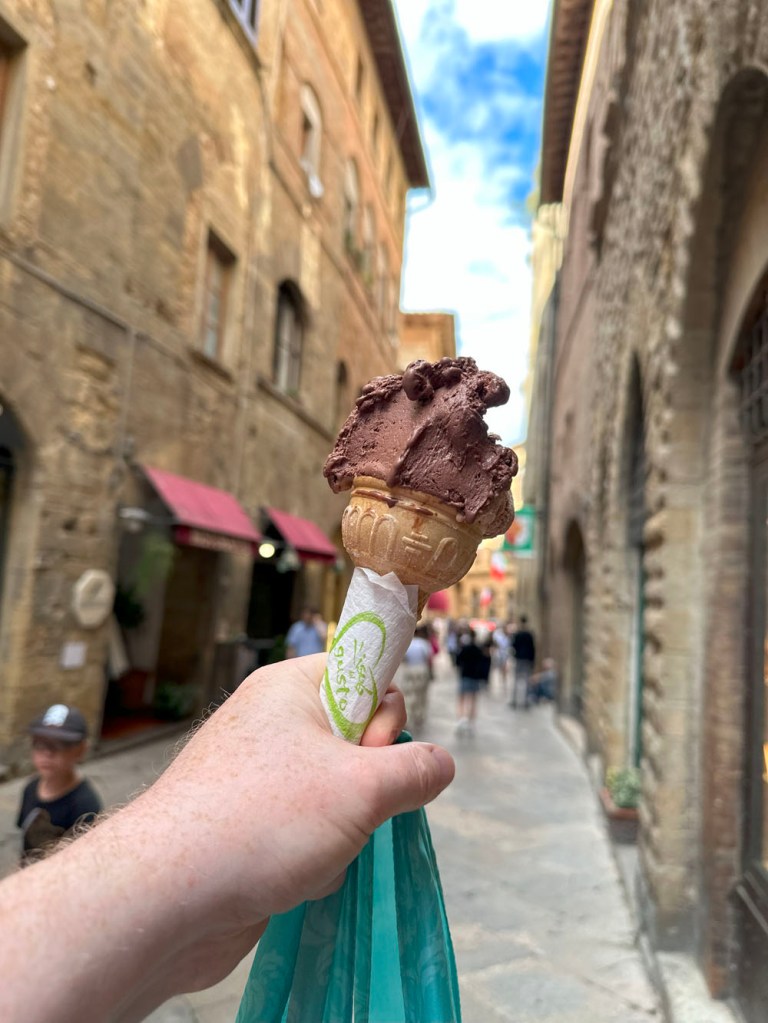
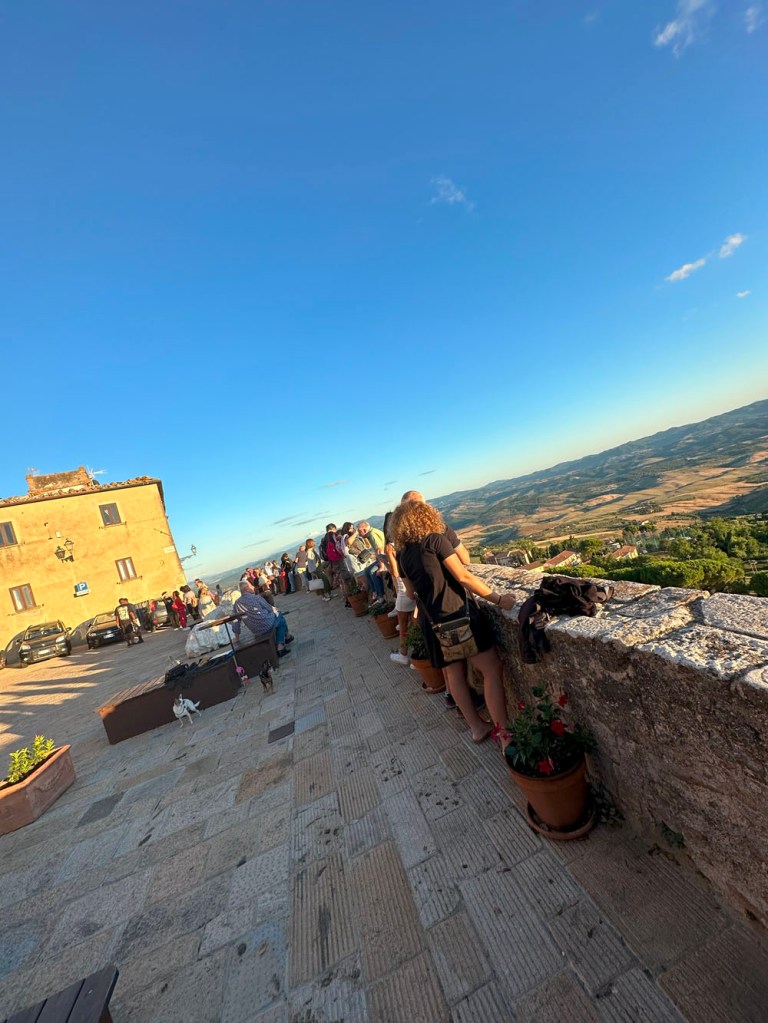
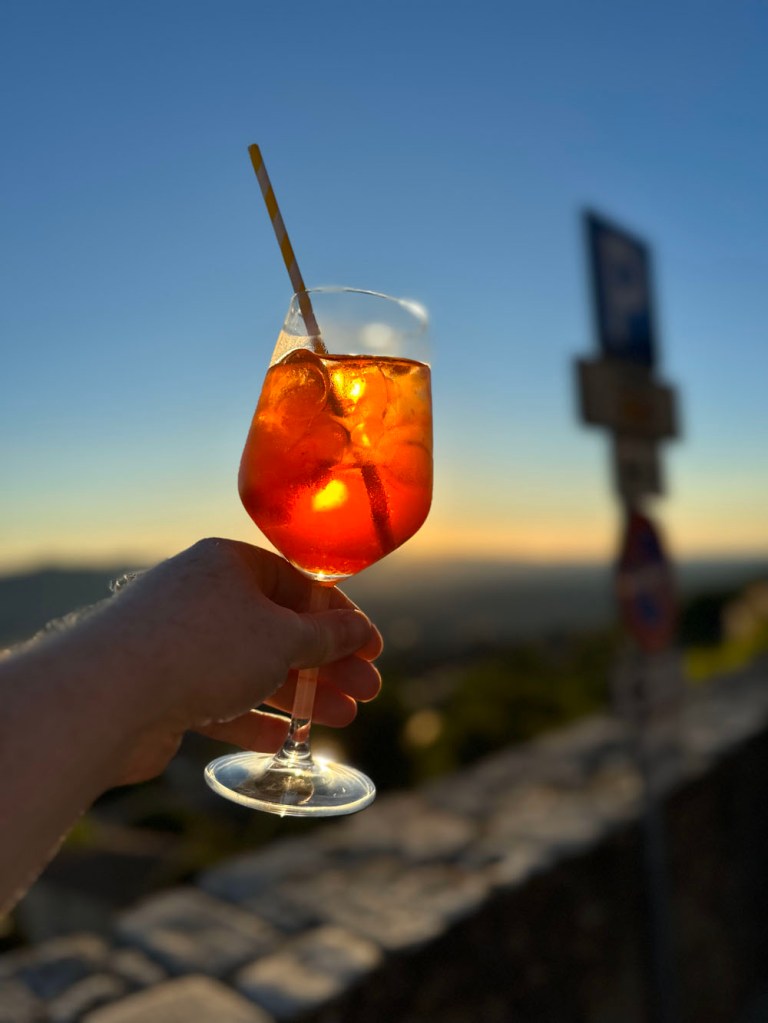
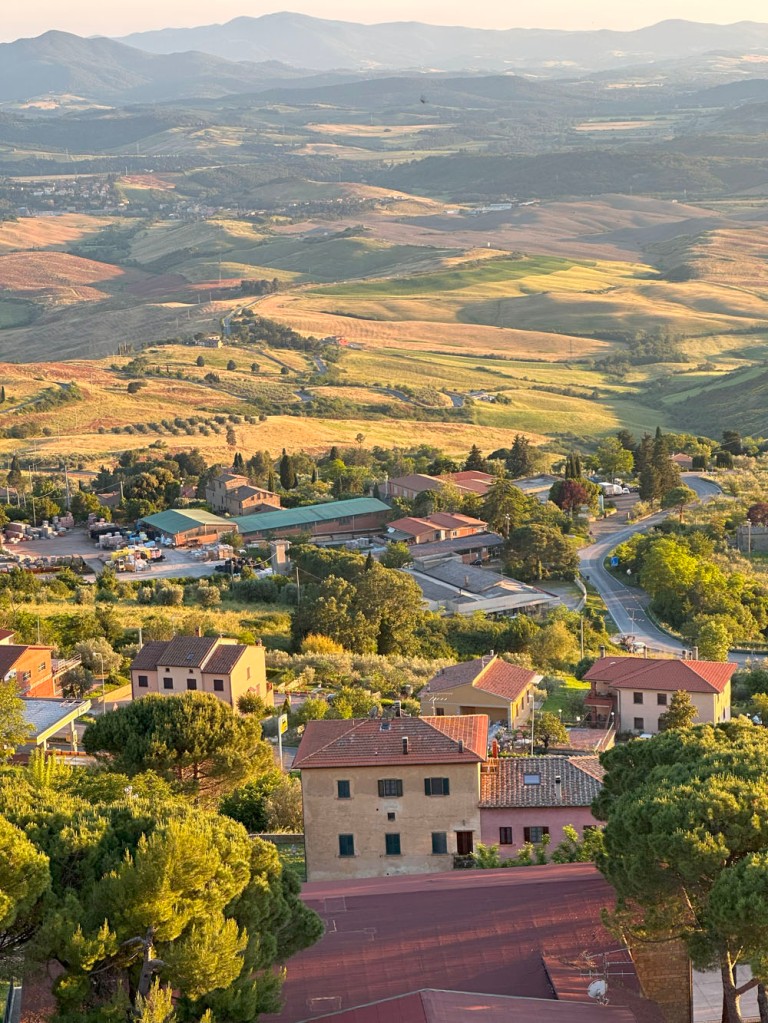
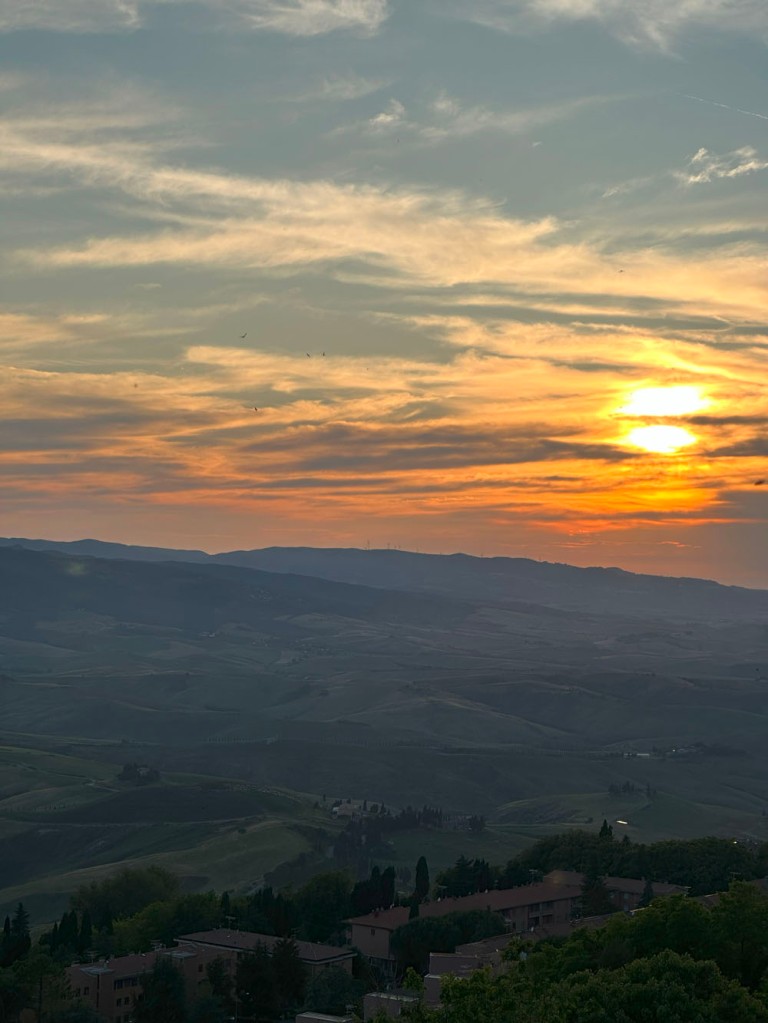
Back to Volterra, and the the rest of the day, consisted of gelato, aperitivi and food. I don’t have much else to say about it, but please do enjoy the photos – some of which of the sunset are fabulous!
Thanks for reading to the end – part 2 to follow – let me know what you think!
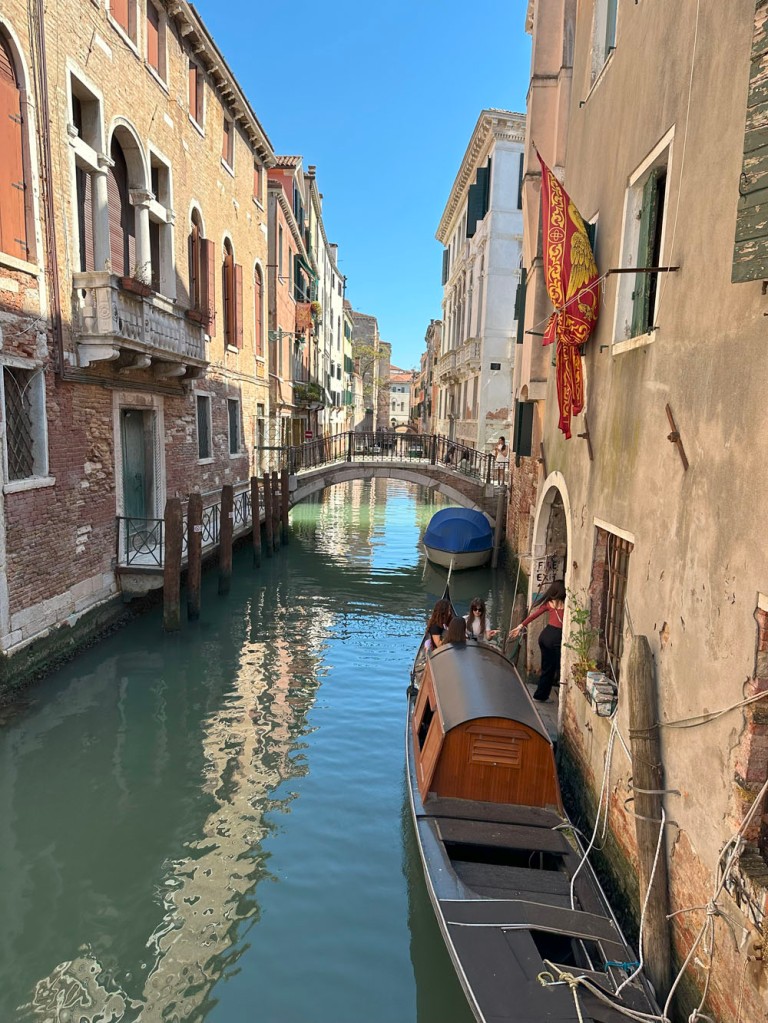
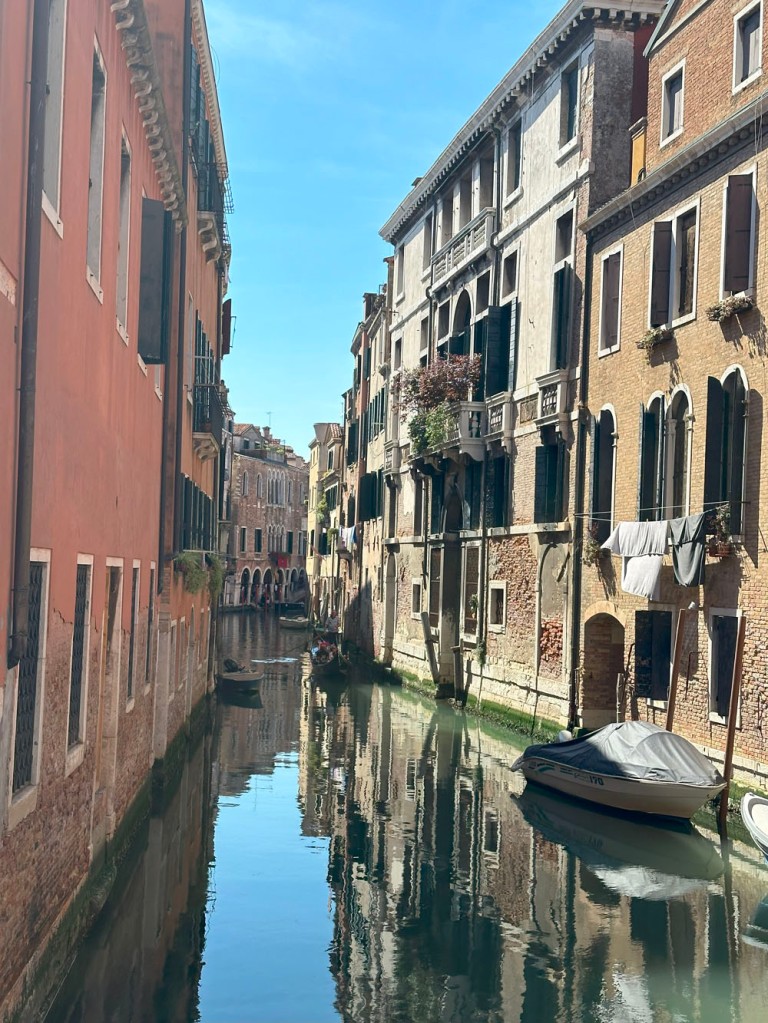
Day 2, which was Niamh’s birthday, was really excellent throughout. We walked our feet off, but we had a wonderful tour of the Doge’s palace and amazing food.
I had a horrible time of it during Covid – most of us did in fairness – and so, like many, my mental health deteriorated catastrophically. While I was building myself back up, I loved to watch travel videos, which included a type of long format video in which the host takes you on a live explore. One of these channels on YouTube is I Love You Venice. It’s less active now than it used to be, as guides are now active again post-Covid. Anyway, one of the hosts was Igor Scomparin (note that the link may fail at first, but try it again in your browser and it should be ok). I always loved his upbeat style and his knowledge of Venice is superb, so as part of Niamh’s birthday present, I organised a skip-the-line-tour of the Doge’s Palace and Cathedral for a few hours that morning.
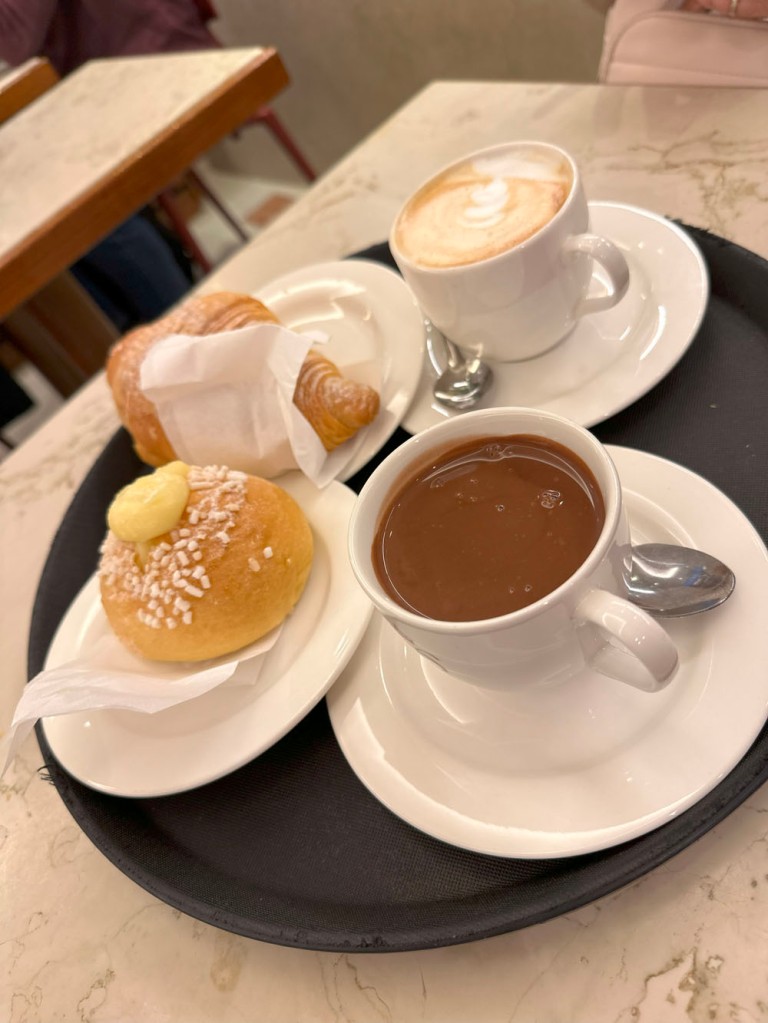
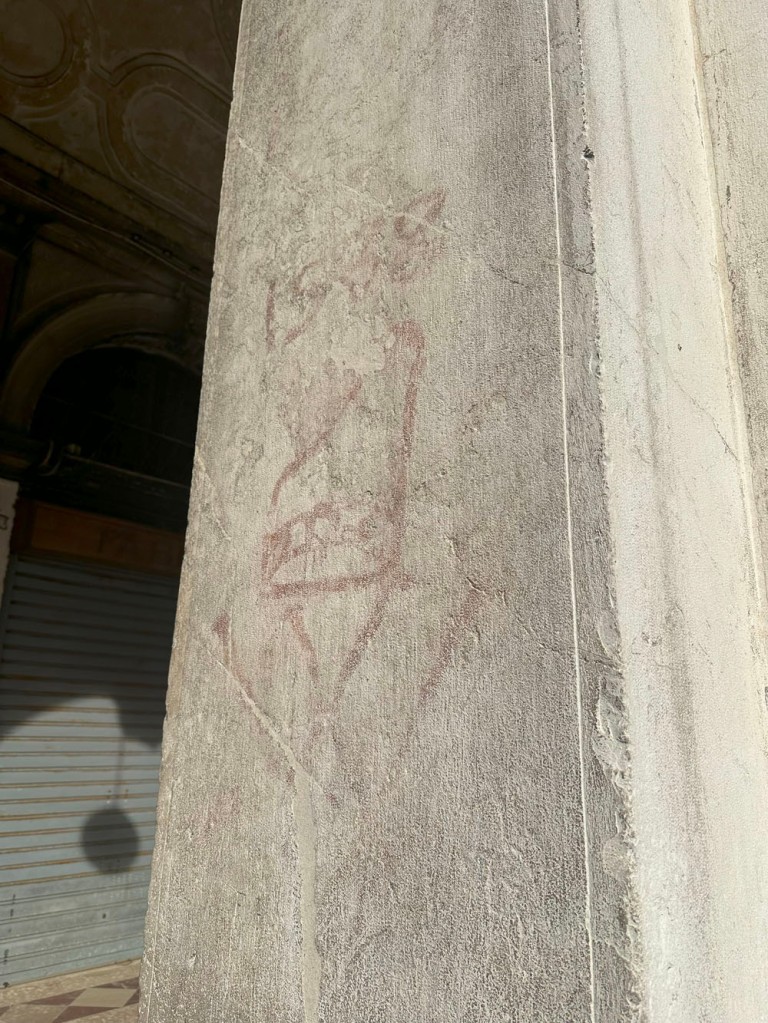
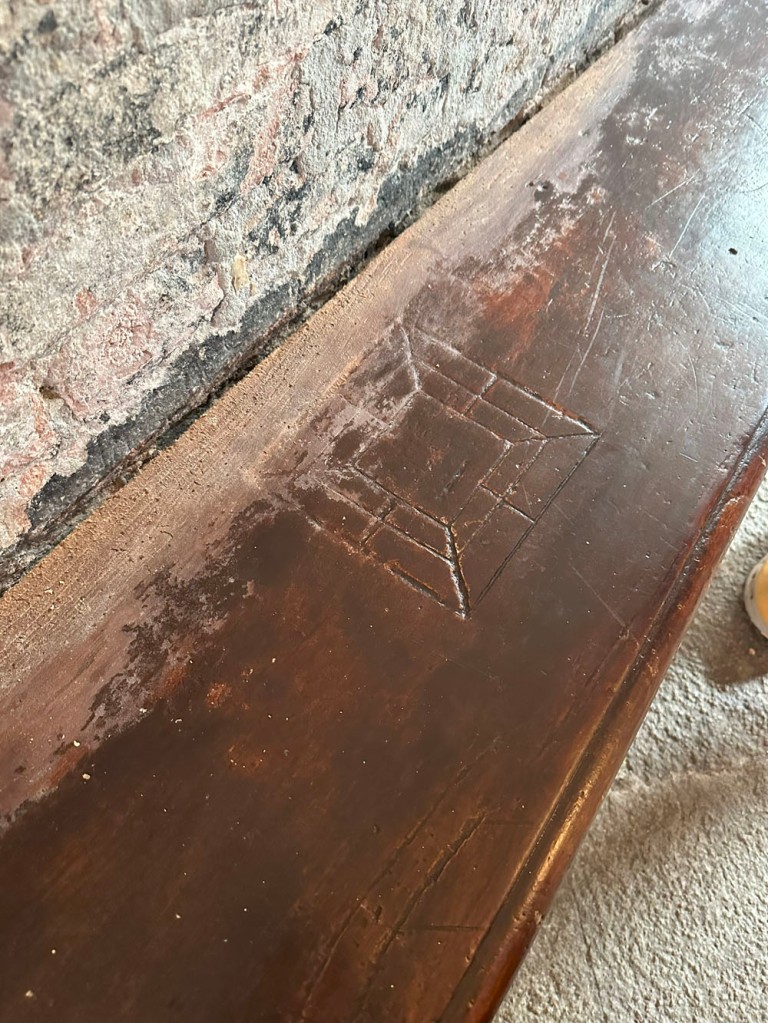
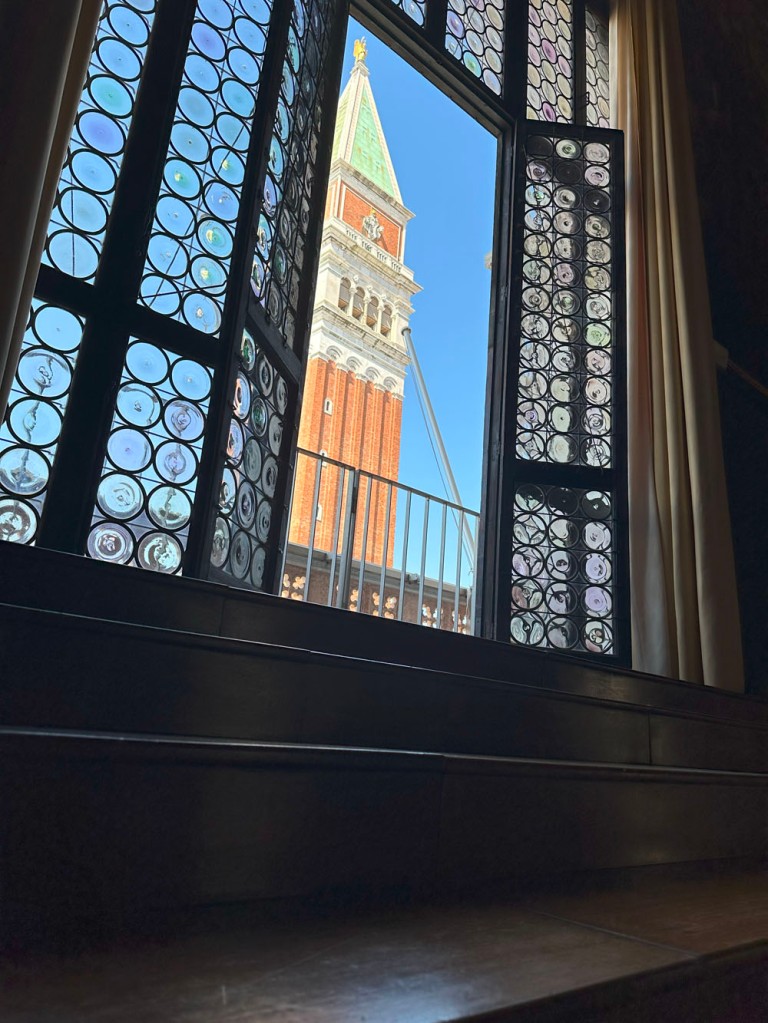
First, we asked the receptionist to turn our room temperature to 20 celsius, and then – breakfast – we made use of our voucher and had pastries and hot drinks next door to the hotel. Really delicious, I have to say – no complaints there – and there were a good few locals present too, which is always a good sign. We had a small walkabout, and then met Igor just off the hotel lobby. He showed us exactly how close we were to St. Mark’s square – much closet than any route we had previously taken had suggested. We were a little early, so we learned a little history in the southeast plaza. Igor showed us a few graffiti on columns supporting the arcades of the building opposite.
Graffitti!
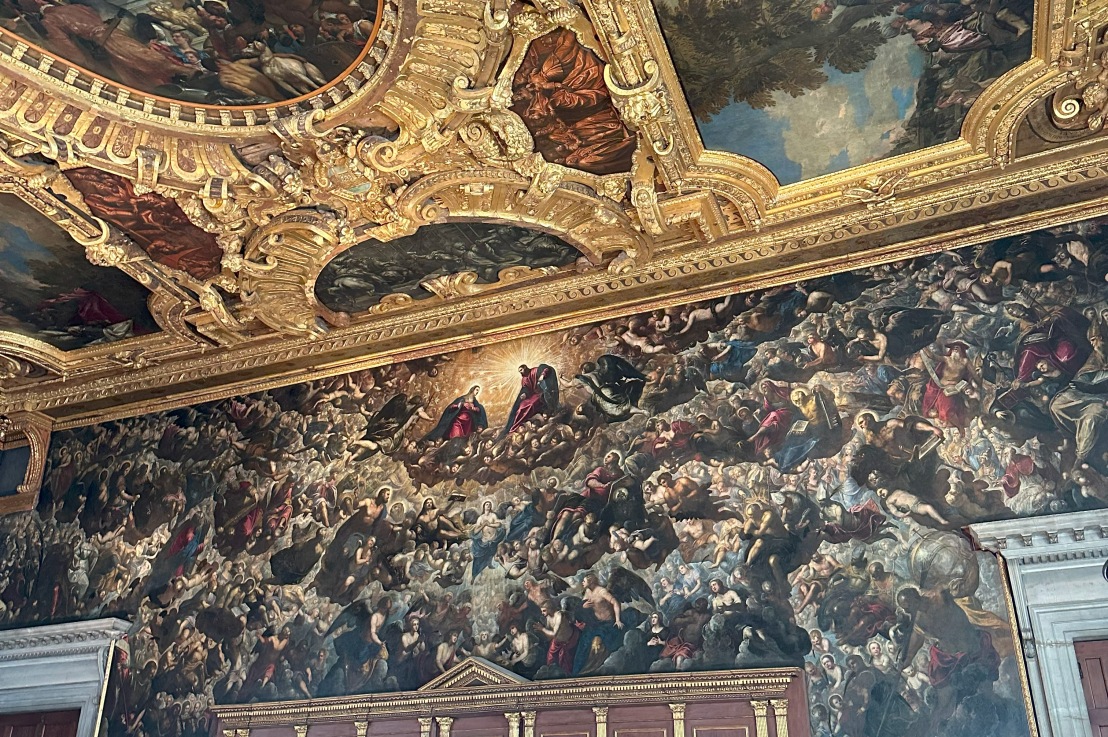
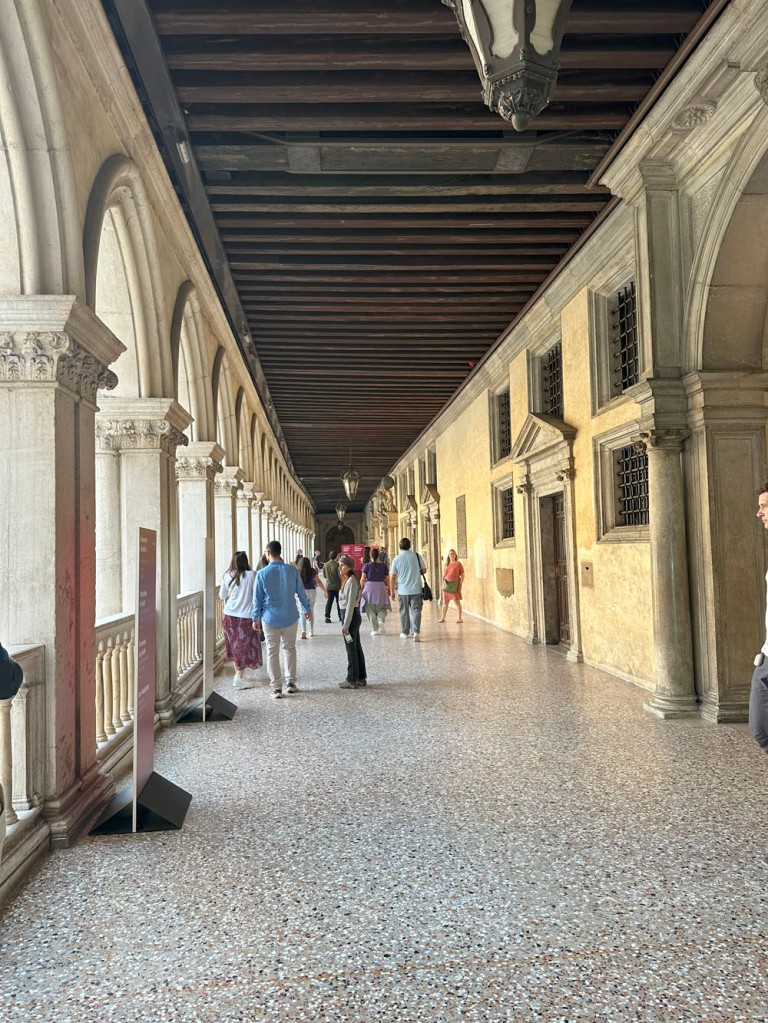
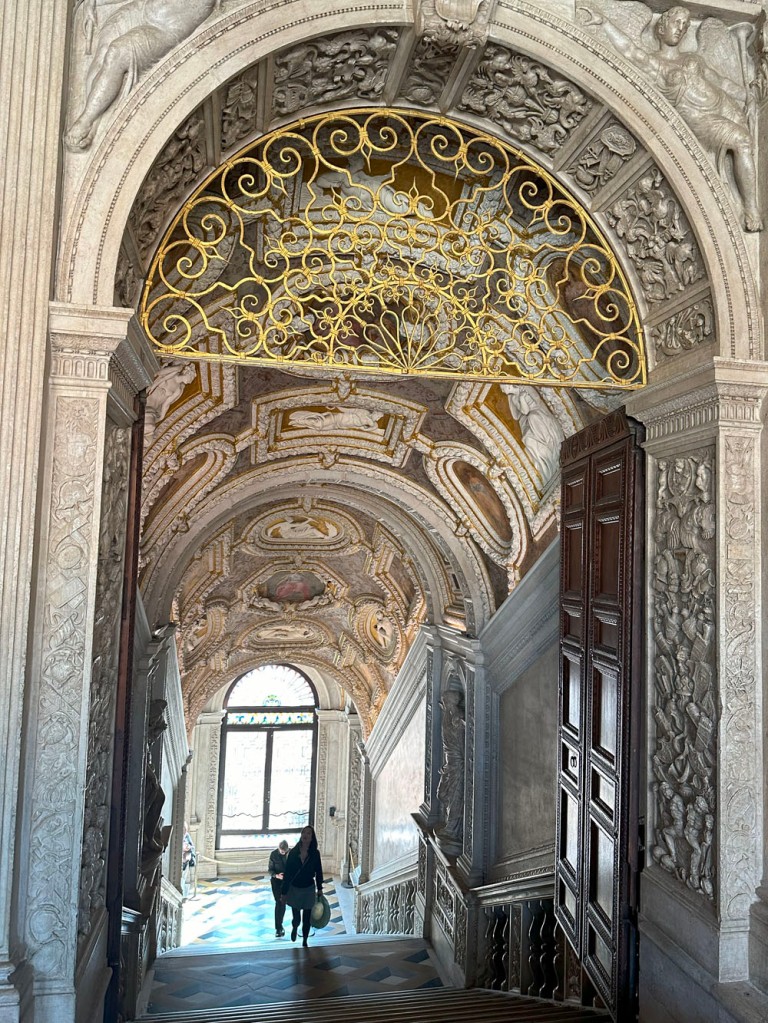
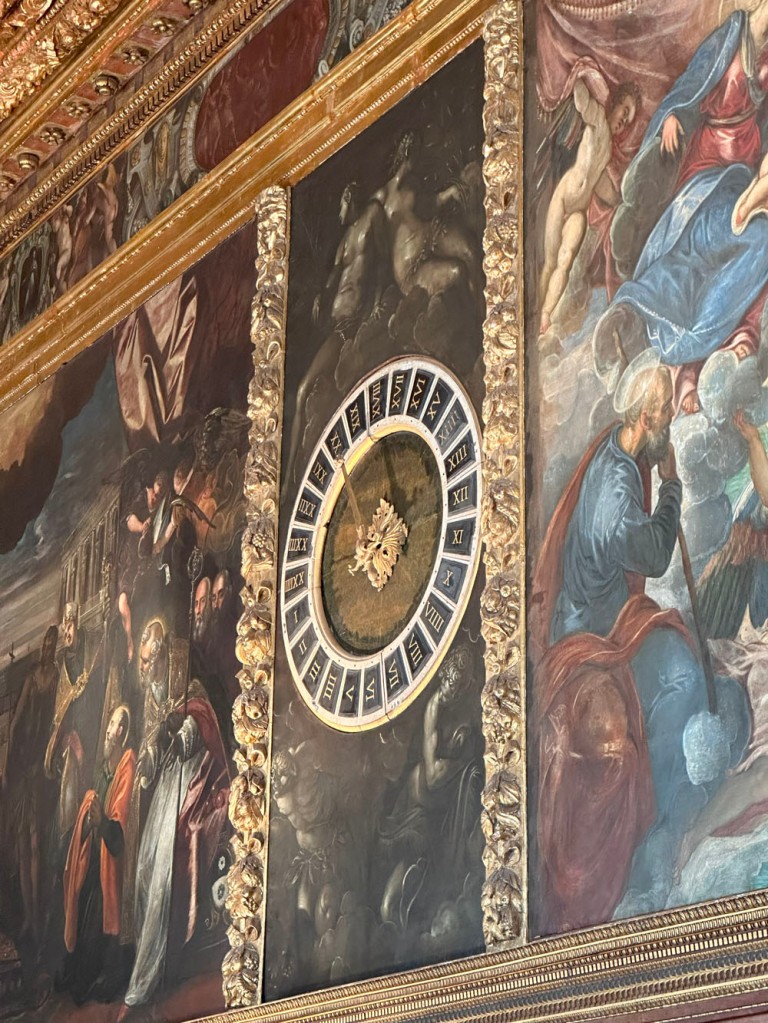
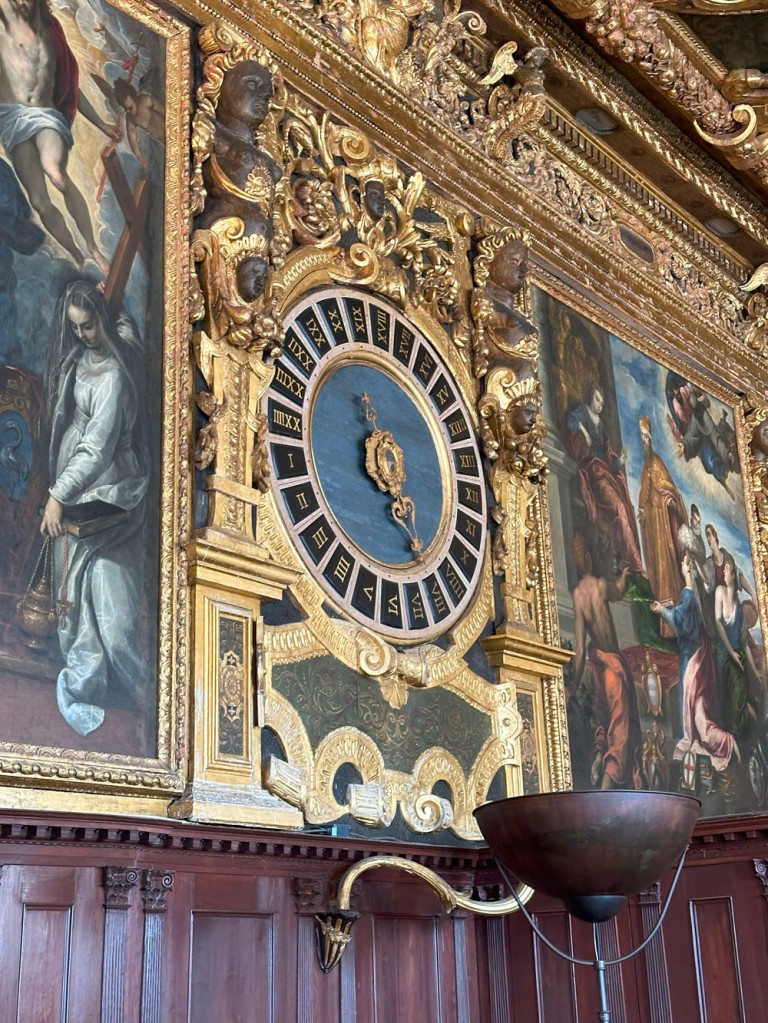
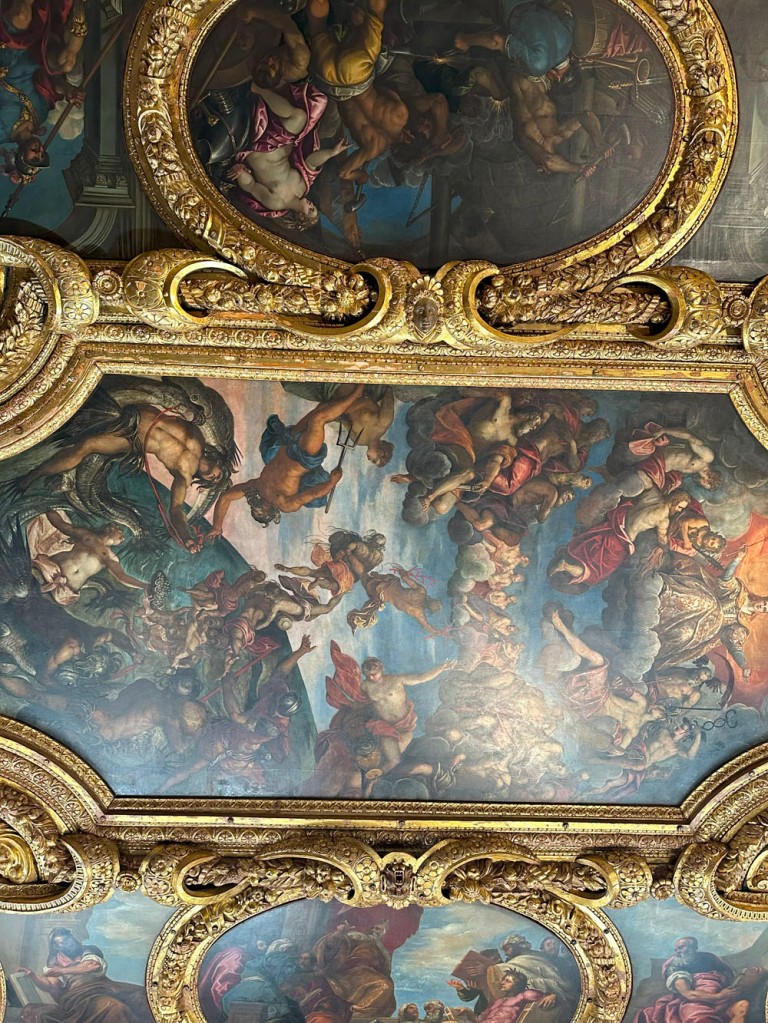
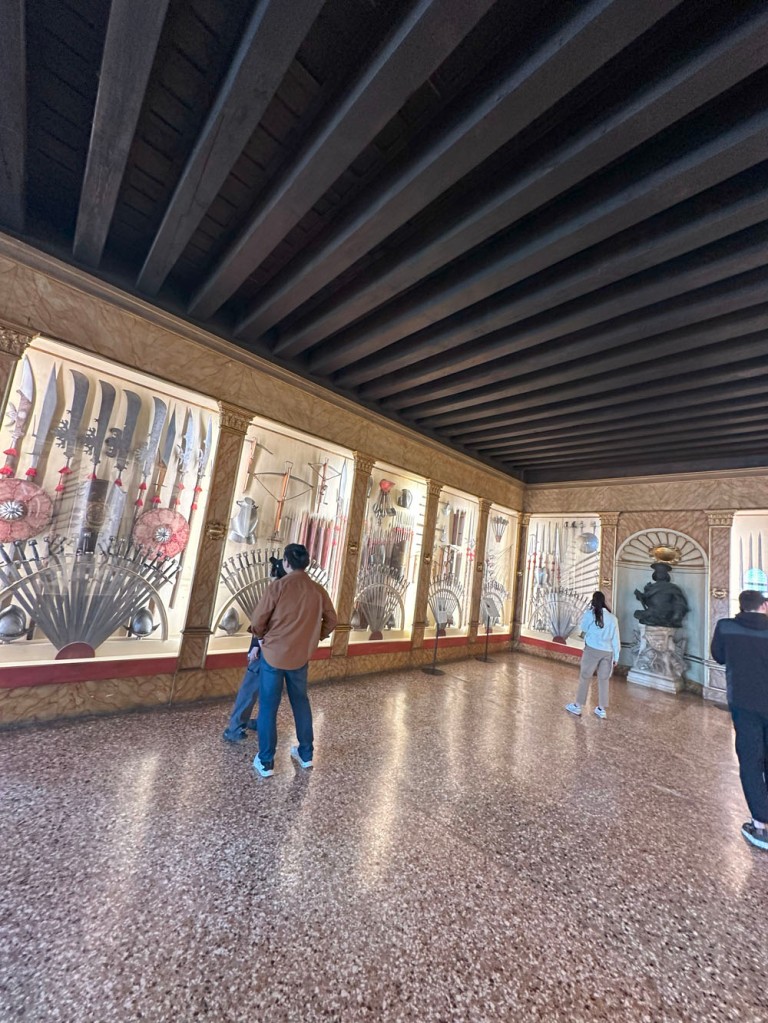
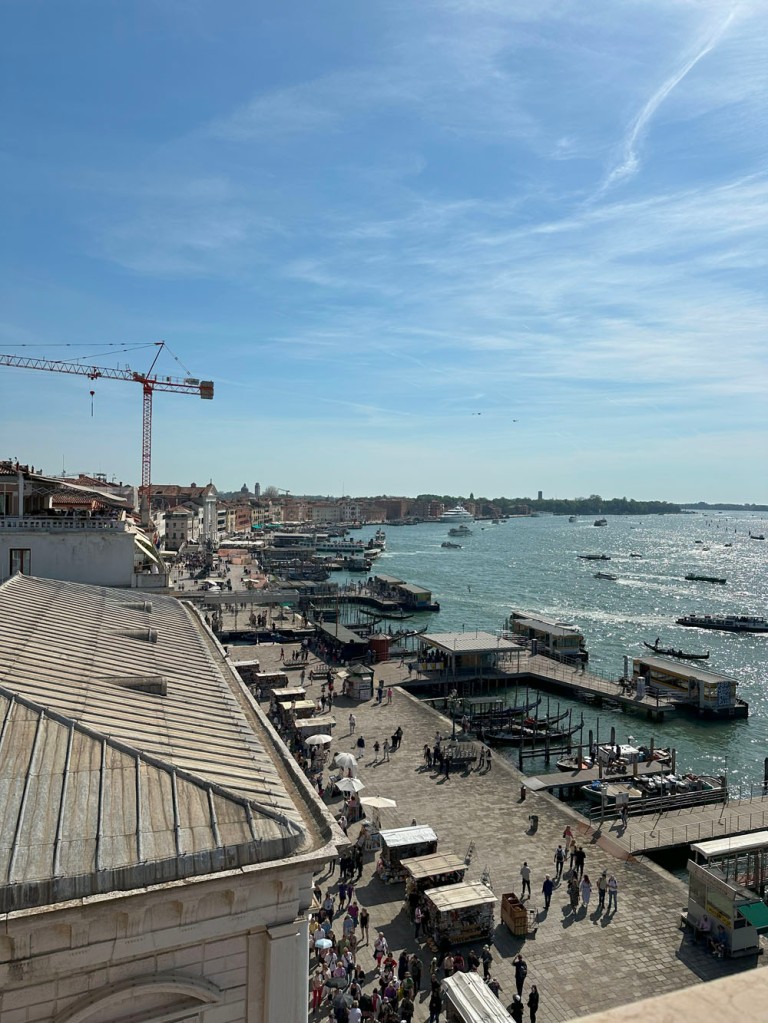
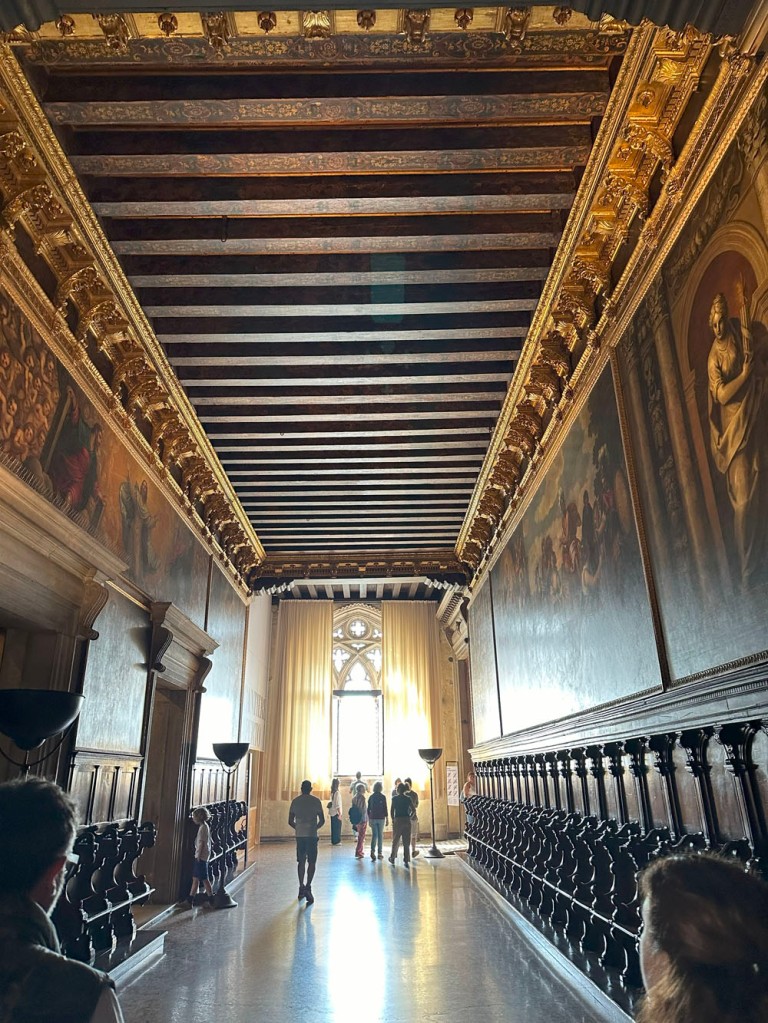
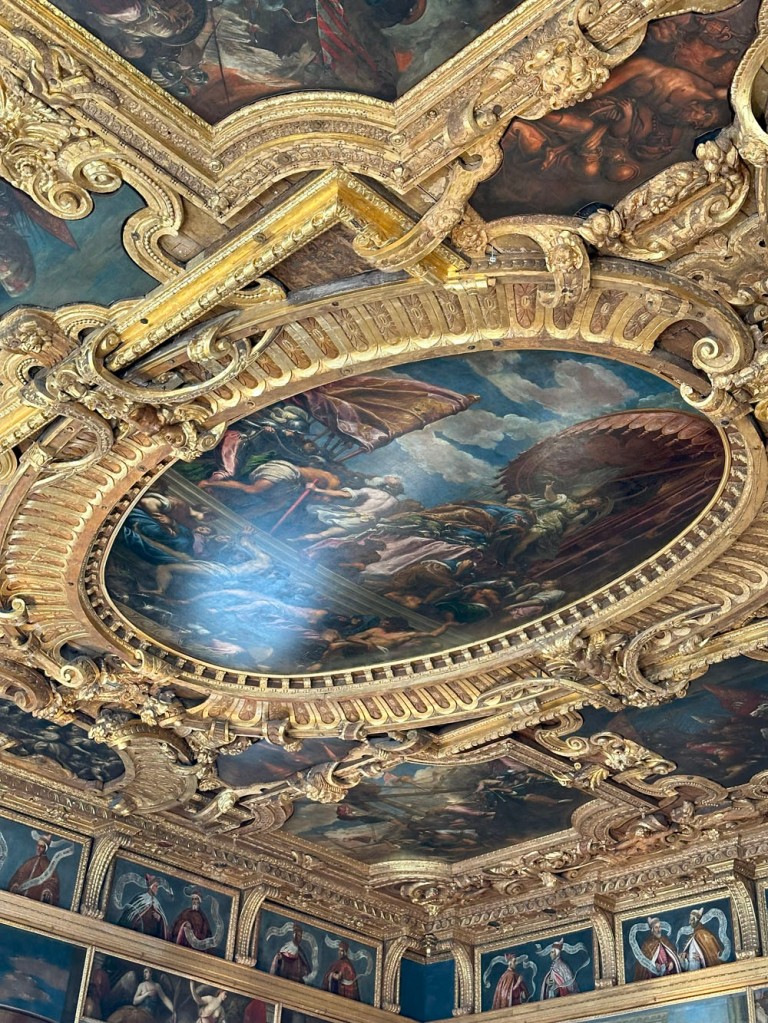
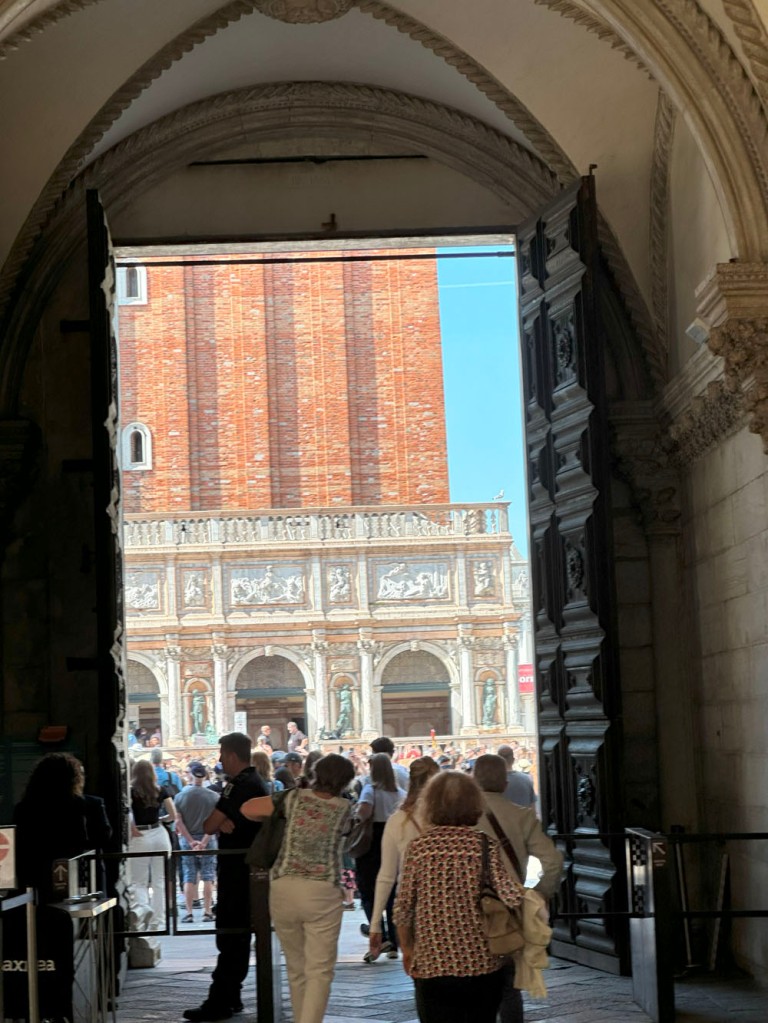
Then it was our time to fly past the baffled people in the queue and entered the palace courtyard. I won’t harp on about the place, suffice to say that it’s incredible. The artwork, stairways, ceilings and art are out of this world and are a must-see. The floors and arcades are uneven in places due to age and subsidence. Unfortunately, I was asked to stop filming by one of the attendants at one stage, which was a pity – I saw others film unpunished, so footage (at the end of Part 3) is limited. Also housed here is one of the most impressive displays of medieval armaments I’ve ever seen. The Doge’s Palace is amazing, and there are other ways you can skip the queue by ordering tickets online. You can google them easily.
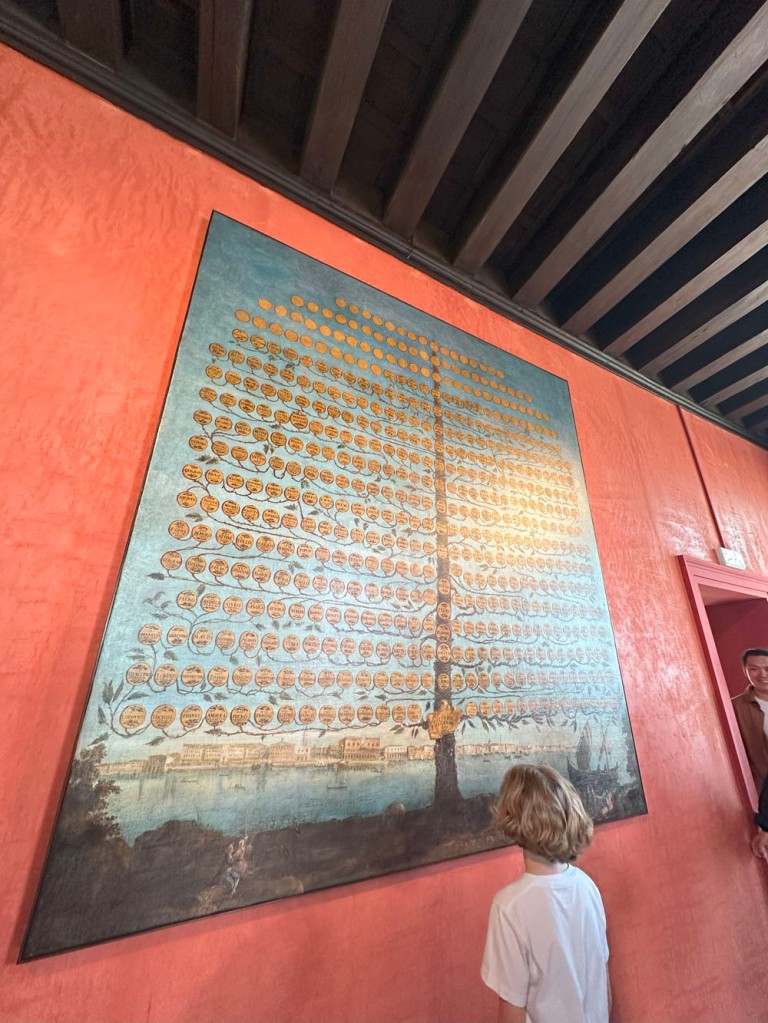
The extraordinary decadence of itAmazing display of armsThe Doge ‘family’ treeA Canaletto in its natural habitat Crossing the Bridge of Sighs – see the video in Part 3 for moreMore on the prison in the videoThe Bridge of Sighs, as viewed from inside the palace
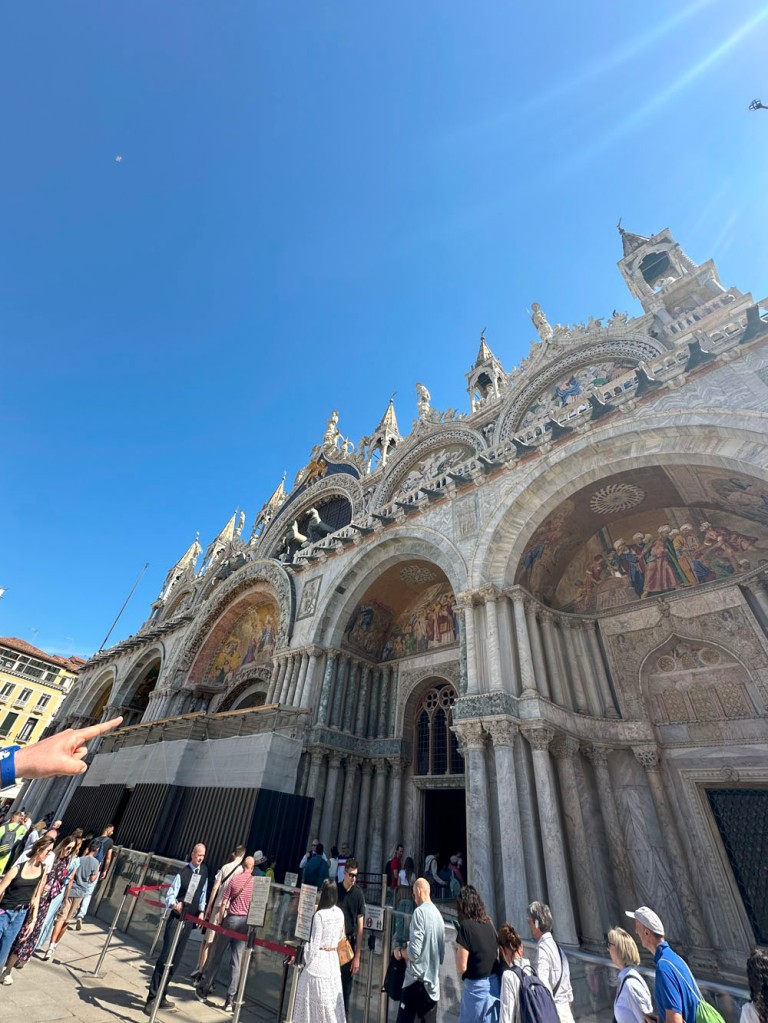
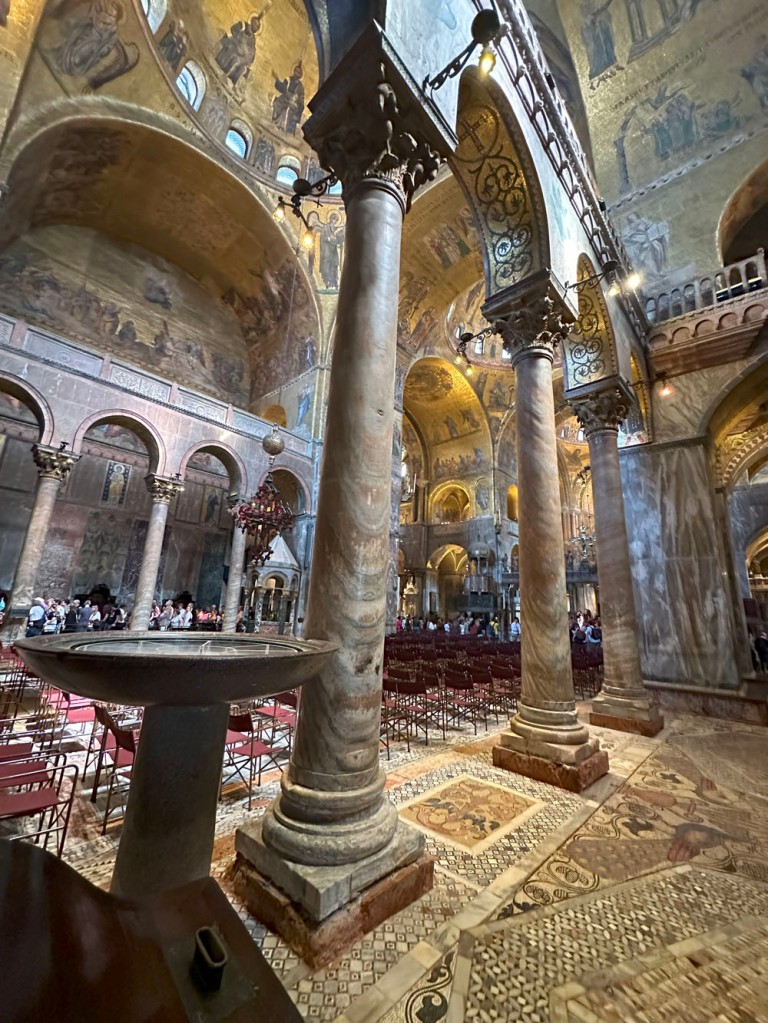
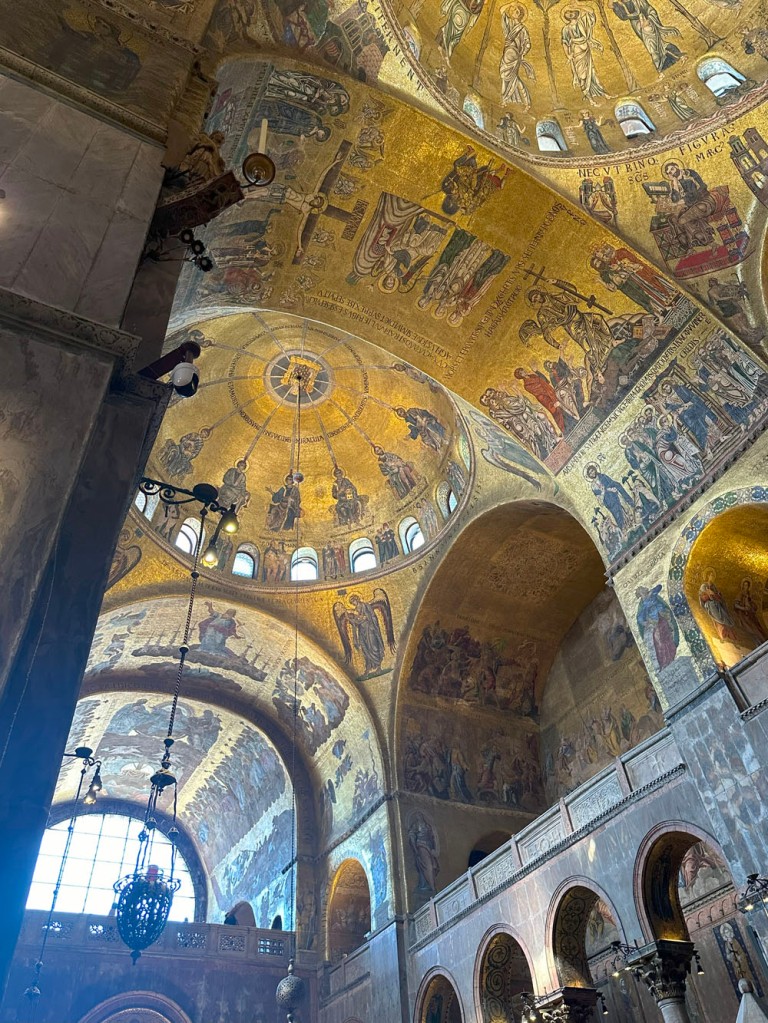
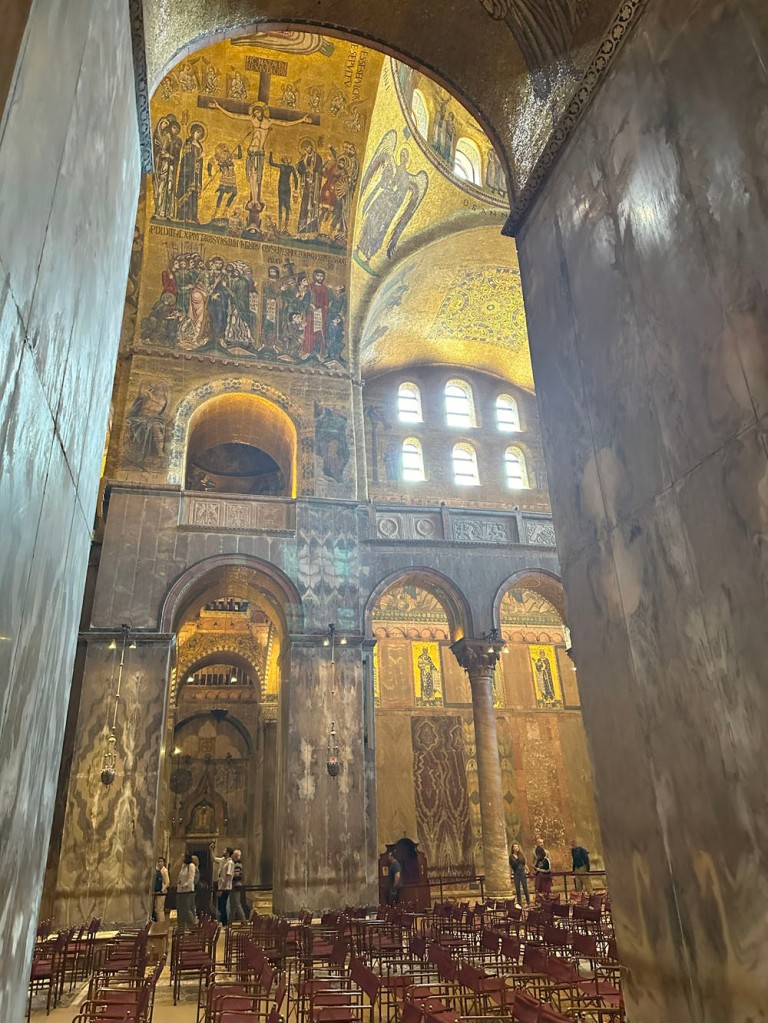
Afterwards, we had a quickish stop at the cathedral – I’ve wanted to see the mosaiced Christ, as I have wanted to see the versions in Cefalù and Ravenna. The cathedral itself looks a little eastern orthodox – unusual for this far north in Italy, I would have thought. There were golden mosaics everywhere – it was incredible. The Christ at the back of the Cathedral is a stupendous work. However, it was then that I began to notice things. It was pointed out that the floor was uneven, and parts of it actually were in small waves. So few were looking anywhere else but up. I began to realise that people were here for the sake of being here, and mentally box-ticking, while the cathedral was dying in front of their eyes. And that we were part of the problem. This was confirmed by the sadness I felt when Igor told me that the Venice council were thinking of allowing Cruise Ships back. He told us that although 50,000 people were registered to live in Venice, only 36,000 did so, and yet the number of visitors a year is 36 million. That is insane. What made me saddest of all, however, is that he said he was once asked by a tourist what time Venice closed at… as if it was Disneyland.
Dodgy pillar supports and wobbly floorsIt’s a stunning place
After that I tried to make a concerted effort to be more aware of my surroundings as I walked. Acknowledge each water cistern I passed, and noted whether or not it had a little cat-bowl carved nearby for the cats who used to keep the rat population under control. Looking out for a little more graffiti. Checking out the interior of smaller restaurants as we passed by them, and even trying to listen in on a conversation or two.
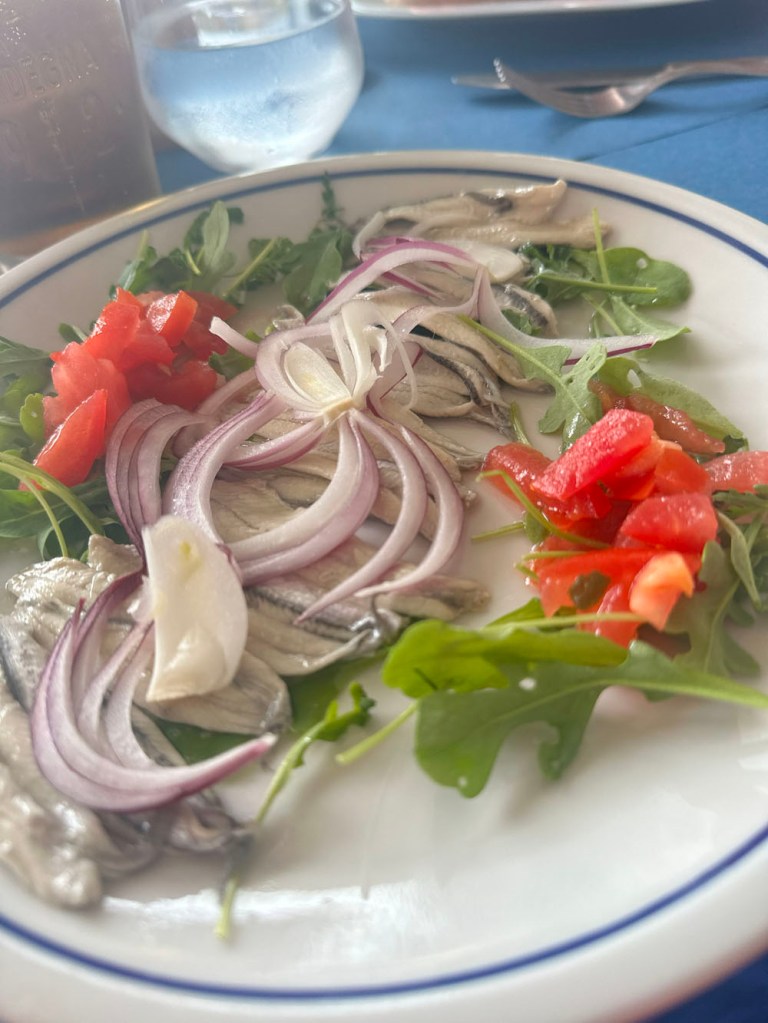
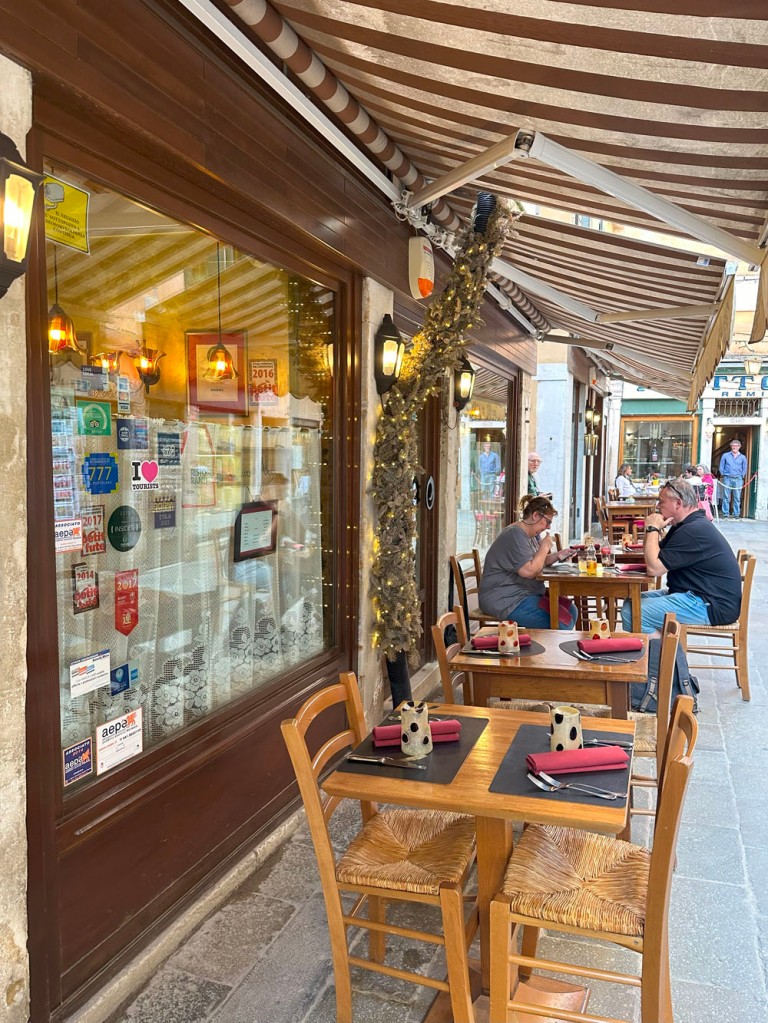
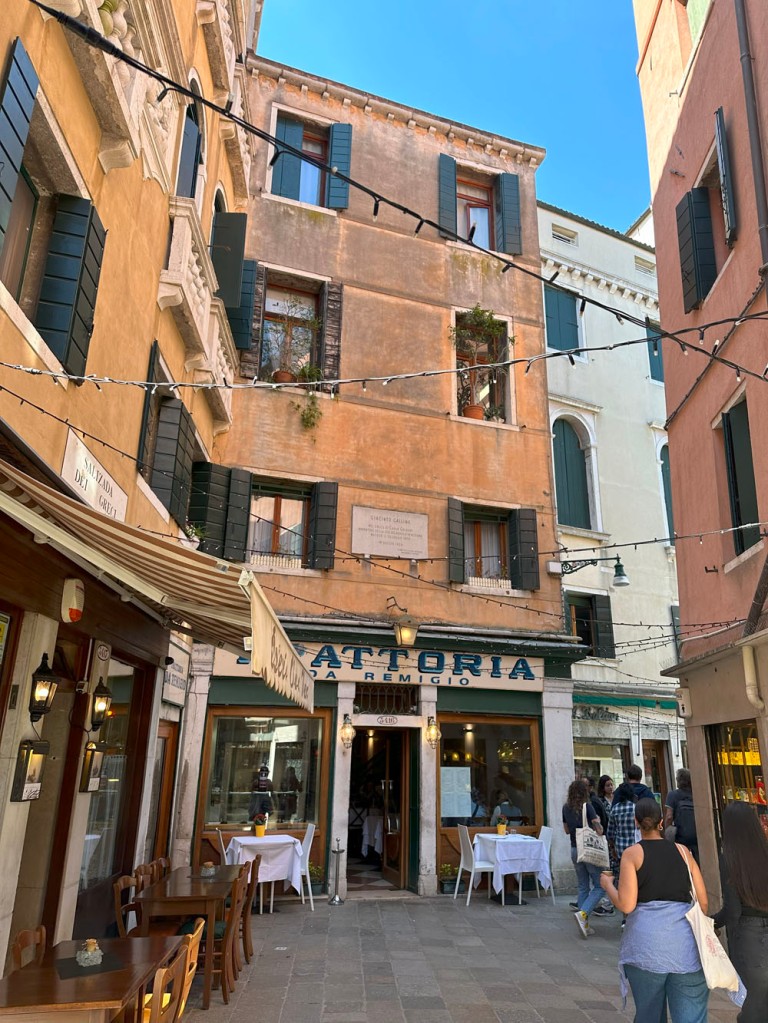
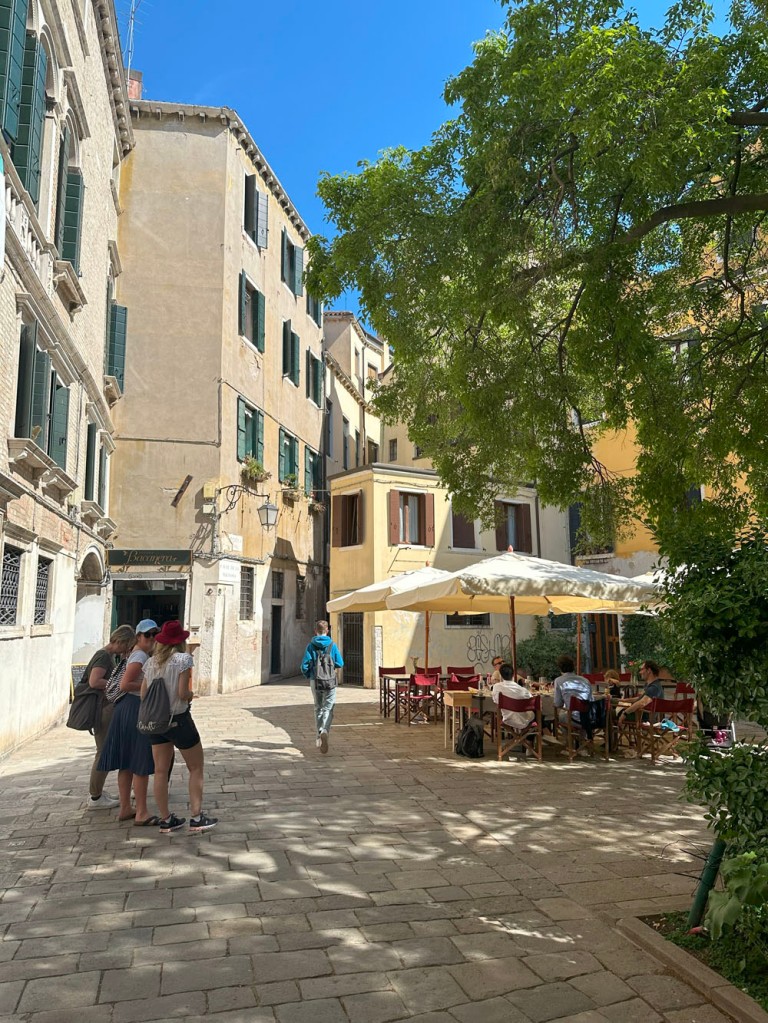
Anyway – I can’t recommend Igor highly enough for a tour. I’ll leave his details in the description box below – do consider him if you want a special tour to yourselves. At the end of the tour, we asked him for a recommendation for somewhere to go for lunch, and he gave us criteria selection, and we finally settled on Osteria Oliva Nera, which served good food, and was in a quiet neighbourhood. And the selection was bang-on! Although when we got there we asked to be seated outside. The larger table near us was chosen by what seemed to be another Irish family… the irony. Anyway, we both had deep-fried stuffed zucchini flowers, Niamh followed that up with lasagne while I had the best pasta dish I would have in Venice – bigoli pasta with anchovies in an onion sauce. Amazing. The locale was so lovely too – a quiet junction near actual functional shops for locals and another restaurant.
TastyWonderful!The restaurant itselfThe cute locale of the restaurant
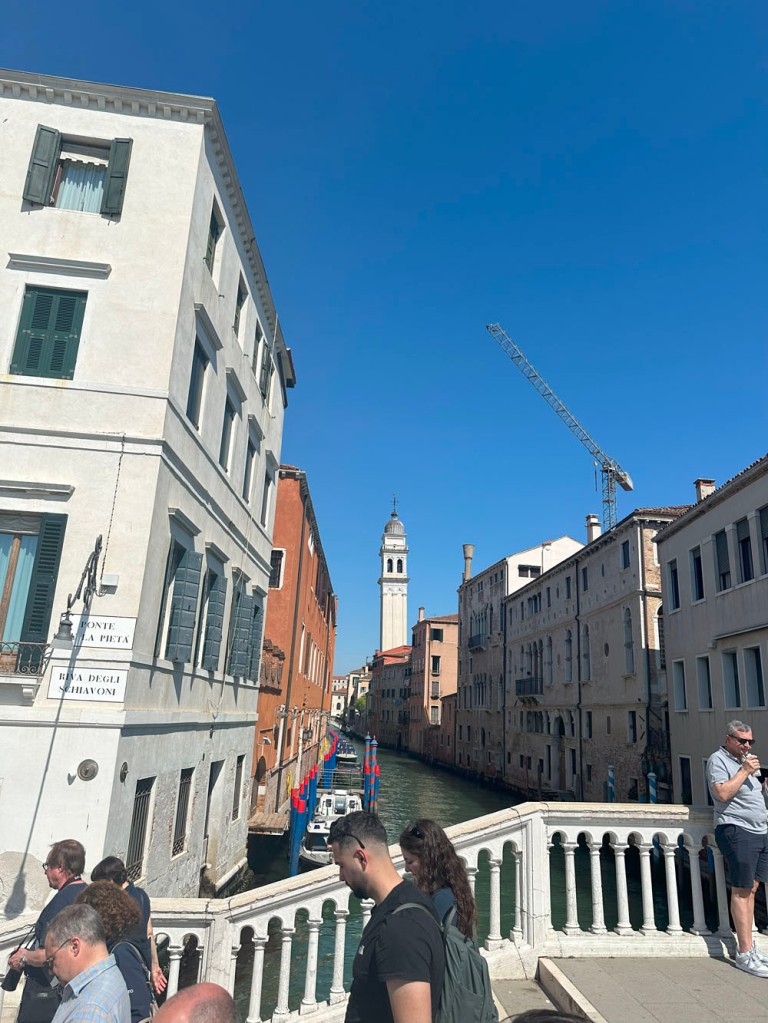
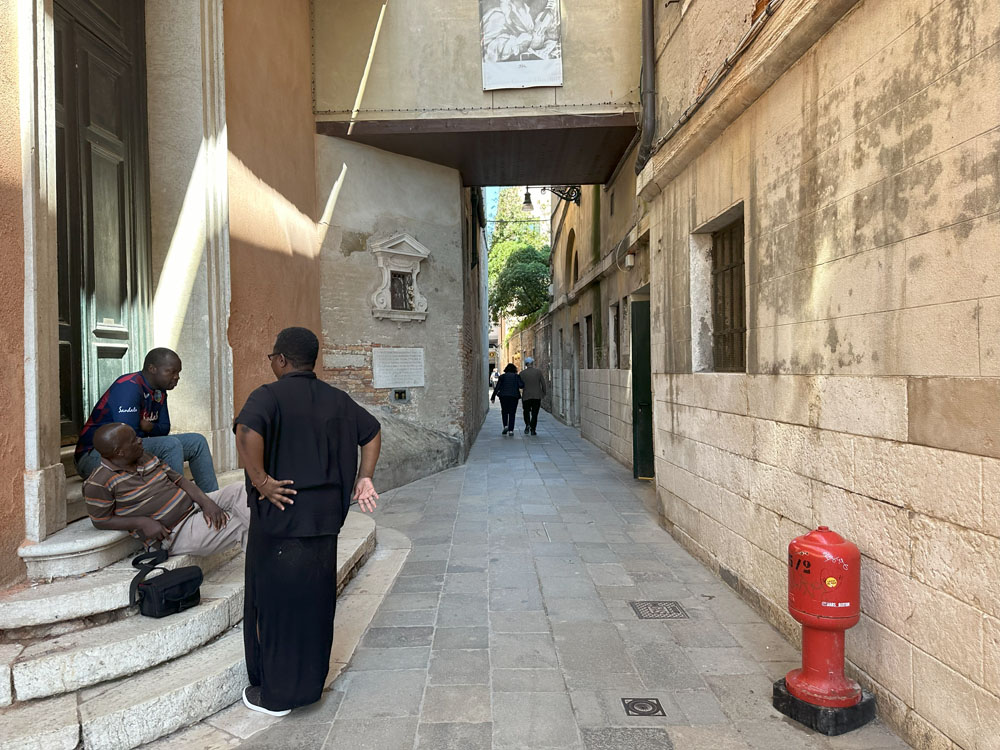
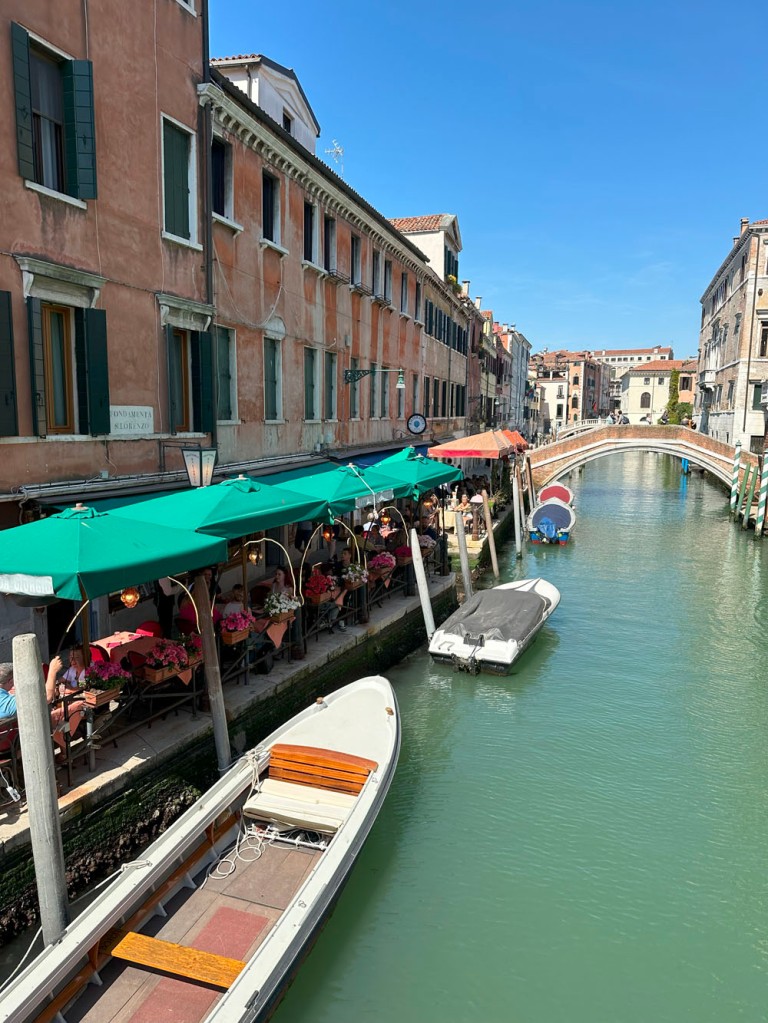
All done, we used the facilities, paid and we started making our way towards the Cannaregio district (or sestiero as they’re called in Venice), to check out the Jewish quarter. We were about a quarter of the way there when I saw in Google that the little island was closed, so with expectations properly set, we ambled our way there. We hit the main street and started walking. We soon tired of that, as there were people everywhere (yes, we are part of the problem), and tried to make our way there through back alleys or walking alongside canals. The latter is rarely available – and we found that exploring alleys was fun and led us to some wonderful views, but they often led us to dead-ends, and so we were inexorably drawn back to the main Corso. At least we got a glimpse of Venice’s leaning tower!
Out of pure coincidence, I checked the map to see if I could find the famous Libreria Acqua Alta. I was hoping to see if I could employ the doctrine of mindful tourism here, but my God it was arguably one of the most disappointing things we did in Venice. Now, this is no discredit to the owners and runners of the bookshop. Had Venice been a normal, functional city serving its population, it would still be no doubt frequented as a nice quirky bookshop with a decent stock of new and antiquarian volumes. What actually greeted us were two circular queues – one to enter and leave by (separate doors), and then at the bottom of the shop, past the mini gondola filled with books, is another circle where you got to climb the steps made of books and take a photo as quickly as possible, and climb down the other side. Always on the move. Never have I felt more like a shepherded animal. Finally, you can exit through a door if you don’t have anything to buy, or go up to the cash desk if you do. I marvel at those who had actual book purchases, because if there’s one thing you need in a bookshop when you’re browsing it’s time – and you simply had none. We were walking out, when a group of tourists who entered through the exit were given out to and made go back around to the front door. And in fairness, the owners have to do this. There is not much space there, and the bookshop would fill up extremely quickly otherwise. Anyway – it wasn’t a great experience.
There’s much more in the video in Part 3
Afterwards, we stopped in a large square, which contained the old famous hospital Saints Giovanni e Paolo. One of the Rosa Salva bars associated with our hotel, for which we had a discounting voucher – but this one also had artisanal gelato, so we indulged, and it was really nice – and needed. When done we trudged onwards. I would say we made it to within 5 or 6 blocks of the closed ghetto when we released that we were both footsore. We made our way back. It took a long time, but it was enjoyable exploring more nooks and crannies, even if some of them were rammed with people.
One of those secluded squares worth seeking out
We got back to the hotel and aahhh’d in satisfaction at the coolness of the room, and had an hour’s rest before we headed out for Niamh’s birthday celebration meal at our sommelier friend’s recommendation: Osteria Da Carla. It was only a short walk. It’s a nice, intimate place, with excellent food.
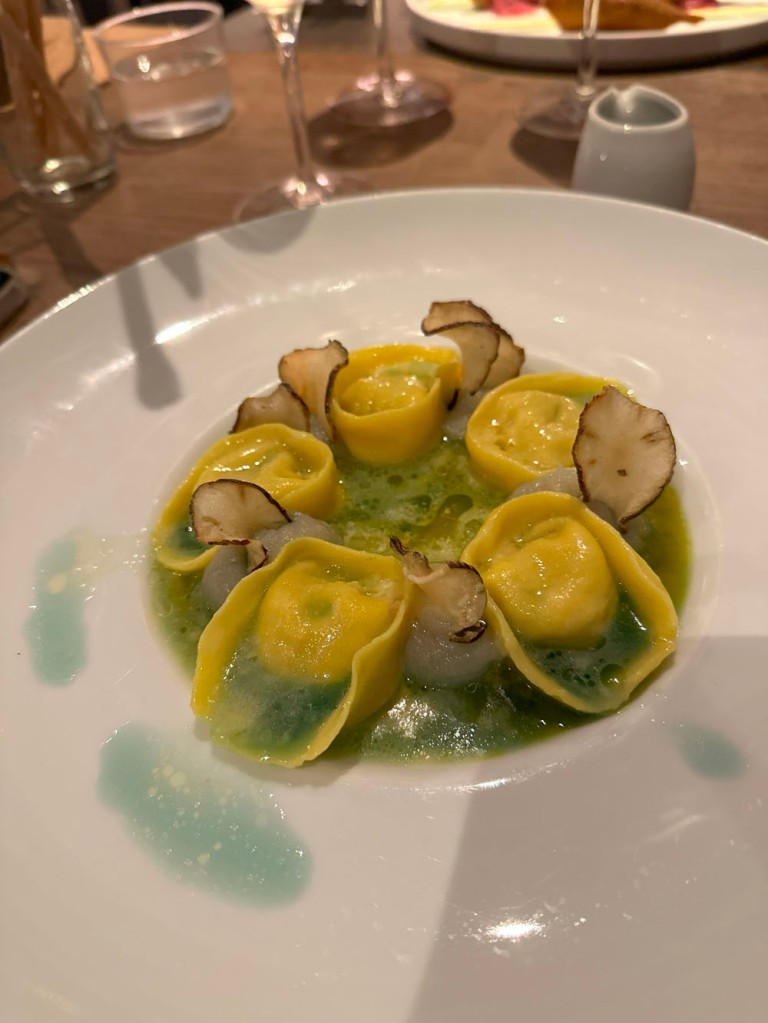
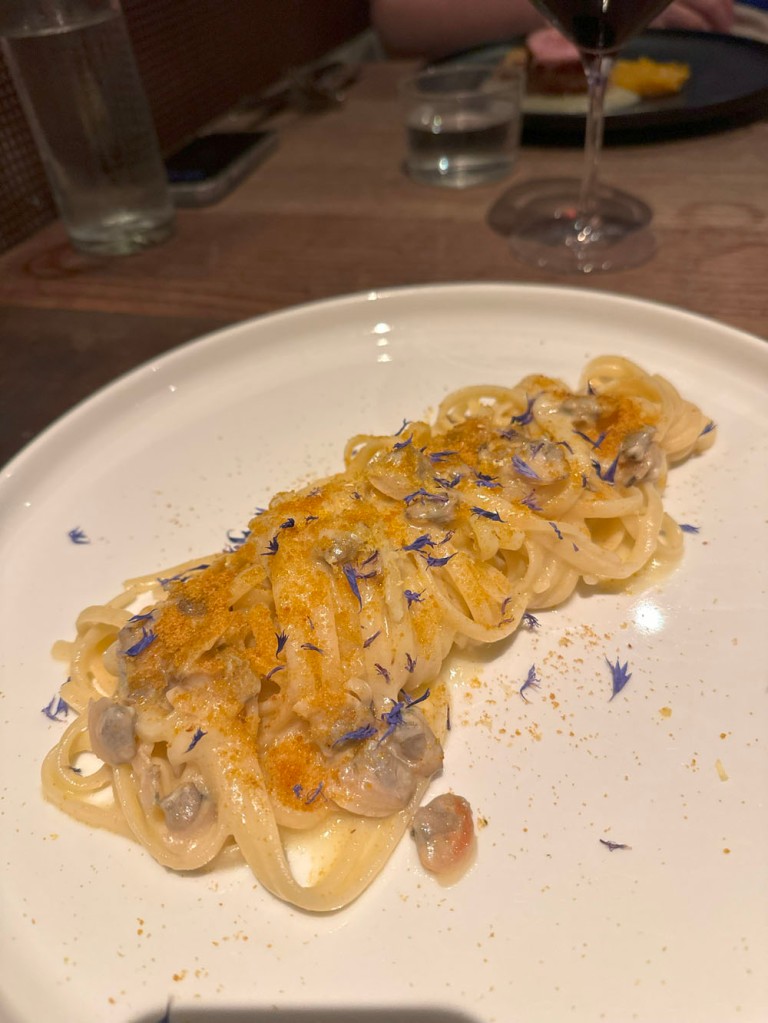
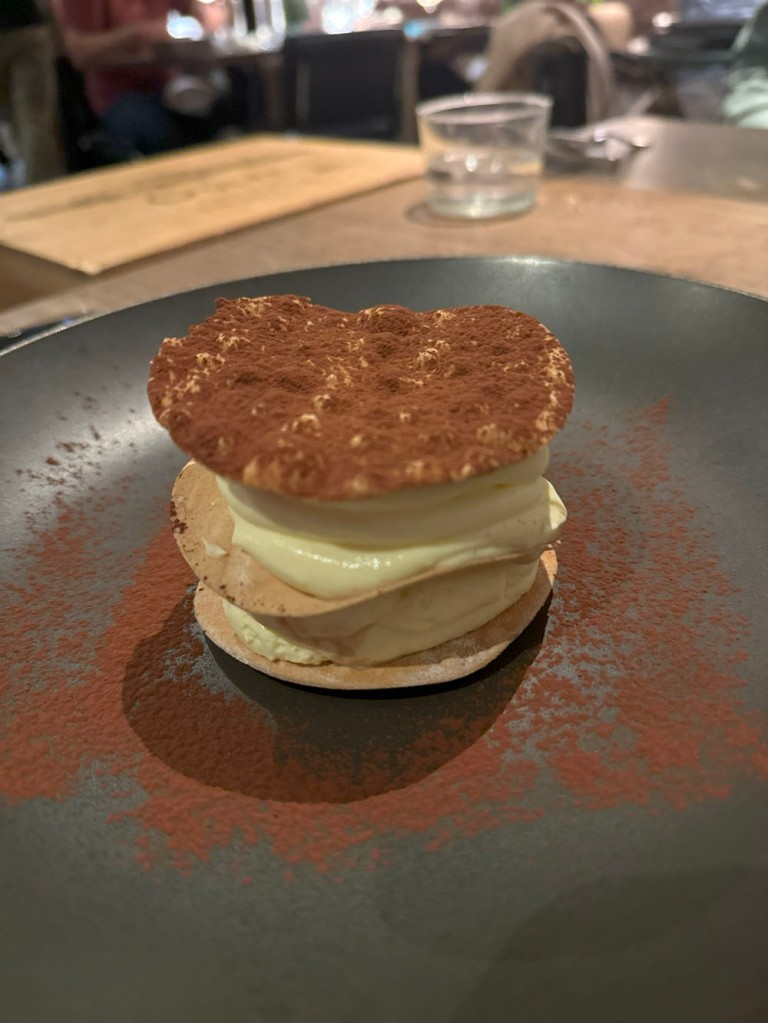
We had an aperitivo each and both ordered a glass of wine. For starters, Niamh had tortelloni (cappellacci as they were called on the menu) stuffed with rabbit, and I had deep fried sardines. Afterwards, I had linguine with clams and bottarga – the clams were already out of their shells so I could have at them immediately. It was a beautiful plate of pasta, but I think I would give the nod just about to the anchovy dish I had earlier. Niamh’s, however, was a pure winner – Iberico pork fillet wrapped in bacon. Perfectly cooked, a little pink in the middle and tender. Desserts… Niamh had fancy tiramisu and I had a wonderfully inventive home-made cream egg, where the white was ricotta and the yellow pureed mango – delish. A lovely place all in all for a fine meal in a romantic environment.
The plate of the night
Afterwards, we had a little walk about town, stopping off in Il Salotto di San Marco for another drink (see Part 1). There was a table of 6 next to us, and the kitchen/bar had prepared squid ink risotto. We were the only other people there (the place is tiny), so rather than see us go without food, they gave us a half-plate between us to try. This is a wonderful example of Italian hospitality! We chatted briefly with the locals, and it was just one of those special moments.
Yum and with tender squid
and that squid ink risotto I mentioned earlier. Anyway – and so to bed. I tell you, getting up with that 20c setting was a great deal chillier than we expected, so we asked them tap it up to 22c for our last night – would it be the goldilocks temperature we needed? We’d see.
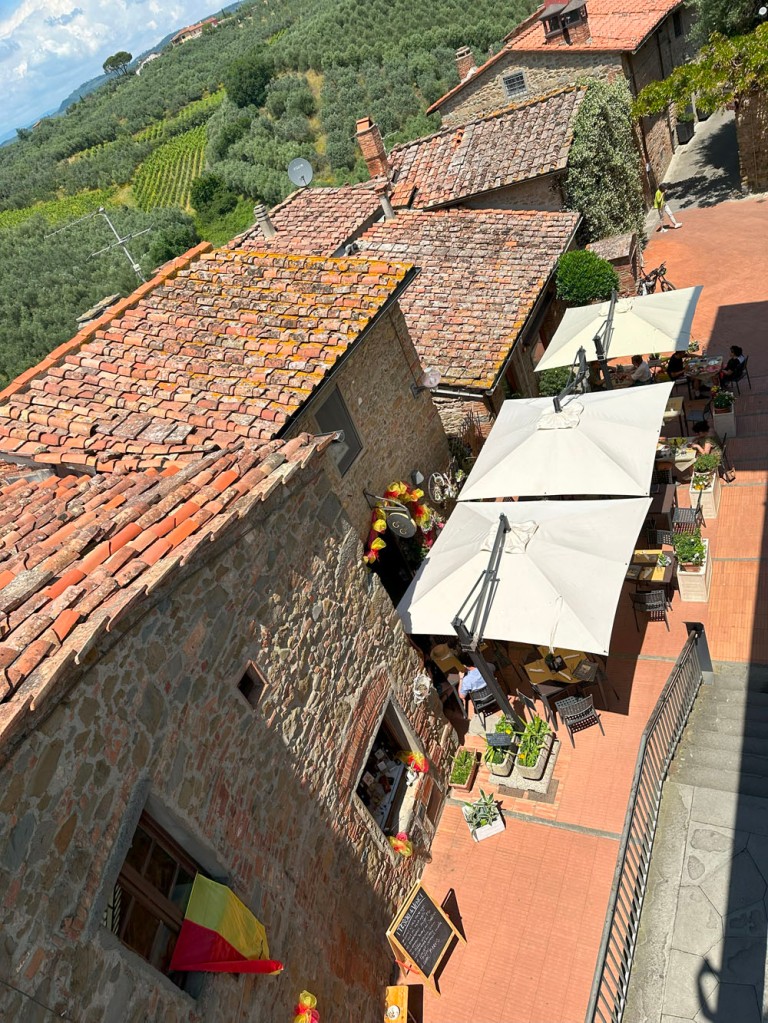
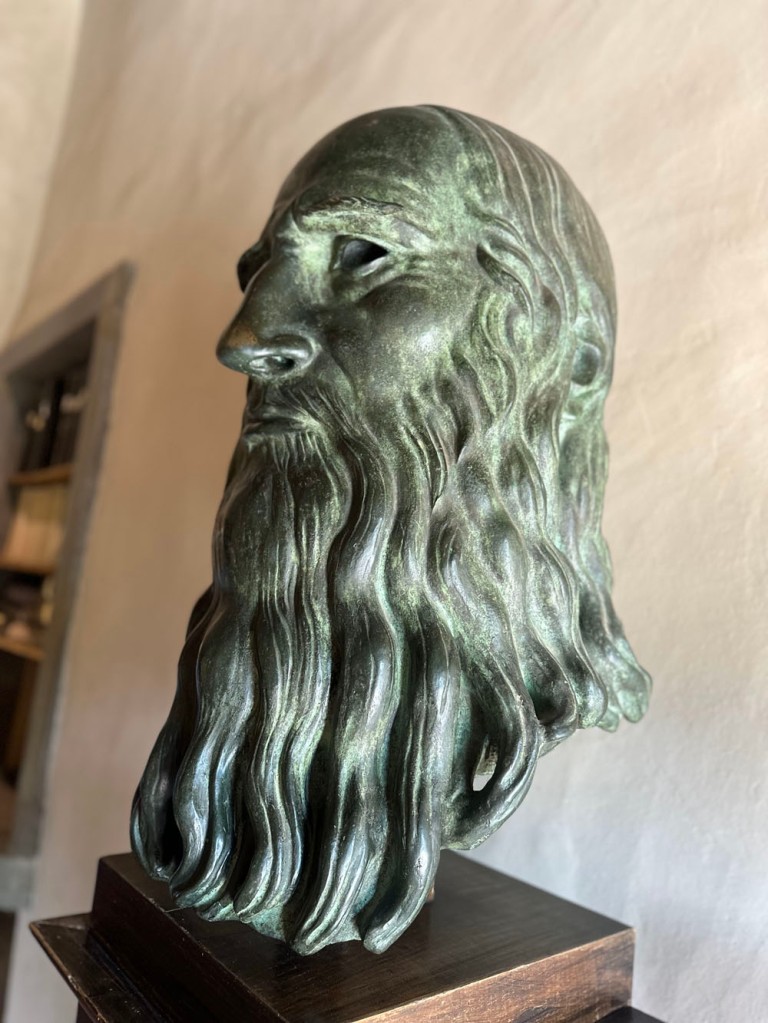
Yay! It was time for another Day Of Fun™! Due to our friend’s love of history, and that fact that we hadn’t been to it in ages, we decided to drive out to the village of Vinci. Yes, that place, where your man is from – Frank… nah, just kidding, Leonardo, of course.. While perhaps not quite from the village, it is said that he lived in a house up in the hills nearby. Scholars (and charlatans, probably), can’t be 100% precise where he lived, but they have all settled on a particular house, based on his writings and some drawings of the nearby landscape. We had been to the village before, seen the museum and even eaten there – but this was before I started blogging or vlogging. So, this is effectively net new to you guys.
What isn’t net new, is that I went on a lovely walk. This was going to be (mostly) a lovely day, so the colours are lush and were not unwelcome. Enjoy!
The Apuan alps in the backgroundSexy cloudsI always love taking this shotDon’t think I ever papped this statue on Via Franceschini
As you can see, I kept it inside the walls this time around. I then to it to the top of the walls to have a look at the beautiful countryside surrounding the town.
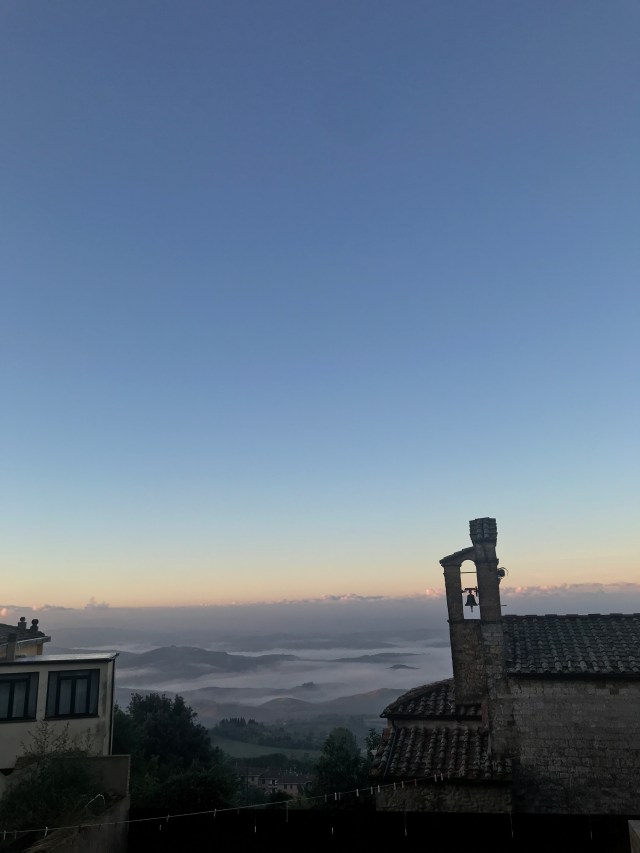
I love this islands in the cloudsA panorama for youHow about islands amidst the, um, land?The spookiest lane in Volterra actually looking invitingStill inviting?The street where we live
After breakfasting and abluting we walked to the car, and drove the hour or so there. There’s handy parking, but it’s at the bottom of the town and it’s a mild uphill walk through the new part of town before you hit the museumticket office.
There were only a couple of small groups ahead of us. While we waited, we marveled at the little birds who had nested in the ticket office. Anyway, when we go to the front, he completely blanked my wonderful “Tre studenti, per favore.” and paid complete attention to Niamh and my friend, who were obviously the adults in the group. We got our tix (which incidentally cover entry to Leonardo’s childhood home outside the town) and headed up the ramp immediately outside, into the old town.
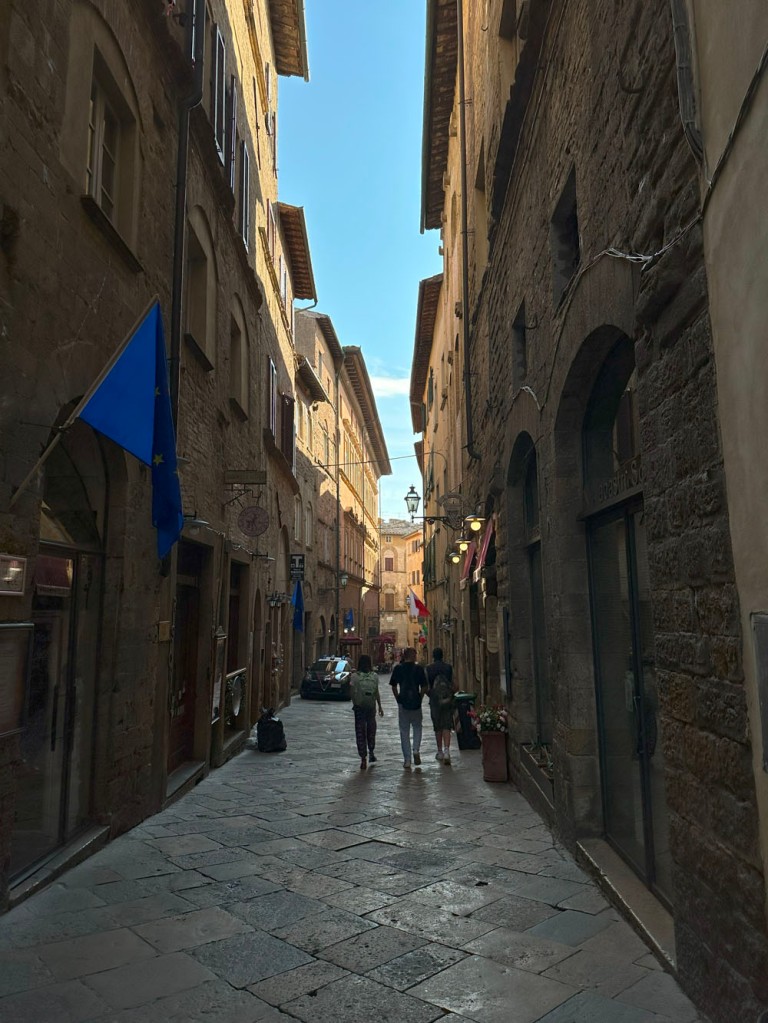
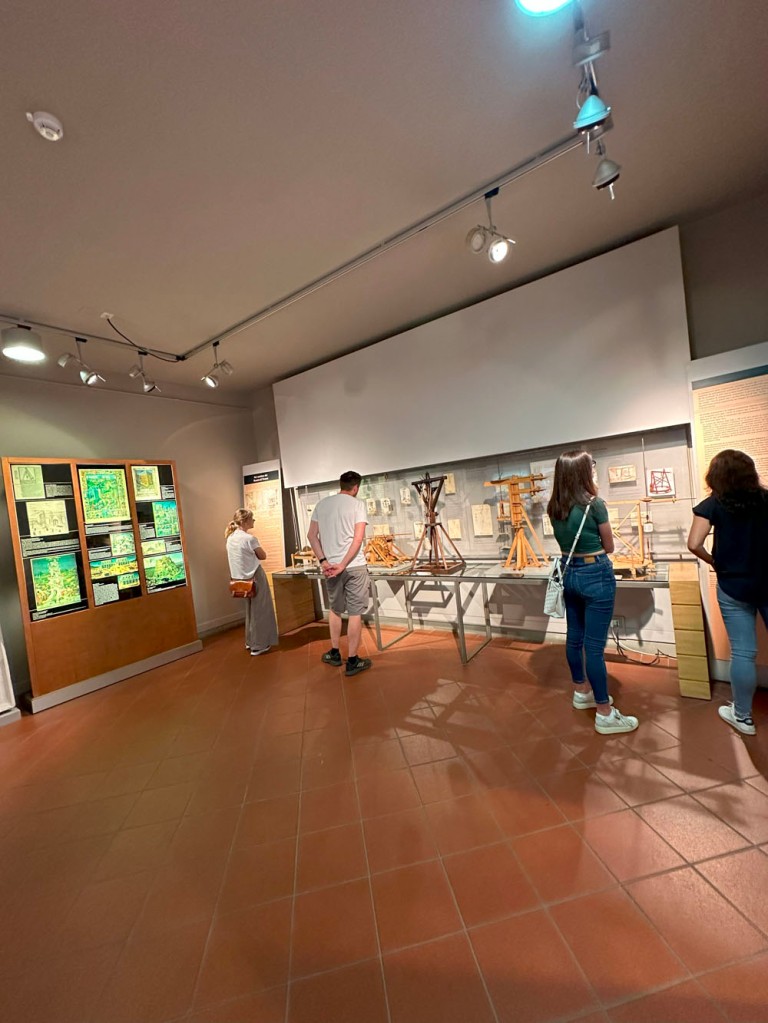
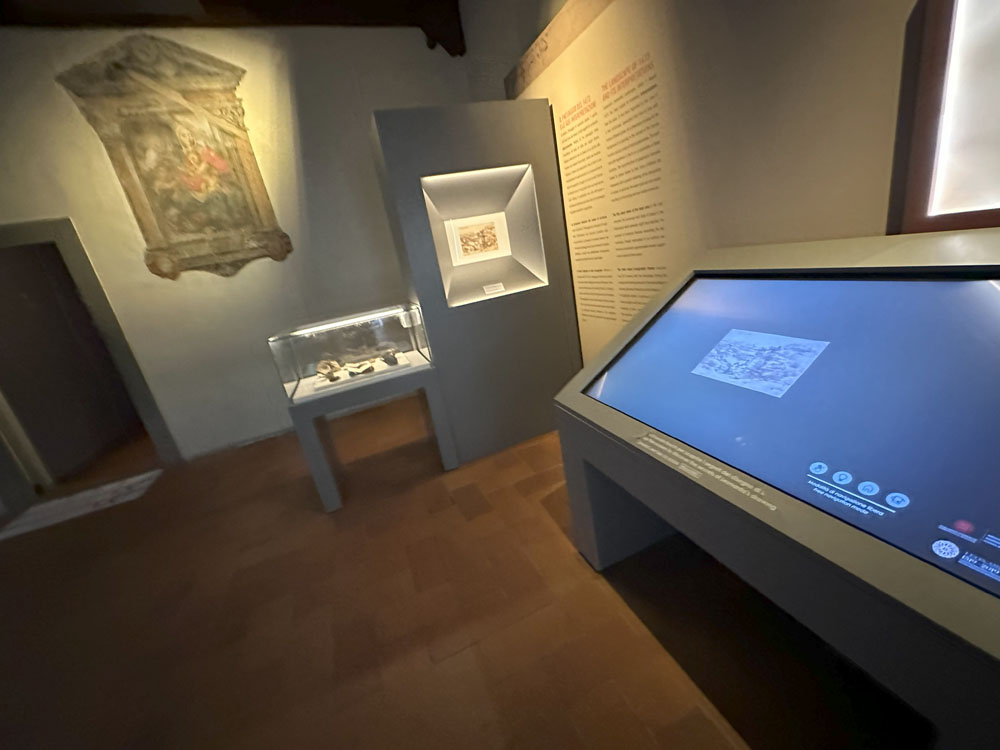
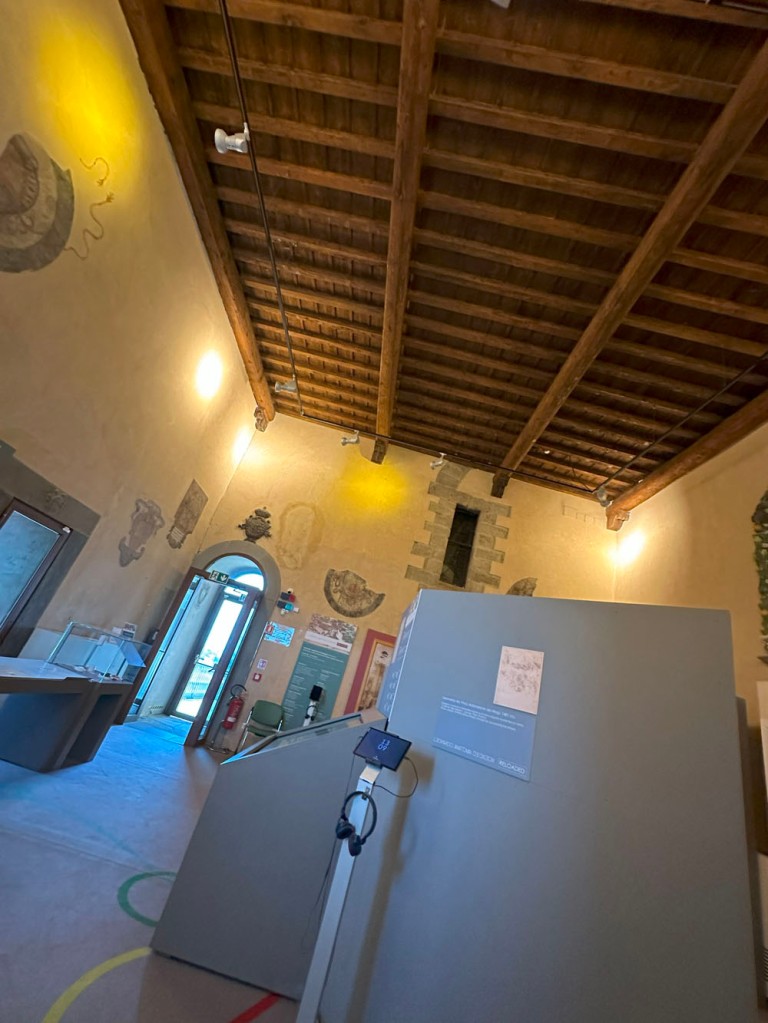
I assure you that there actually some people there! One of the great things about having a car at your disposal is that you get to visit tons of places most tourists will never see – even one as culturally significant as Vinci. We walked through the old town’s laneways, had a look at Leonardo’s possible place of baptism, and admired some modern sculpture, before entering the exhibitions themselves. A couple of things to note here: firstly, these exhibitions relate to his engineering and anatomical studies and feats, not his art – and second, I don’t have many photos, as I was taking video at the time.
Ok, there is also a third thing: it was mercilessly hot in the building. They only had air-conditioning turned on in one room, in which we sat down for a little while.
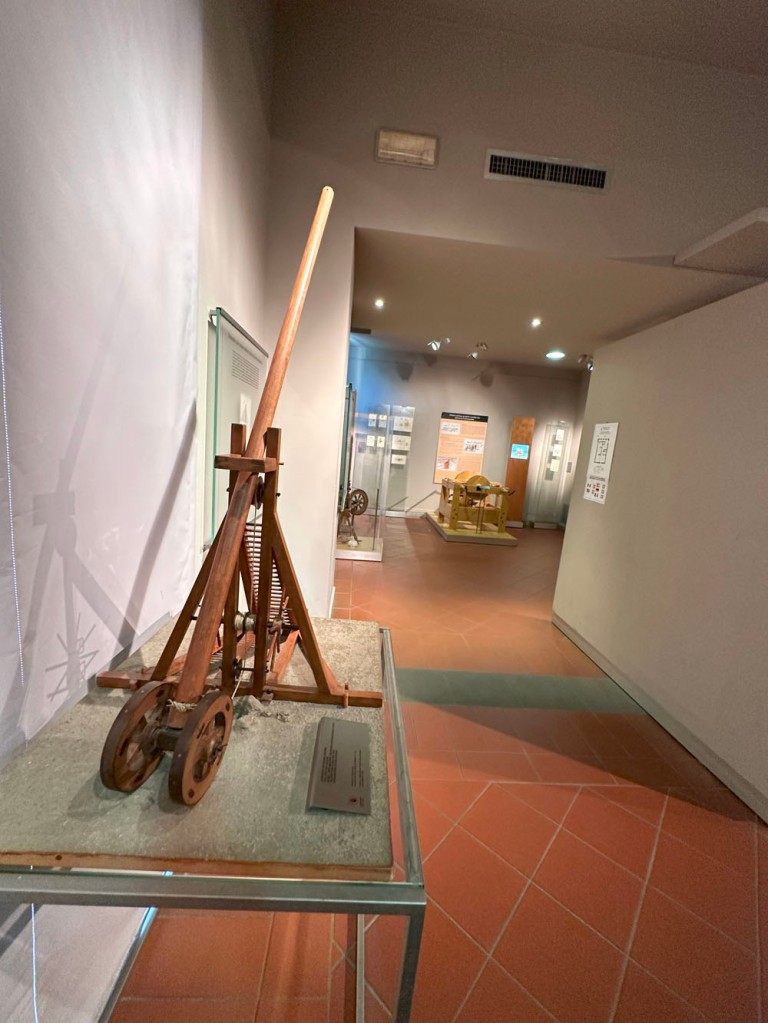
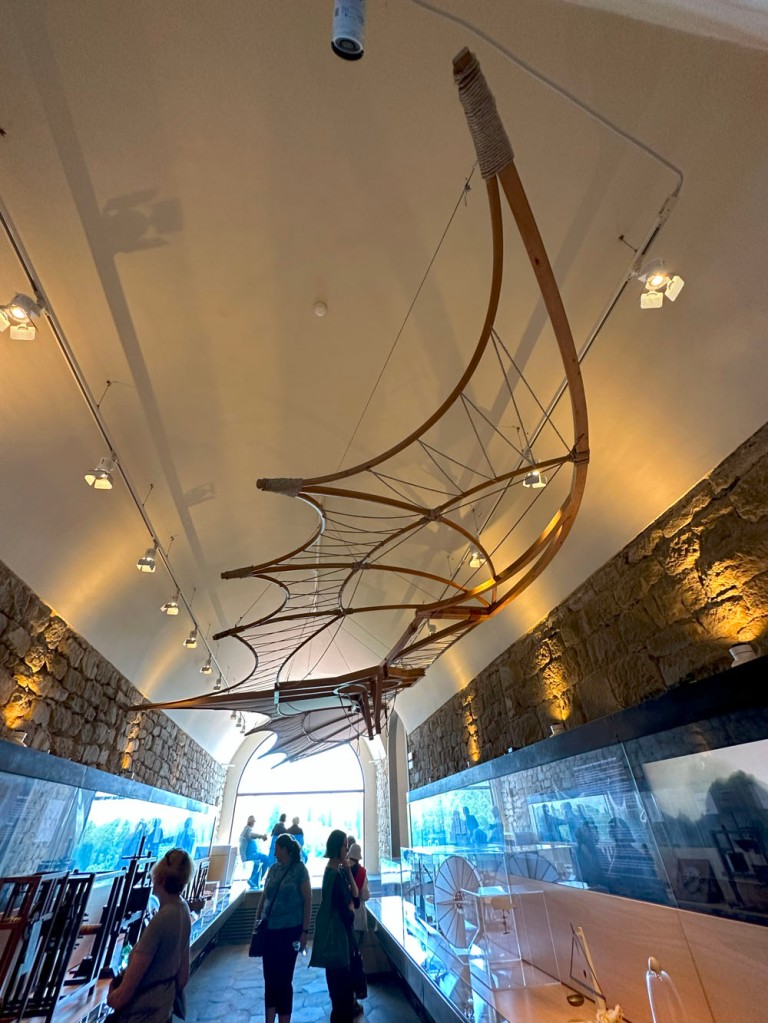
The museum itself is fascinating, and contains many miniatures and working models of his machines. I lamented how he had to turn to making war machines to satisfy his benefactors and make a living. One curious thing – they had a huge model of the wings for humans, spread across the ceiling of one of the rooms. When we were reviewing the photos after, the ladies were astonished – neither of them had seen it!
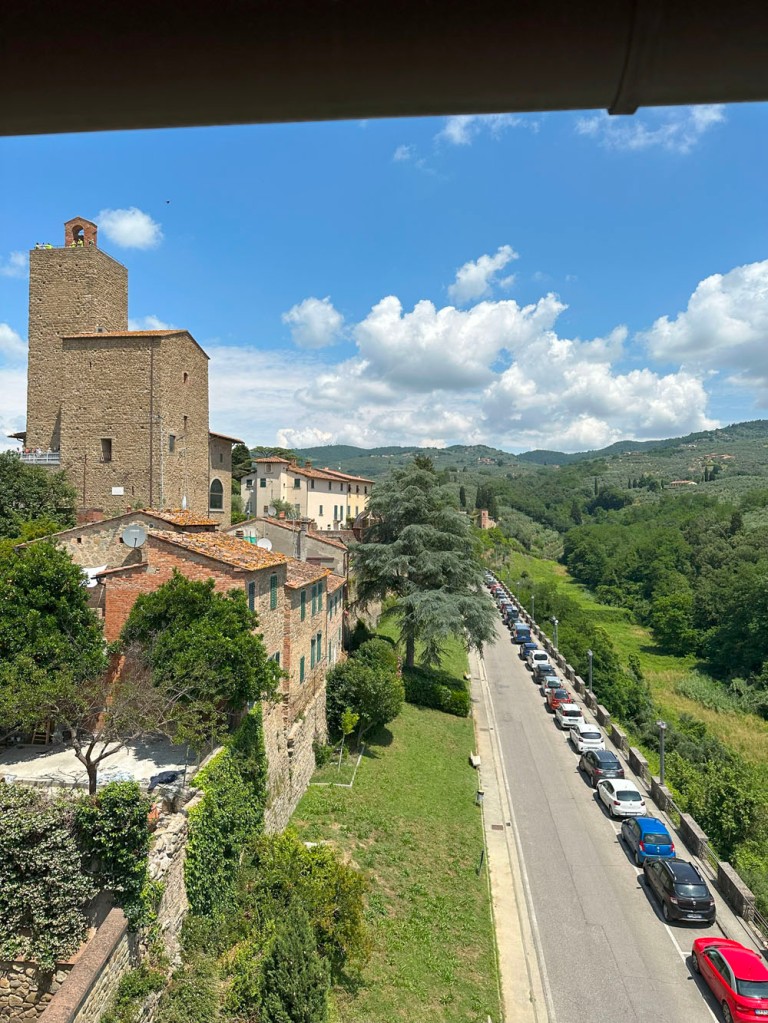
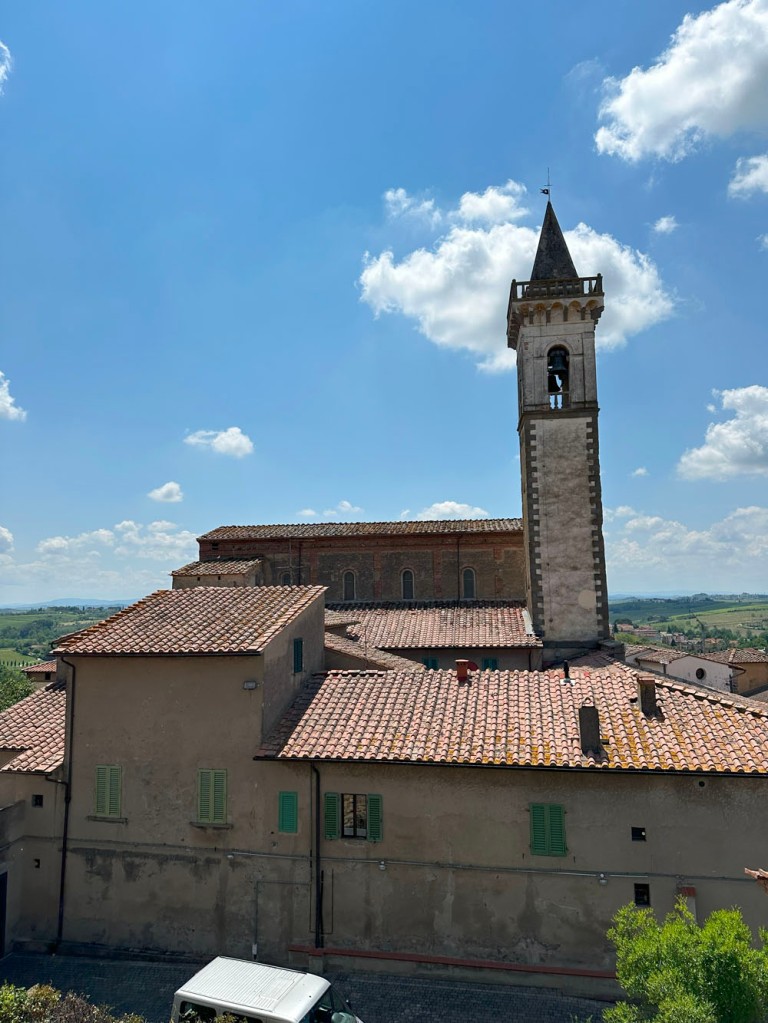
Nice view outside one of the windowsSwapping museum buildingsHow could you miss it?!It really is a tiny little village.
We were hungry, and when looking for a place to eat, we came across a little piazzetta in which there were statues of Leonardo da Vinci and Qi Baishi (Chinese painter) by a Japanese sculptor. I have no idea why I have no photos nor video of these, as they were quite lovely. Such is life. Anyway, we were hungry and spotted a couple of snacky-restaurants below. Now, usually I’d run away from these types of places in obviously touristy areas, but I wasn’t getting the ‘we’re here to fleece you’ vibe from it, so we gave it a bash.
And I’m glad we did! The food was above average, but the people serving were so chatty and lovely – I live for these kinds of random interactions. We were just talking about where we came from, and if we’d visited here or there – nothing World-changing, but just… nice!
The little snacky barThe lasagne doesn’t look too clever, but it really was good!
Before heading back to the car to try to find Leonardo’s gaff, we first entered a tiny souvenir place where I desperately tried to find some t-shirts that fit me – some of the designs were cheesy but fun. Sadly, most shops in Italy don’t cater for the larger gentleman. I lost 22.5 kg (50 lbs) when I was very ill with generalised anxiety disorder. Now that I’m (mostly) out of that, I’ve since put that and more back on – I need to lose weight. But even when I was at my skinniest, buying clothes in Italy was a huge challenge! I bought one anyway as a ‘promise’ to myself to fit into it.
Then we drove up the steep and wriggling road to where Leonardo’s house is said to be. Parking is easy, and there thankfully was a refreshments van there too, which we made use of on the way back.
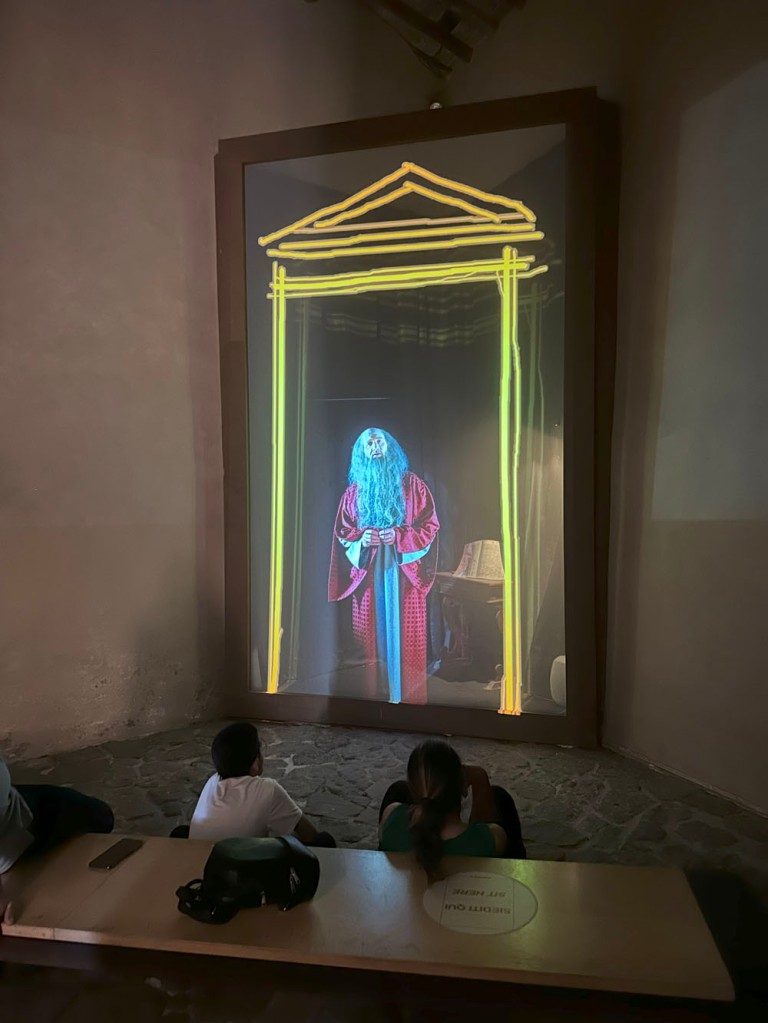
We walked across the narrow road, and through a small olive grove until we reached the complex, of which Leonardo’s birth home is a part. A nice young man took our tickets and we entered the building. It’s not particularly big – just a few rooms. The room to the right contains a little diorama indicating Leonardo’s travels and other memorabilia. The room to the left had the most interesting thing: a projected mini-documentary where a lone actor playing Leonardo tells his life story, but through his love of his mother. This is definitely worth catching. Italian and English versions play alternately, and there is another room in the modern part of the complex, which it also plays it on a small TV – I’d catch the more immersive version in his house, if I were you. I didn’t take many photos, because I was taking video instead (see below).
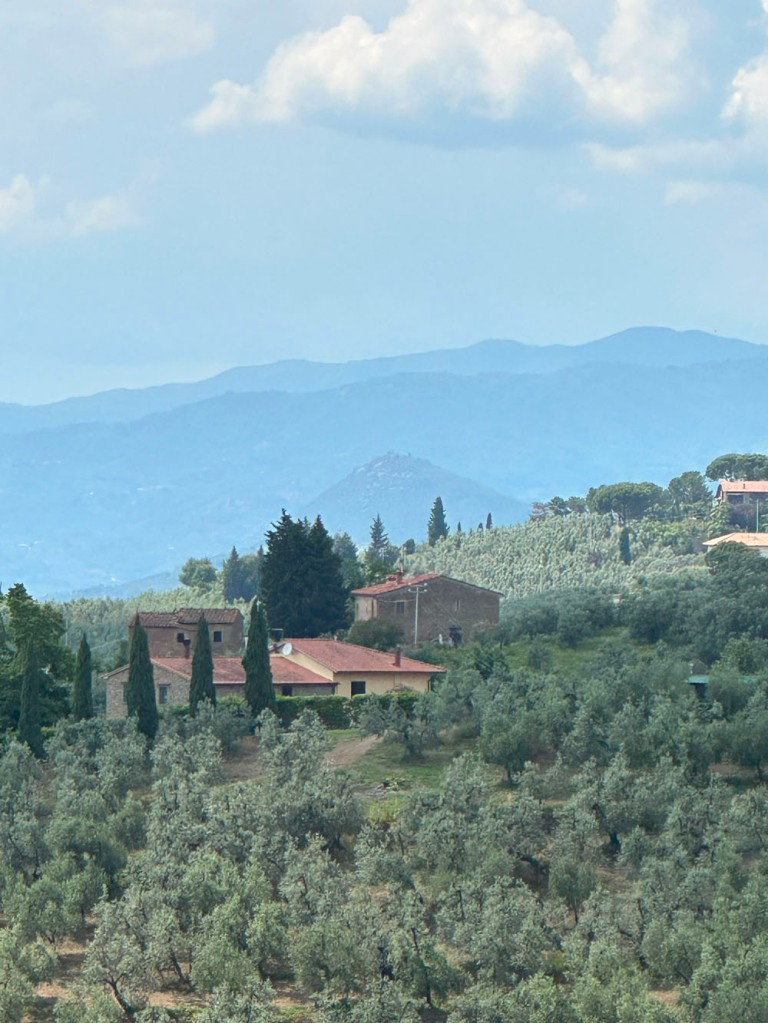
If I ever publish a travel book, this will be on its back coverCatch this if you can – it’s lovely, if a bit melancholicThis hill in the mid-distance is the one that Leonardo sketched and caused people to think that the house we were at was the house of his formative years
We strolled around outside after, taking photos and video. Then we walked back to the car, got ourselves some refreshments back at the van (it was a hot old day!) and drove home.
Except we didn’t get as far as the apartment, did we?
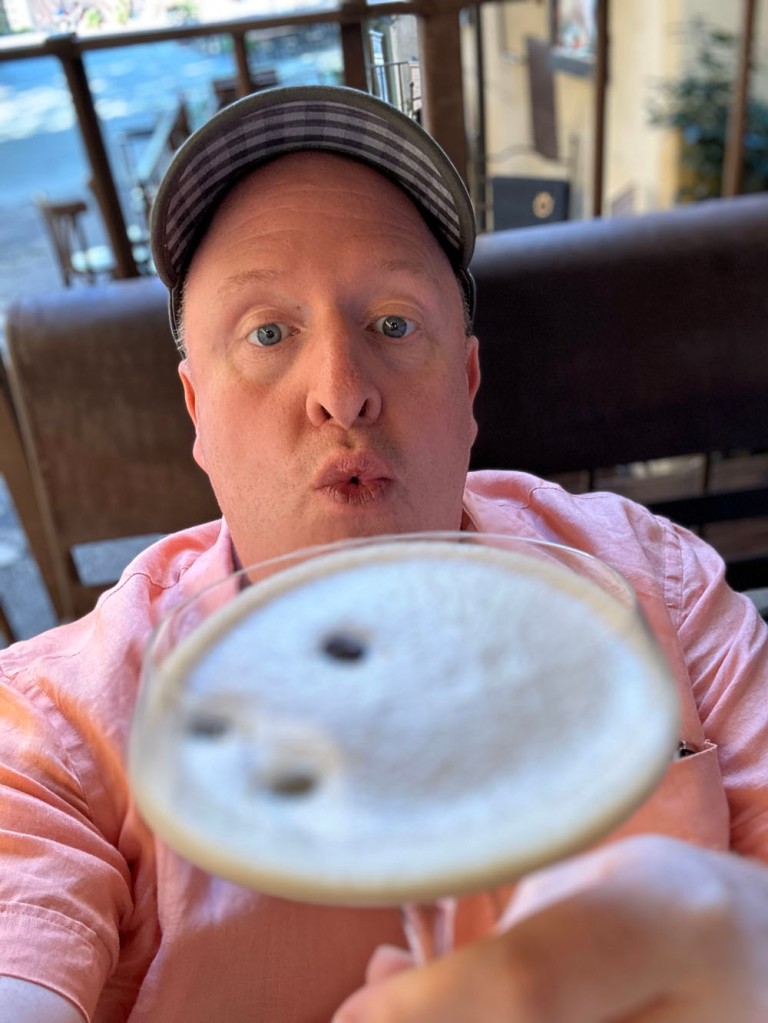
Espresso martini at Antica Velathri Café!
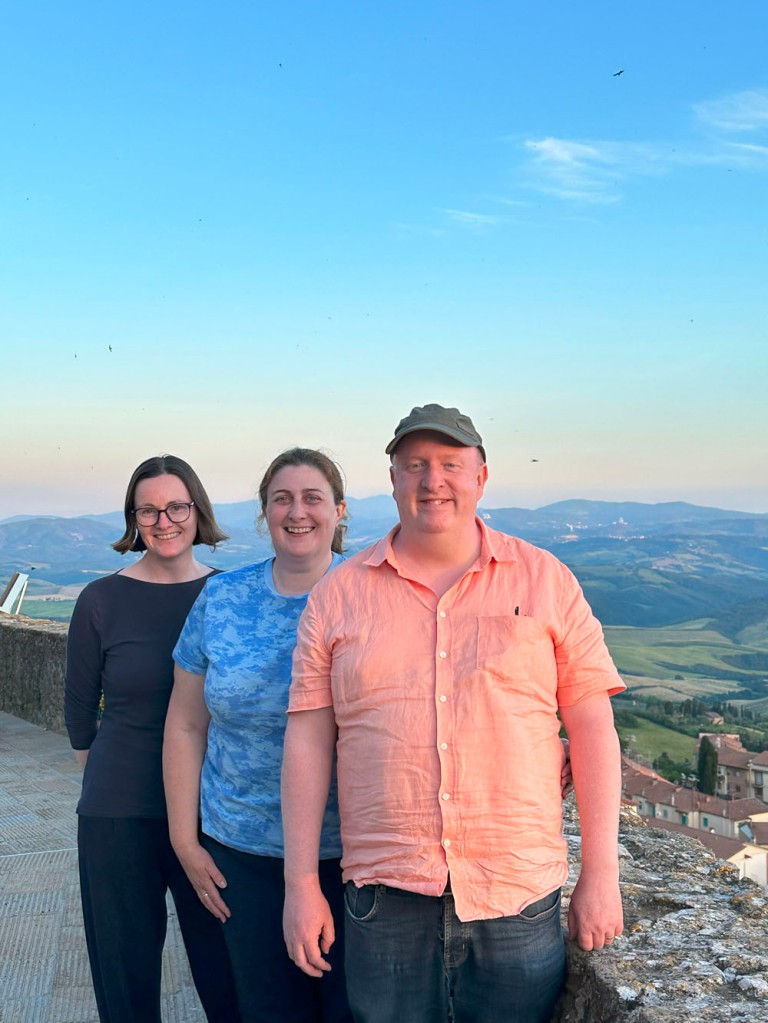
And we didn’t quite stop at Antica Velathri Café. It was golden hour, so we raided Piazzetta Fornelli to check out the sunset. We met another friend there, and took photos of each other in between sips of aperitivi.
Do you prefer over-exposed, or……under-exposed?Or our first folk album cover?
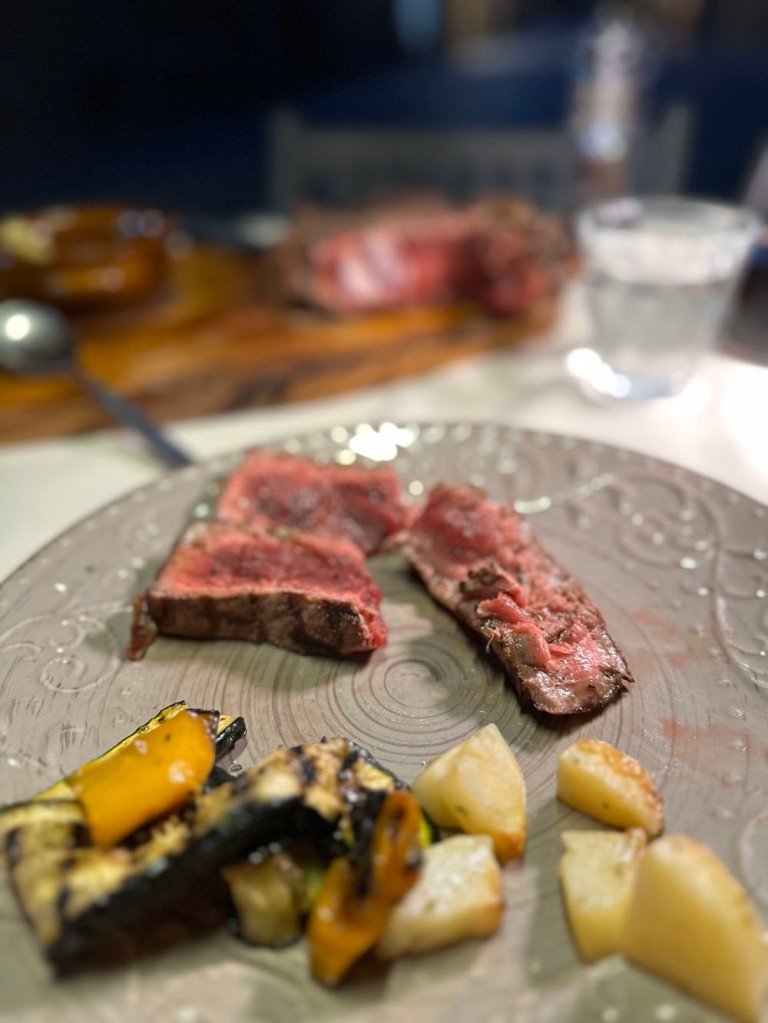
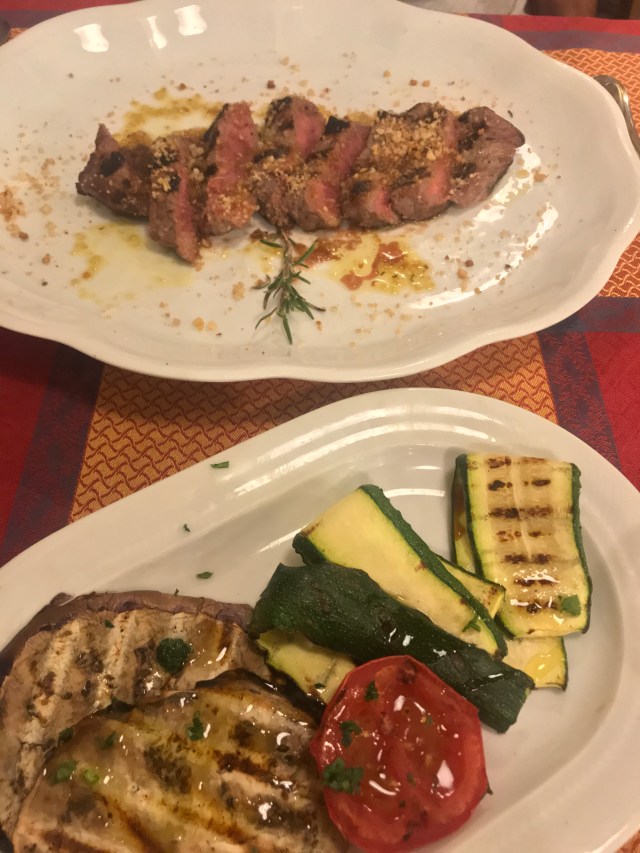
We were getting hungry (what else is new?), and thought we’d give one of our favourite places a bash: La Taverna della Terra di Mezzo. We just love Robbi and Aurora, the owner and waitress respectively – and the food is good – especially the meats. So that’s just what we had: a big, flip-off Florentine steak.
You don’t get to dictate how a Florentine steak is cooked!
We were finishing up our meal when we heard a bit of a cacophony approaching Via Gramsci (where the restaurant lies). It turns out it was the feast of Saint Clement and Giusto – so there was a protracted procession of the town’s finest, chanting and holding candles while responding to a cleric on a loudhailer. You can catch this in the video just below:
And that was our day! I hope you enjoyed the read. Give me a shout with any comments/queries!
It’s been a while since I posted the first tour route, and so this sceond route is long overdue. This post will use the same concept – I will use larger photos. To view full-sized pics, if you’re on a PC:
Right-click an image and select to open it in a new window or tab;
In the address bar, remove all text to the right of ‘.jpg’, then press enter on your keyboard. Many of the photos are quite large.
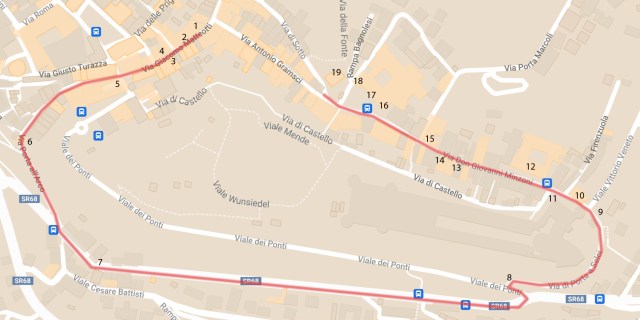
Here’s the route we’ll be following. It’s starts at 1, travels anti-clockwise and ends up at 18.
Note that this will be a lengthy blog with tons of photos.
Andiamo!
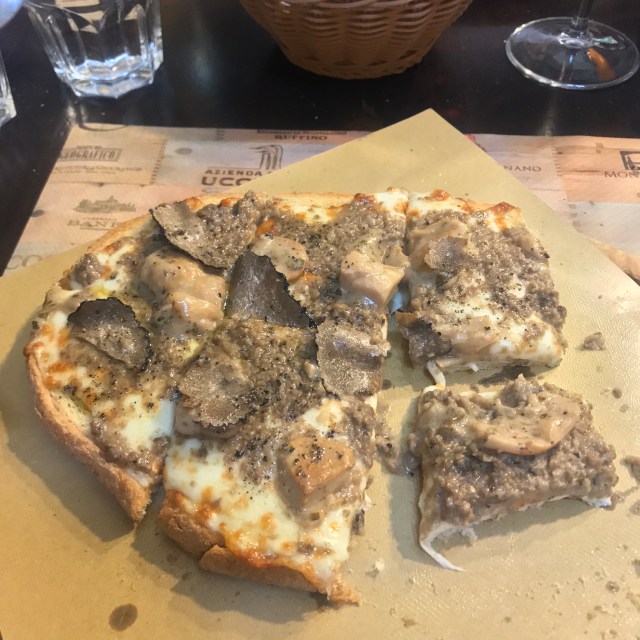
#1: There’s a nice little eaterie right beside the entrance to our apartment building called’ Porgi l’Altra Pancia, which literally means ‘Grow another belly’. With good reason: the portion sizes in here are quite big – certainly pasta dish sizes are bigger than average. They make one of my favourite things in Volterra: a crostino with mushroom and truffle creams, topped with melted cheese and flaked black truffle.
Ah, the deliciousness!
They naturally also have a great selection of wines.
One thing I’ll remember them for is that one of their waiters was really kind to us when our electricity went out, and contacted our building’s super to help us switch it back on (it was just a tripped switch, embarassingly).
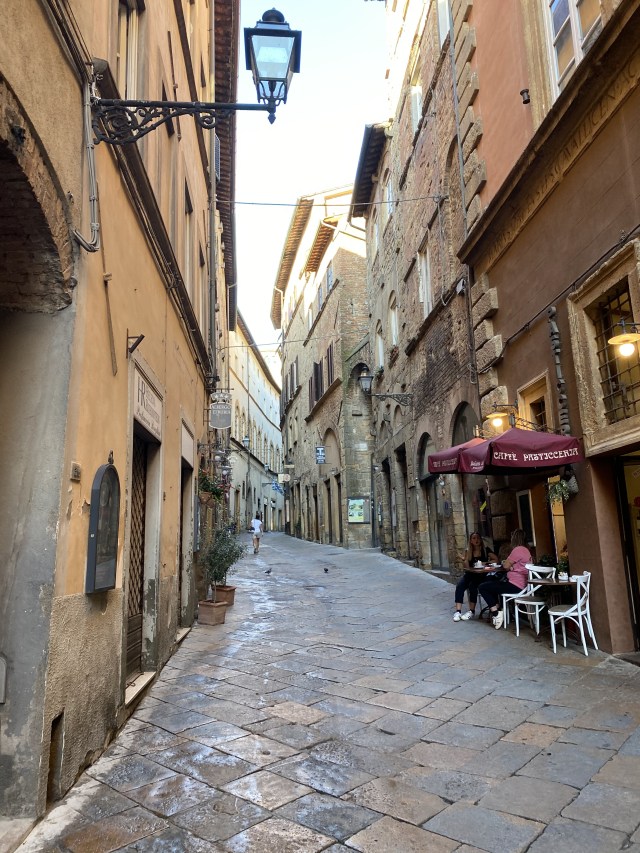
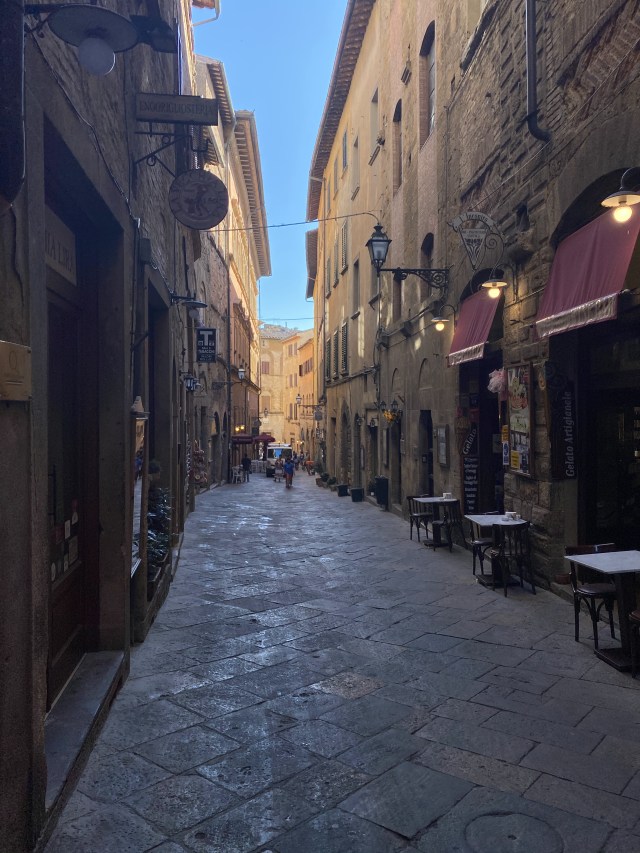
#2: Turning right after leaving the building and heading uphill we pass a pasticceria: Dolceria del Corso, which is one of the three pasticcerie we usually frequent. Unfortunately, the closest thing I have to a photo of it, is one of our street, with the entrance under a burgundy awning.
Looking uphill – the entrance is ahead
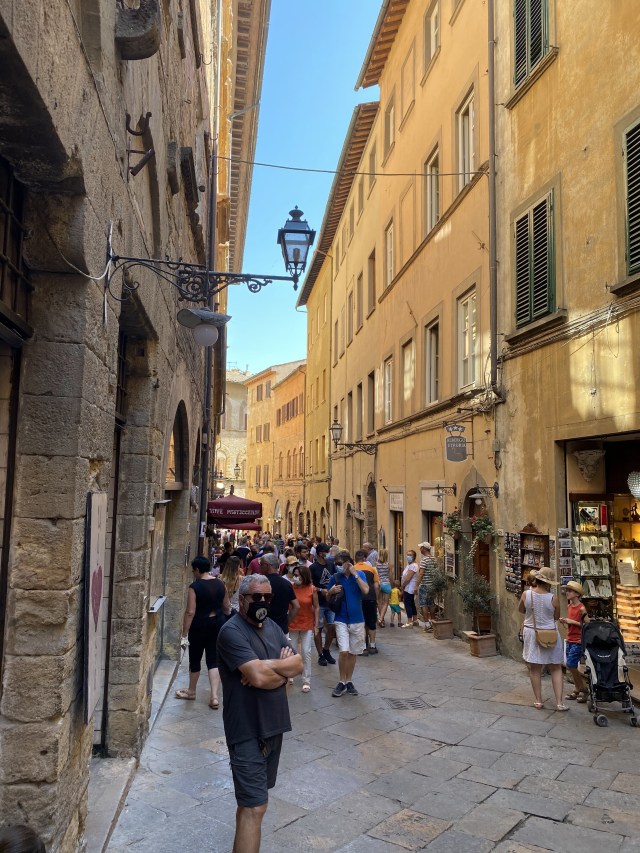
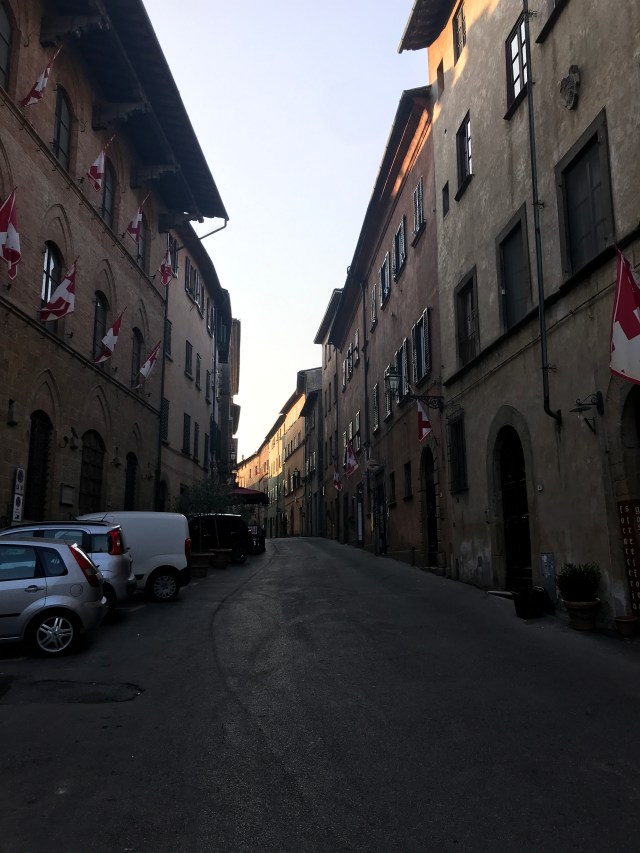
Looking back downhill after passing it – we live on such a lovely street – taken at a different time of the day – lookit those crowds!
Their cakes are yummy, and you have a great selection, especially in the morning – to cater for the typical breakfast over most of Italy: a sweet treat with an espresso. I’m down with the former; never developed a taste for the latter – although I love a good coffee gelato!
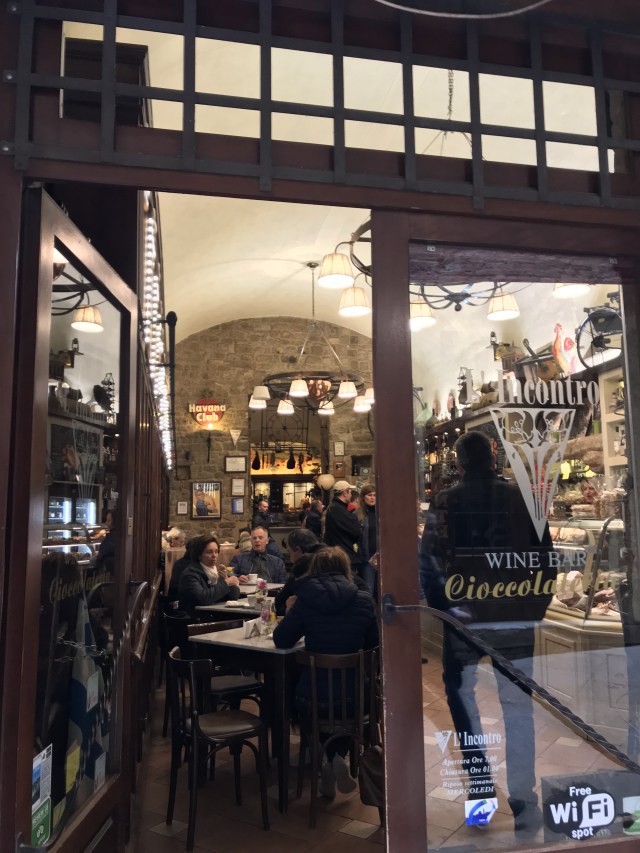
#3: Moving up past Dolceria del Corso, we come across one of the post popular bars in Volterra: L’Incontro. This is a full-on bar, and so has coffee, drinks, is a pasticceria (a good one!) and sells choclolate in the off tourist-season or gelato in-season. I think their gelato is great – maybe second to Isola del Gusto, but still really excellent – and they tend to rotate their flavours a little more often.
You’ll often see people here hanging around during breakfast, during aperitivo and after dinner hours. It can get really busy. Like with all places that serve coffee, you’ll pay normal rates to drink at the bar, and a little more to sit by a table.
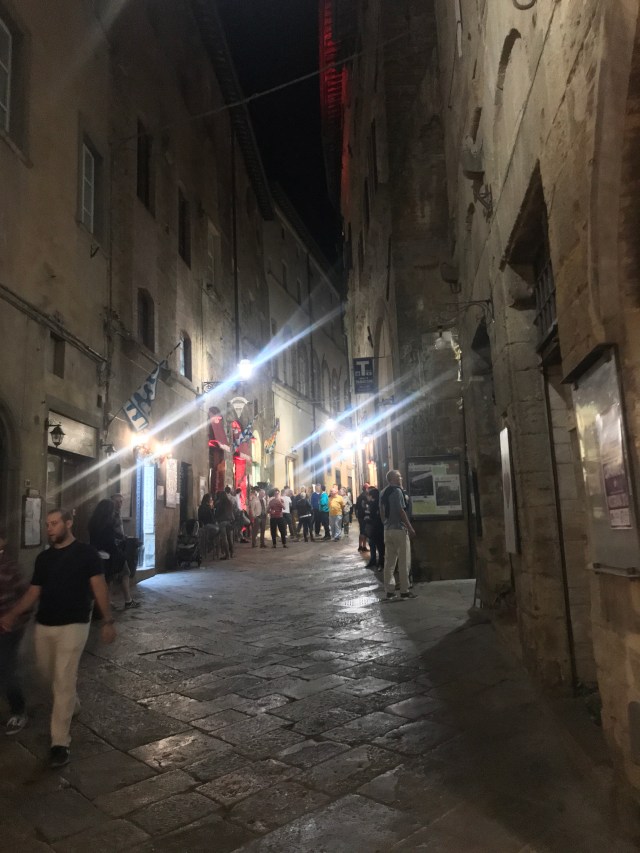
Evening at the bar
Getting busy, dopo cena (after dinner)
Looking backwards again – the bar is just there on the right
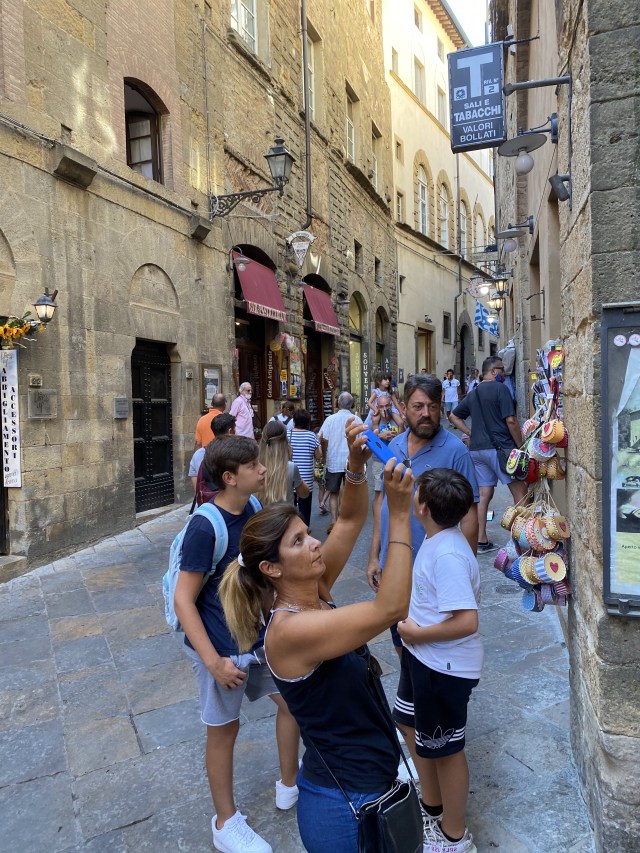
Oh look! A tourist taking a shot of Vicolo delle Prigioni. We wouldn’t have it any other way. There’s l’Incontro in the background.
#4: You’ll find a restaurant, La Vecchia Lira, almost opposite l’Incontro. We’ve only eaten here a couple of times, but are always impressed by the enthusiasm of the owner. The menu leans more towards traditional, but they have some modern takes too – and a daily specials board. Definitely give them a go when you’re in town!
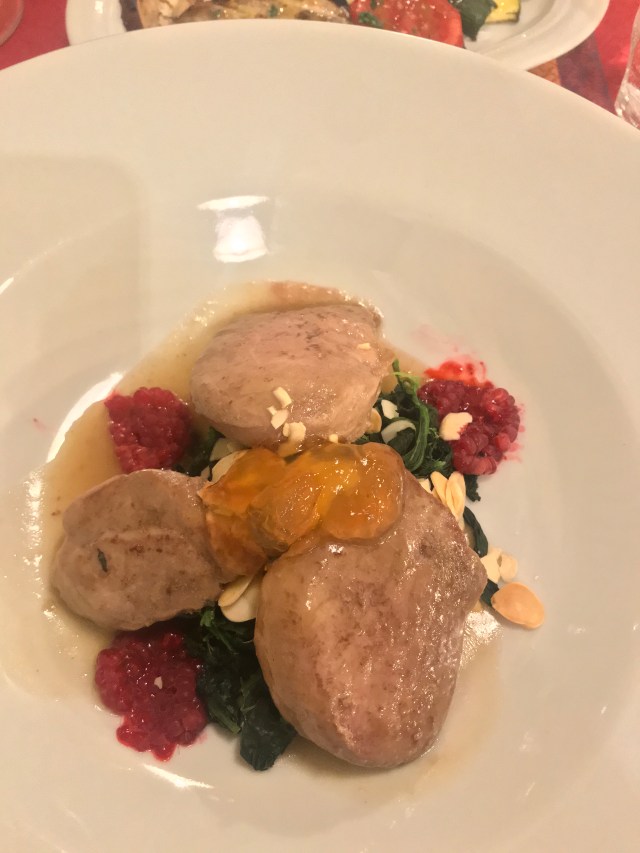
These pork medallions with raspberry in a Vin Santo sauce were amazing!
#5: By now our bellies are ridiculously full, but we’re not done yet. Just beyond the crossroads where Via Giacomo Matteotti (the road we were just on) meets with Via dei Marchesi (look right and you’ll see the Palazzo dei Priori), lies the road we’ll be going straight down: Via Porta all’Arco.
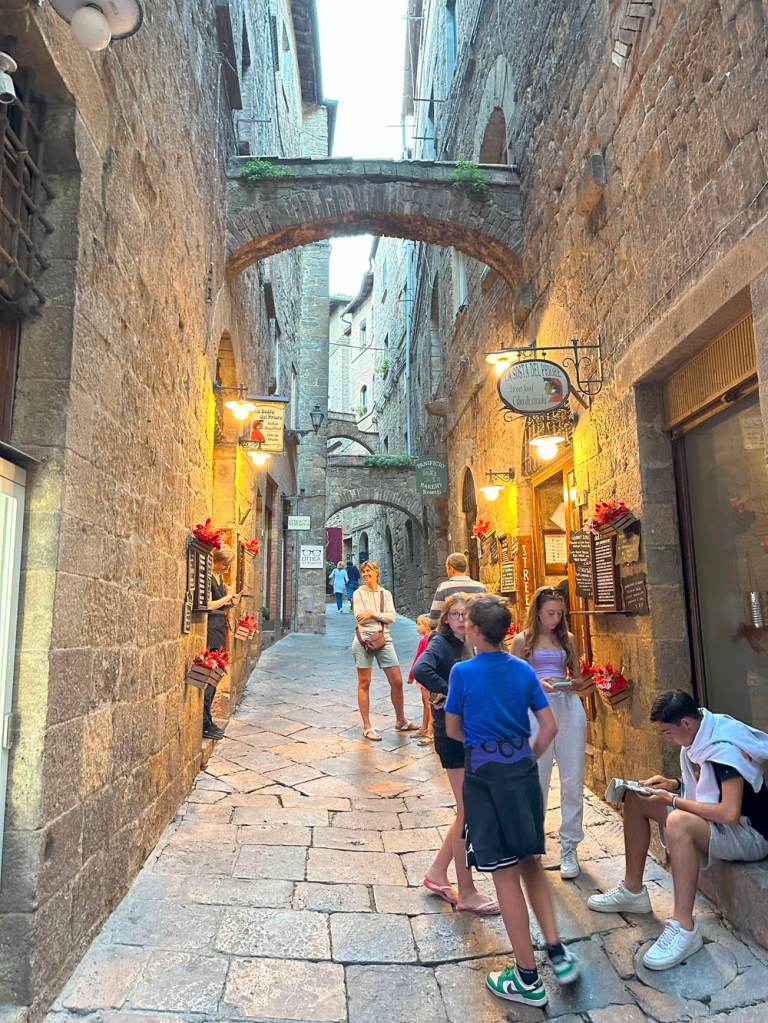
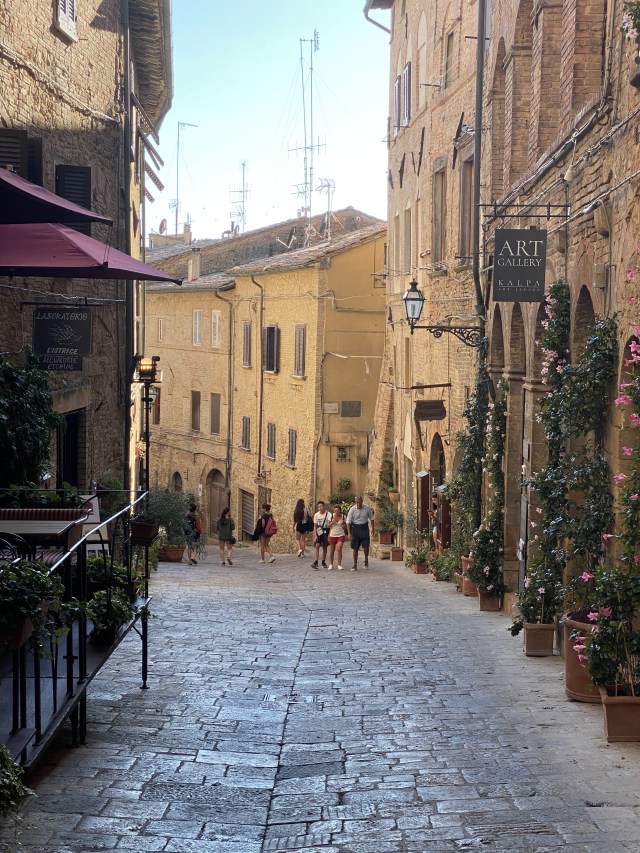
Just a few meters down the road lie two restaurants: Il Poggio and Life Bistro – together they are often the most photographed exteriors in Volterra, due to them being on this beautiful sloping and curving artisan street.
I have to admit to never having eaten in Life Bistro, as it is a purely plant-based restaurant. I am not ethically opposed to this, of course, but there are few world cuisines that turn me on with its vegan offerings, and this includes Italian food. Only food from the Indian subcontinent comes close. However, if this appeals for you then I would say you’re in for a treat, even if just for the restaurant setting itself. I know Niamh wants to give it a go, just to see what it’s like, so we might do next time we’re over.
They seem to have a standard menu, plus a section where you select your own ingredients and ask them to assemble and/or cook them. However, look down, and you’ll see some of the floor is transparent – below it you’ll see some ruins that date all the way back to Etruscan times (2,300 to 2,800 years old).
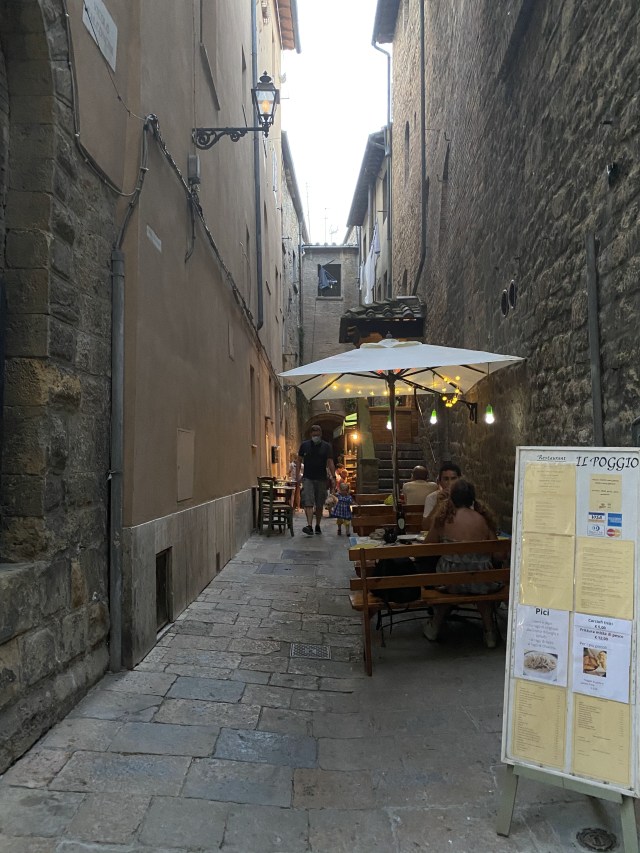
Il Poggio is a more inclusive place, and has a bit of a touristic menu – with pasta, meat and pizza offerings. There are typical traditional dishes too, and if memory serves me correctly, a couple of German plates. The cooking isn’t stellar, but it’s fine to go to for something quick and maybe if you have kids, due to the variety of what’s on offer. In addition, it has some cute outside seating in a lane at the back.
Looks even sweeter when it gets darker
For now, though let’s continue on down this lovely street, to discover why it’s been named the way it has.
As you walk, never forget the golden rule: always look behind you
And there’s the reason!
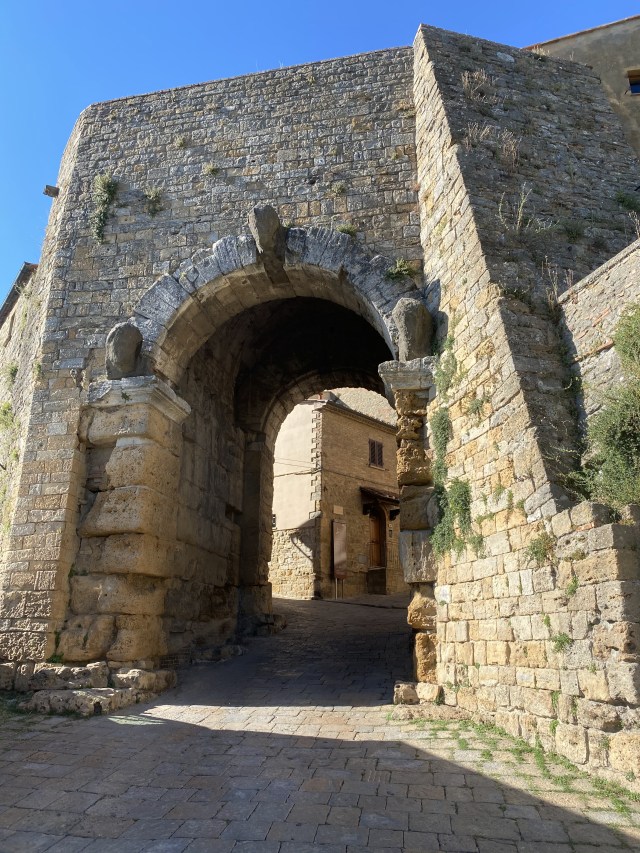
#6: At the bottom of this street lines one of the old gates into the walled town. It’s called Porta all’Arco. Actually, “old” doesn’t really cut it. The larger blocks you can see in the photos below are Etruscan in origin, and are about 2,300 to 2,500 years old.
Big Etruscan blocks!
The three heads at the top, and most probably the arch are Roman. The detail of the busts has worn away over the centuries, but is said to be the heads of three Roman gods, most probably Jupiter along with Castor and Pollux (or Uni and Minerva – let’s not have a debate!).
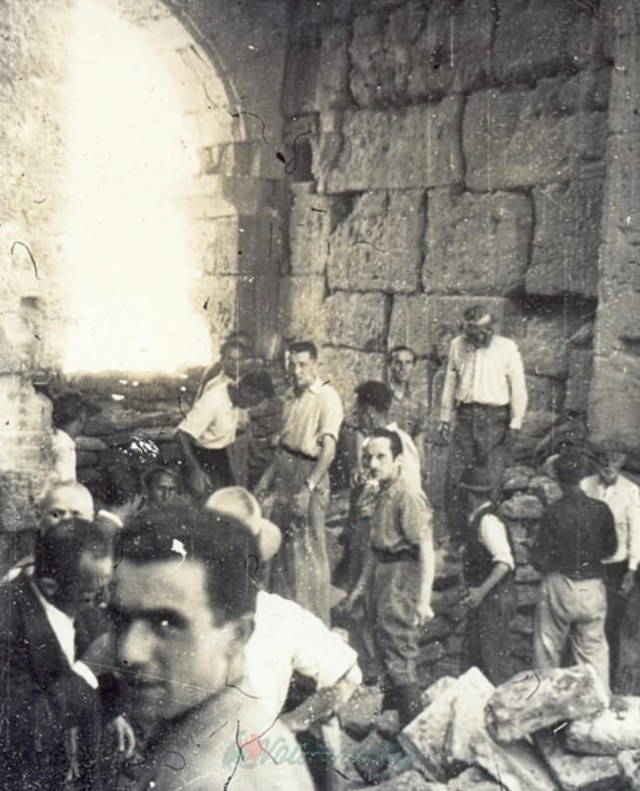
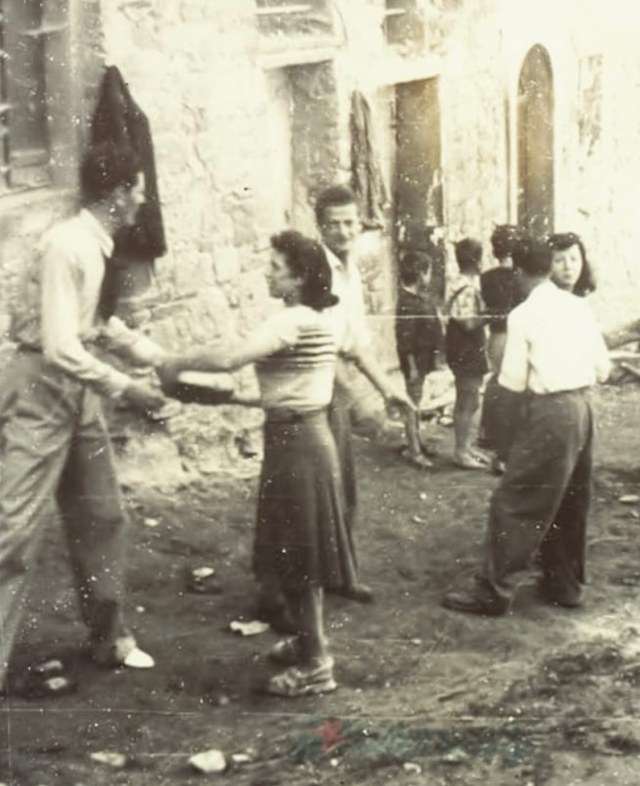
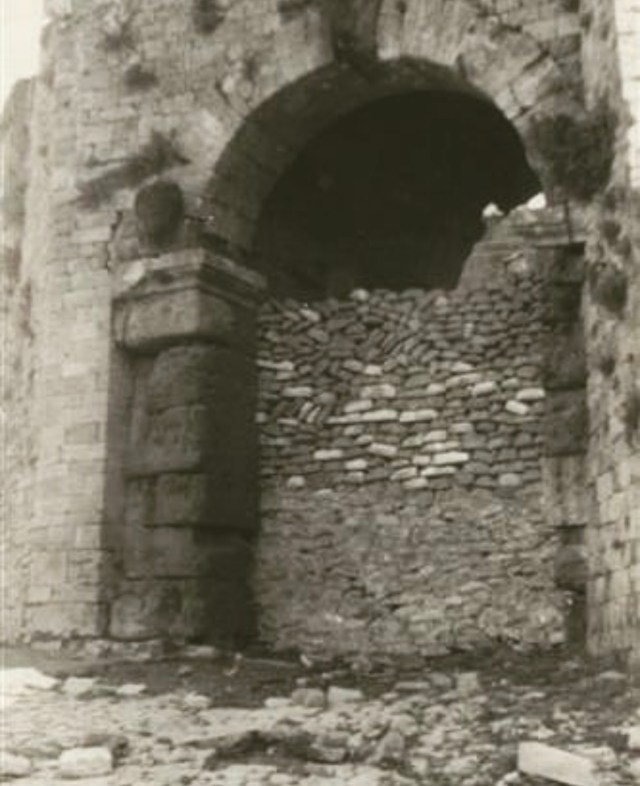
Towards the end of the second World War, the Nazis threatened the gate with destruction during their retreat, in an effort to slow down the Allied advance. The townsfolk pleaded to save their gate, and said that they would instead block it. They were given 24 hours to do this, probably by those who thought “Yeah right, good luck!”. However, they did it by forming a human converyor belt and passing stones from hand to hand, and the gate remains to this day. Here are some photos. They are not mine, so I ask the forgiveness of those who may own the copyright.
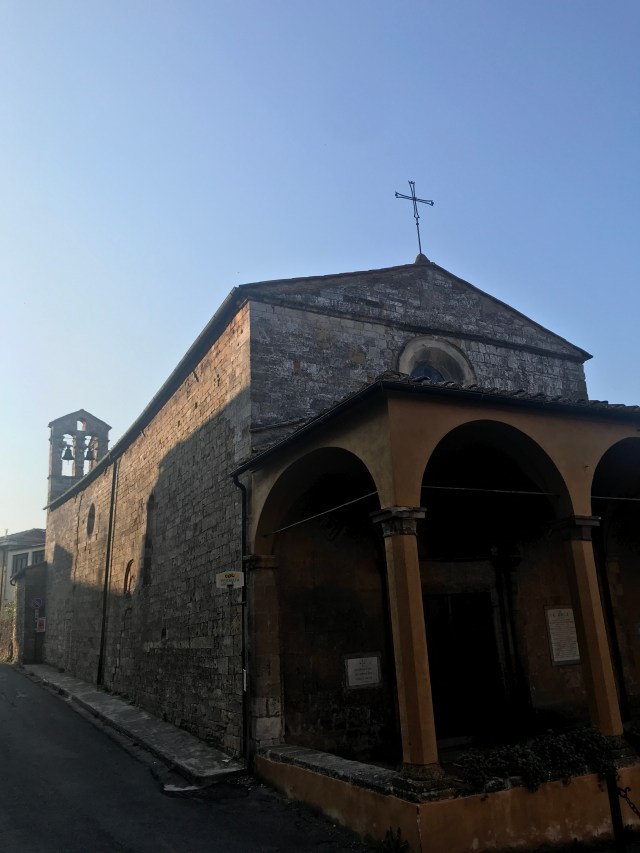
#7: A ramp a little over 100m leads down to the parts of the town outside the walls. Passing a cute little bar (Giordani’s), we head southeast for a few meters, and where the road bends towards the east we pivot to our right to have a look at the belltower of Chiesa di Sant’Alessandro.
The church as seen from the bottom of the steps at Bar Giordani
This is one…
…of my favourite shots…
…in Volterra. Can’t you tell?
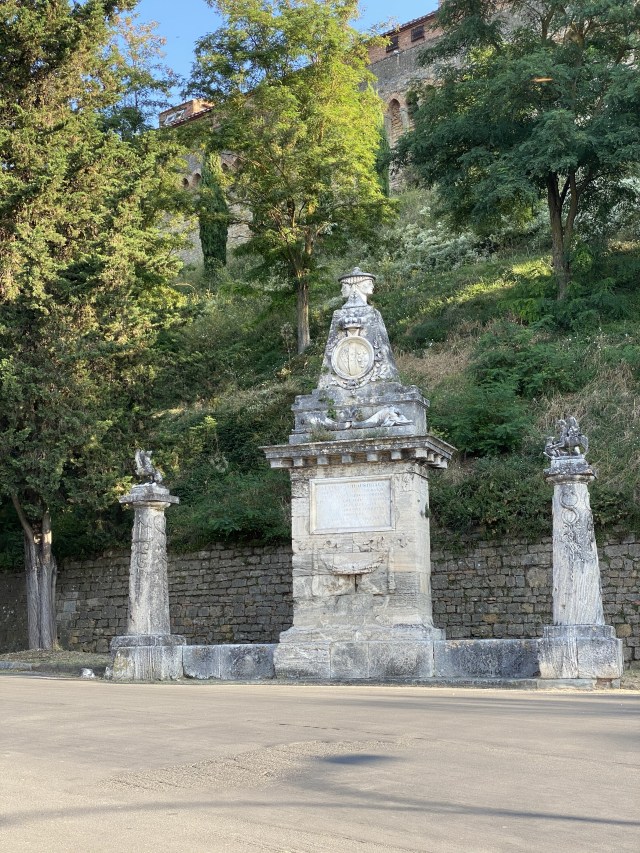
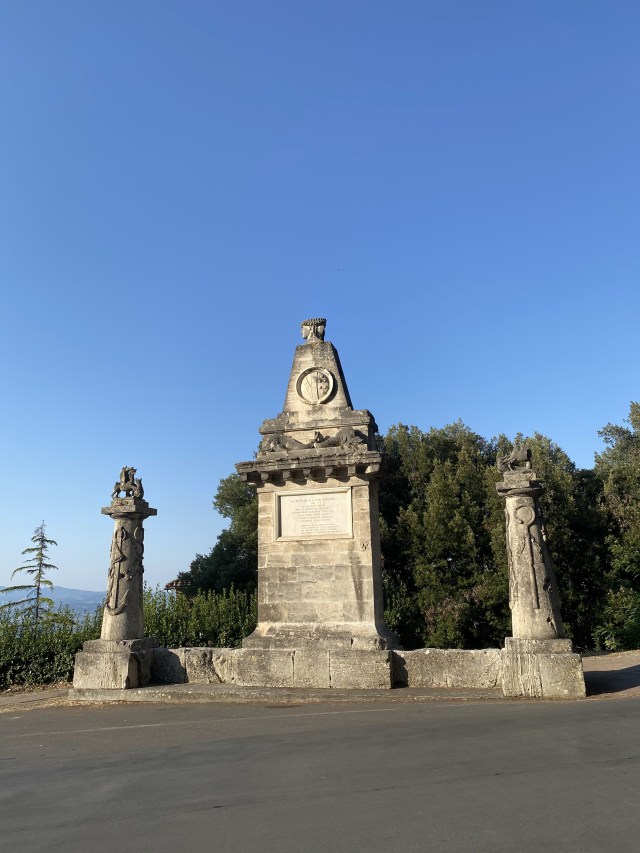
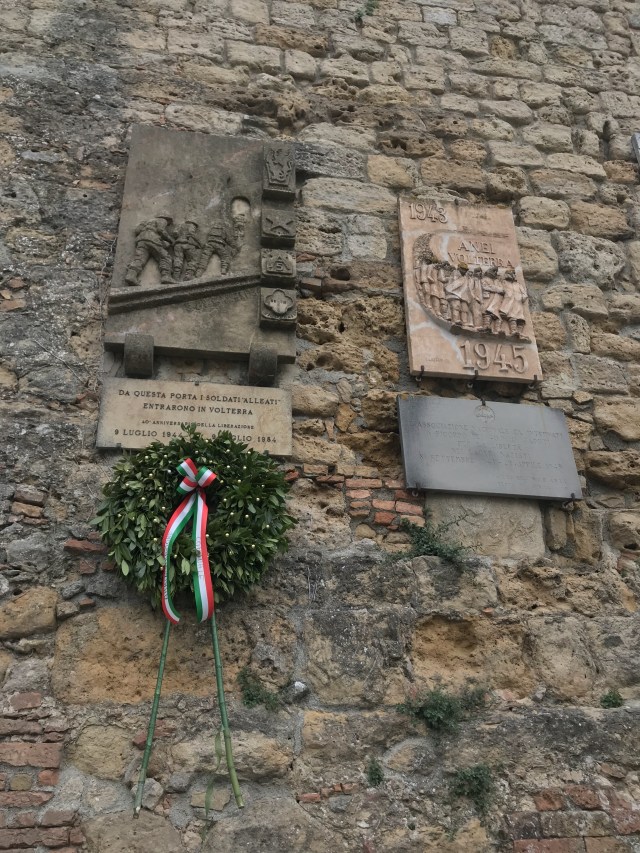
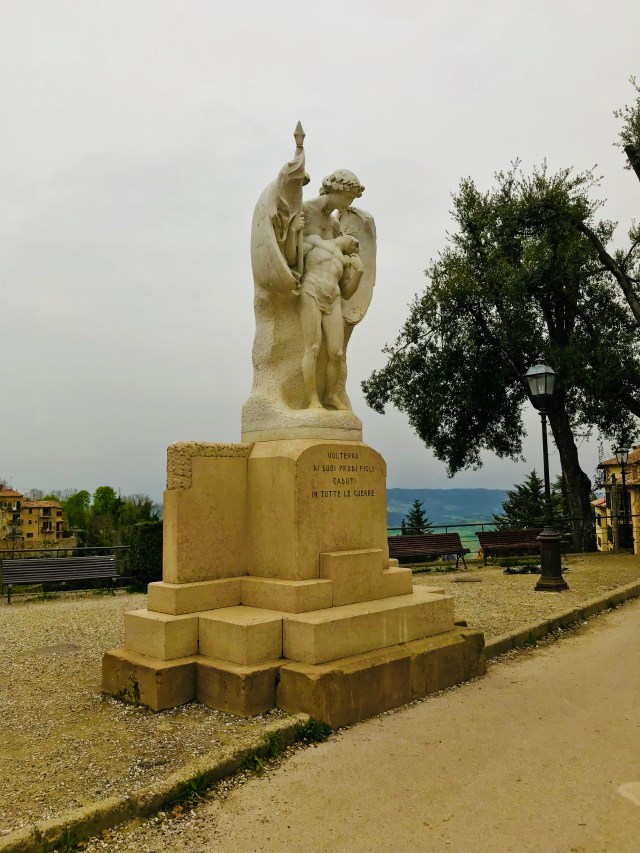
#8: We head uphill for a couple of hundred meters, until we have to cross the road to have a look at the lovely memorials at the bottom of Viale dei Ponti. In Ireland we don’t have an abundance of war memorials, whereas on continental Europe, they’re in a great many towns and villages.
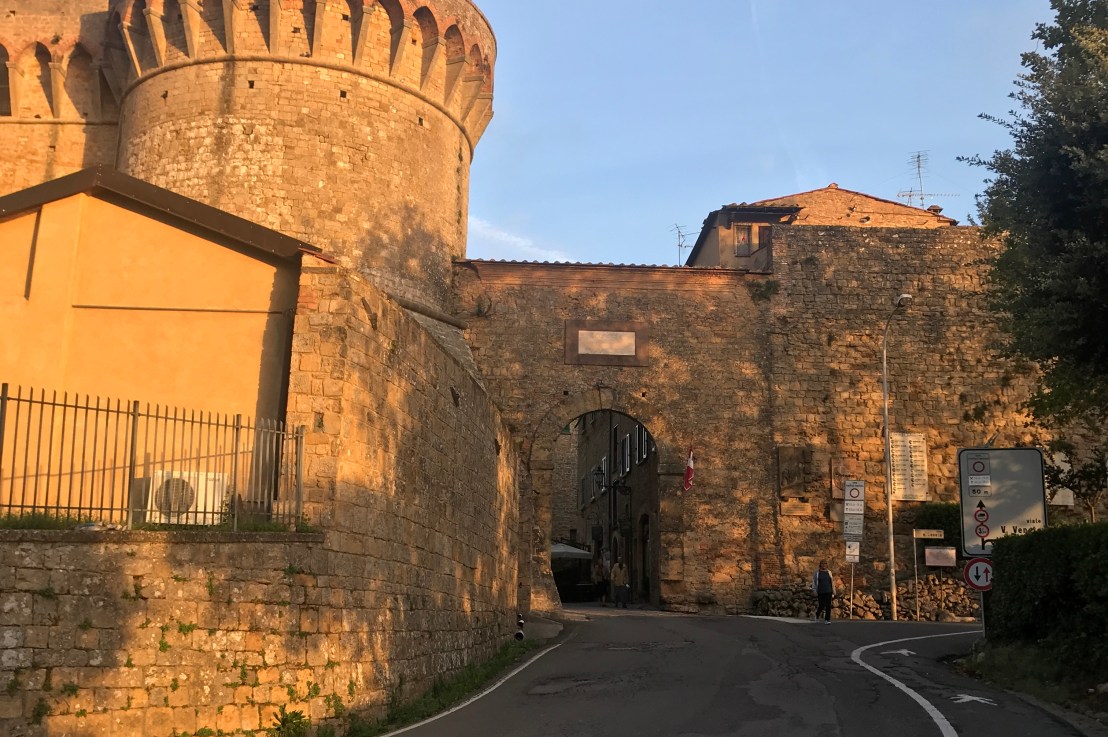
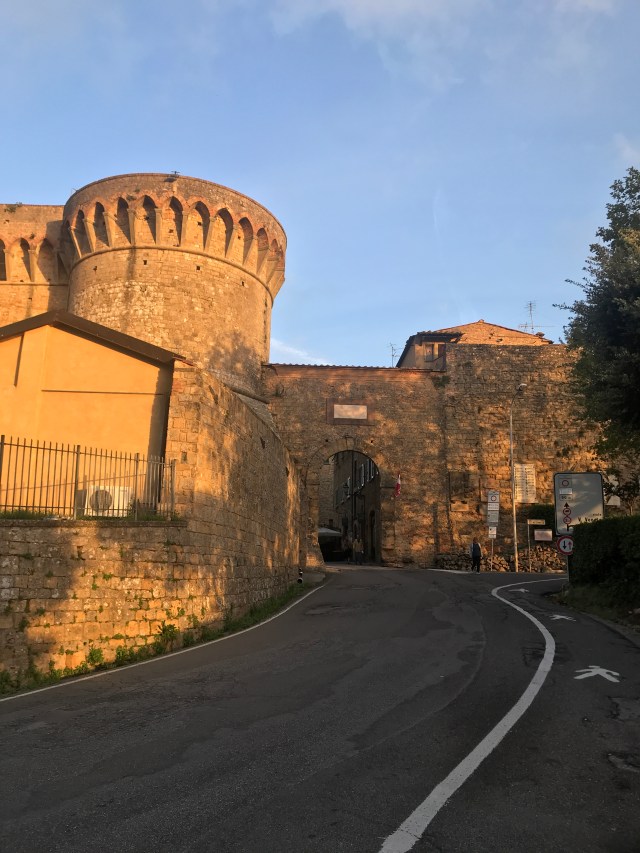
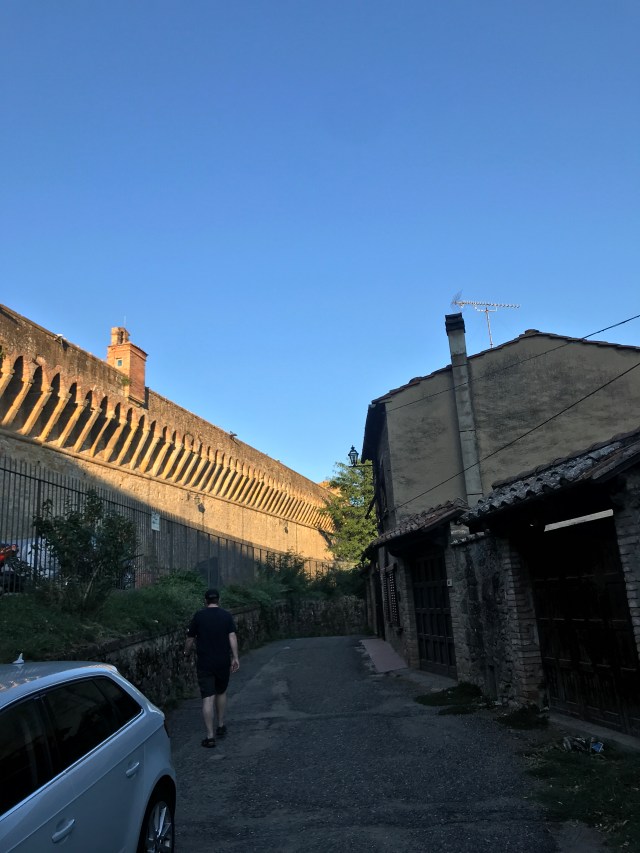
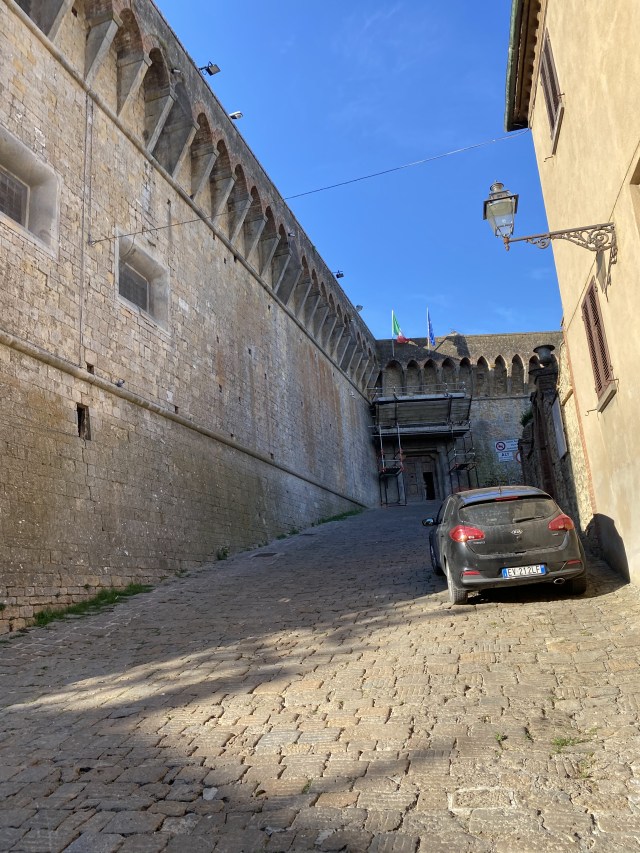
#9: We don’t head up the gently upwards sloping Viale dei Ponti, but take a left then a swift right that curls backwards. We can see the walls of the Medicean Fortress here, and the steep path leads us to one of the main gates to the walled town: Porta a Selci. Caution as a pedestrian, as this the only gate where you might meet traffic coming in both directions.
Porta a Selci
Some war memorials beside the gate
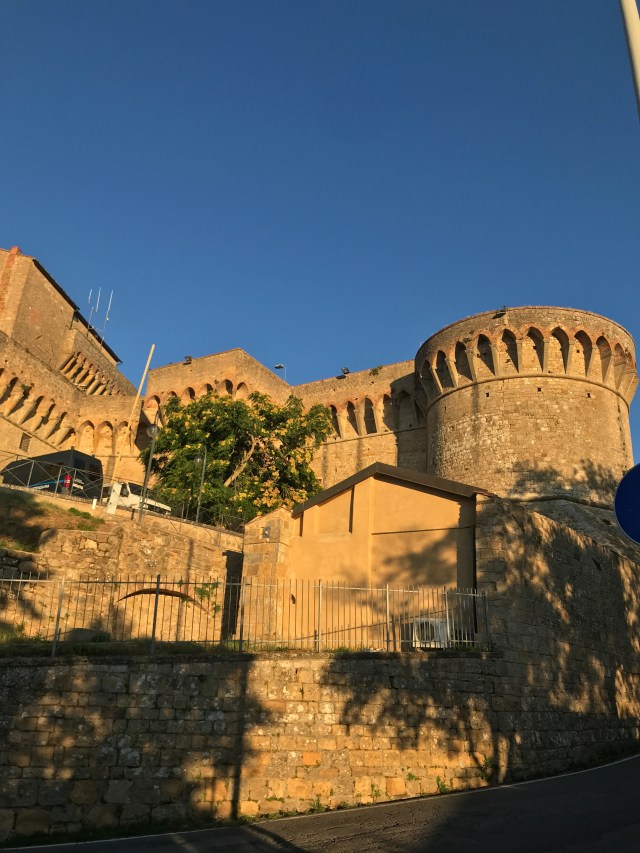
The Medicean Fortress beside the gate
You can see our next foodie destination through the gate now!
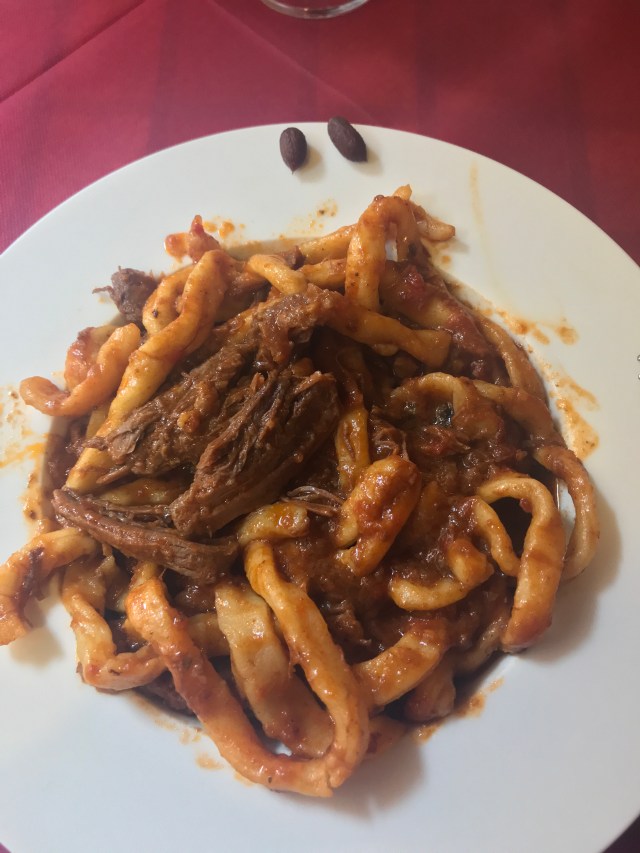
#10: Through the gate and to the right, you’ll find Osteria La Pace. They serve one of the best pasta sauces in Volterra here: wild boar with black olives. I love it especially with pici (pronounced ‘peachy’), a form of thick noodle.
From the outside…
From the inside 😉 Hand-made pici with wild boar and black olives… amazing.
Not pictured is a killer tiramisù, served in a large coffee cup… delicious. This place is definitely worth a visit.
#11: Opposite the restaurant, there is a ramp which leads up to an old fortress, which is still very intact – and necessarily so, as it is a medium security prison. It was originally built in the mid-14th centry, and updated by the Medici in the late 15th.
It’s no ordinary prison, though. Rather than simply confining people for the purposes of punishment, they attempt to rehabilitate. The three major programmes I am aware of are:
Allowing trustee residents to occasionally leave the prison to gain work experience in some of the businesses in the town;
Teach residents how to run a restaurant from top to bottom, by having a chef come in and open up the prison as a restaurant, around once a month. You can book a table here, if you book well in advance. I suspect you’ll have to wait for the current pandemic emergency to be done with too; and
They also run an acting school and dramatic troupe from the fortress, one of the most renowned in Italy. They occasionally put on shows – both normal dramatic pieces, as well as experimental theatre.
I think it’s a wonderful thing to do, rather than simply throwing away the key. It would be interested to see the level of non-recidivism as a result of this.
In 2019, they opened one of the fortress’ towers for tours in September and October. I visited – more on this here. They may revert to doing this every year, pandemic permitting.
#12: If you clicked on the link which detailed the visit to the fortress tower, you will have seen that once a year, in mid-September, they have an arts festival one night. Many museums are free to visit, and many private buildings are opened for visit. It’s a great idea, and it enables you to see parts of the town you would never see otherwise.
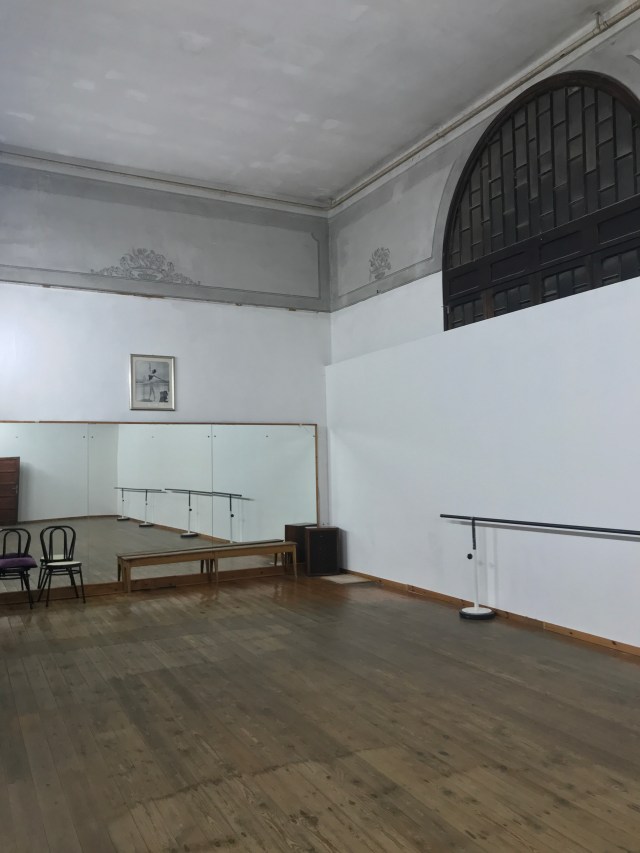
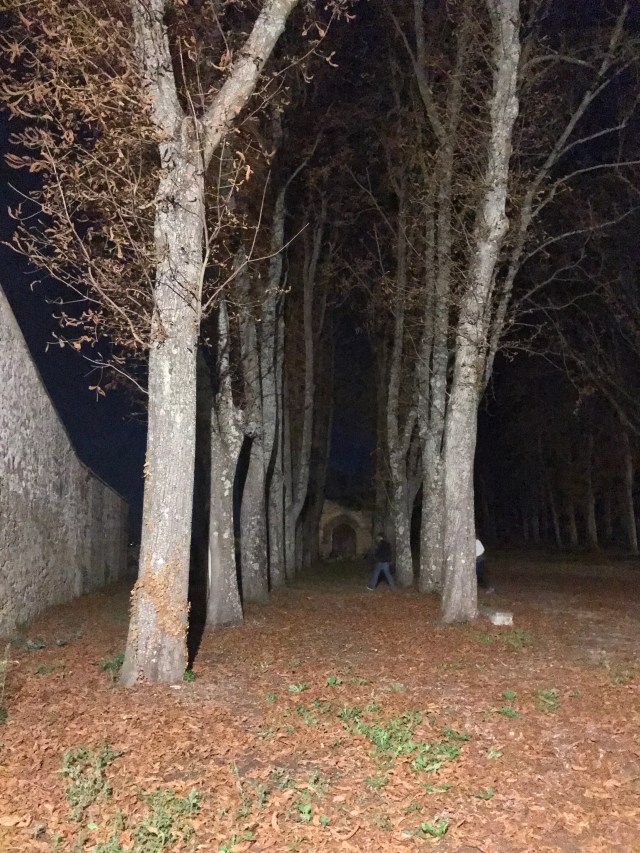
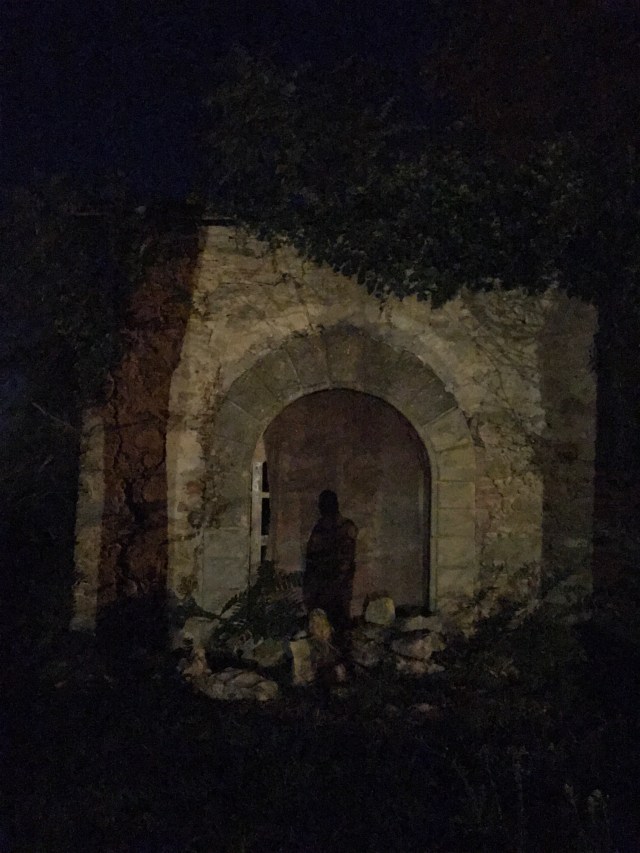
One of these buildings is just up from the Fortress: Centro Danza Classica di Volterra. It’s a dance studio/school. At the back is a large garden, which you would never otherwise see… and it’s kind of spooky at night.
#13: Another 120-150 meters down on the right, you’ll find a gallery: Colpa del Vento, which features the works of Vanna Spagnolo. She’s a lovely, ethusiastic and talented lady who specialises in Tuscan bucolic scenes. Niamh and I, and later on, Niamh’s mother, bought lovely pieces from here. Here’s ours:
As far as I can tell, Vanna doesn’t paint using references, but from memory, and hikes around Volterra frequently for inspiration.
I hear that she may be closing her shop some time in September this year. Niamh and I hope to catch up and maybe add a piece to our apartment from her collection. Good luck, Vanna!
#14: To my regret, I don’t have any photos from La Vena di Vino, a wine bar just beyond Colpa del Vento. I’ve had some amazing fried fish in here, and the owner is always keen to recommend wines to regulars and first-timers alike. The ceiling of the bar is also one of the most notorious in Volterra: it is strewn with brassiers, presumably from ladies volunteering to give them up.
I have not witnessed, nor (thankfully) been asked.
The entrance to Vena di Vino is just opposite the covered seating. This is the view in the opposite direction to the one described in the route. We’re looking back, having passed.
#15: A little farther down on the right lies the entrance to the Guarnacci Etruscan Museum. It is one of the oldest continuously open museums in the world (the pandemic notwithstanding), and has been welcoming visitors since 1761.
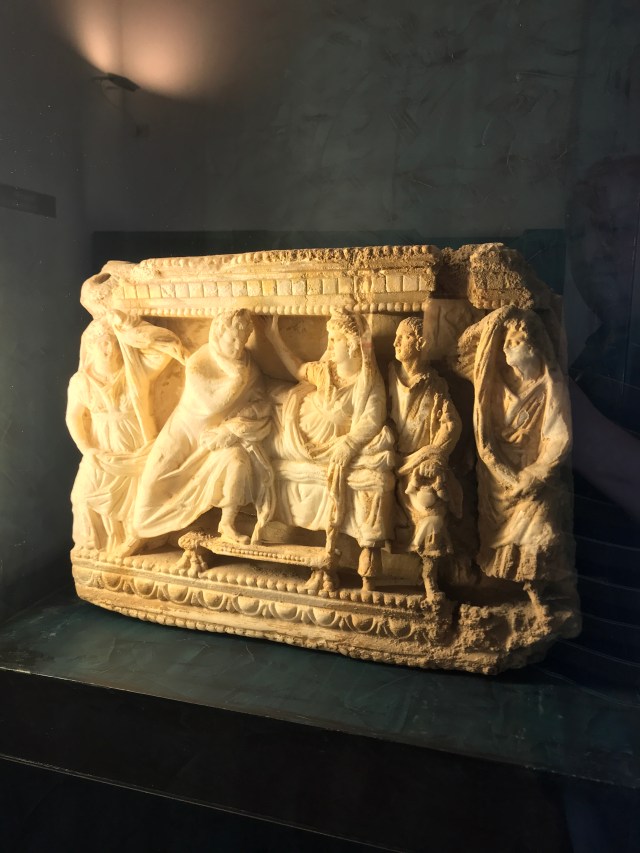
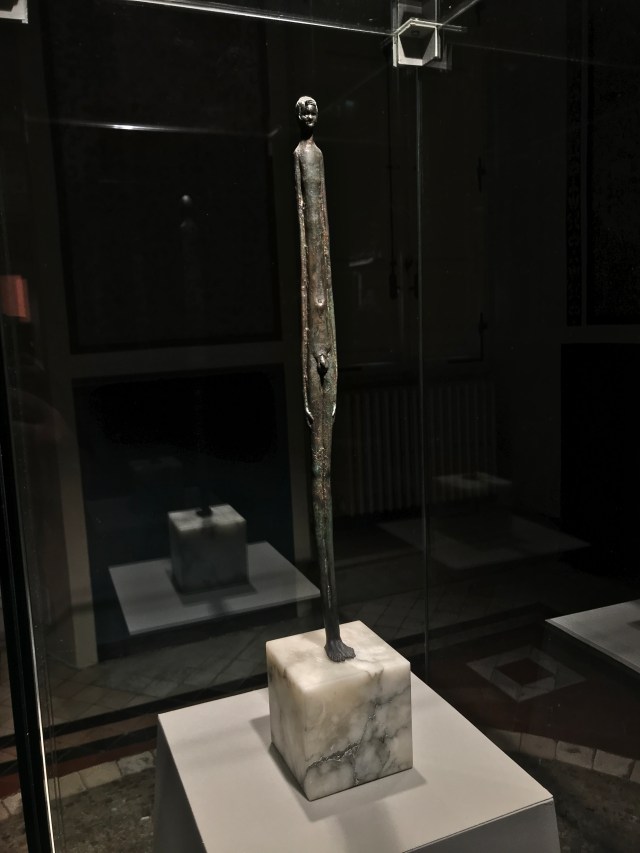
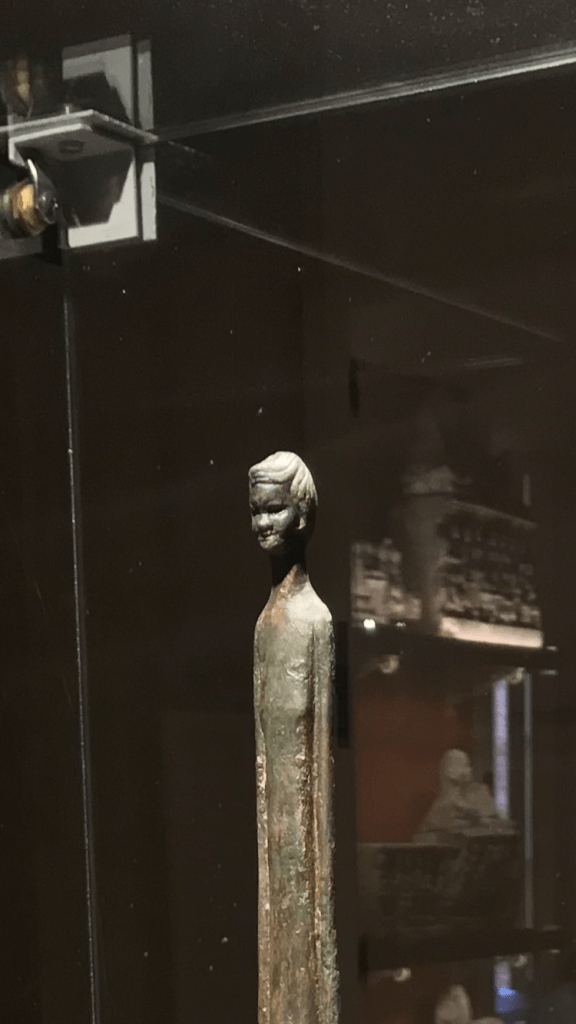
Within lie tons of Etruscan goodies: funerary urns, coins, warrior’s tombs, pottery with Greco influences. It has a couple of masterworks: the funerary urn of the married couple, and a spookily elongated bronze statue of a child called L’Ombra Della Sera.
A little creepy…
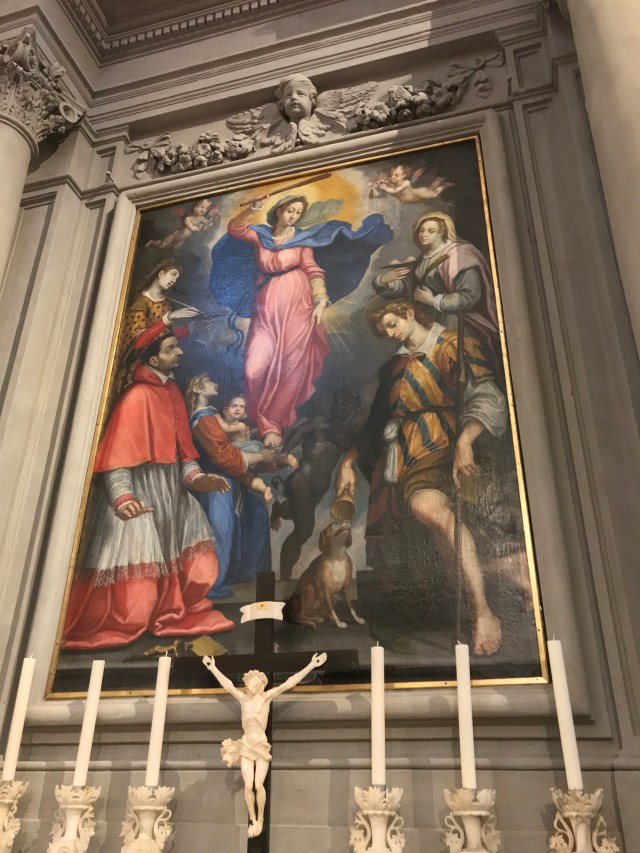
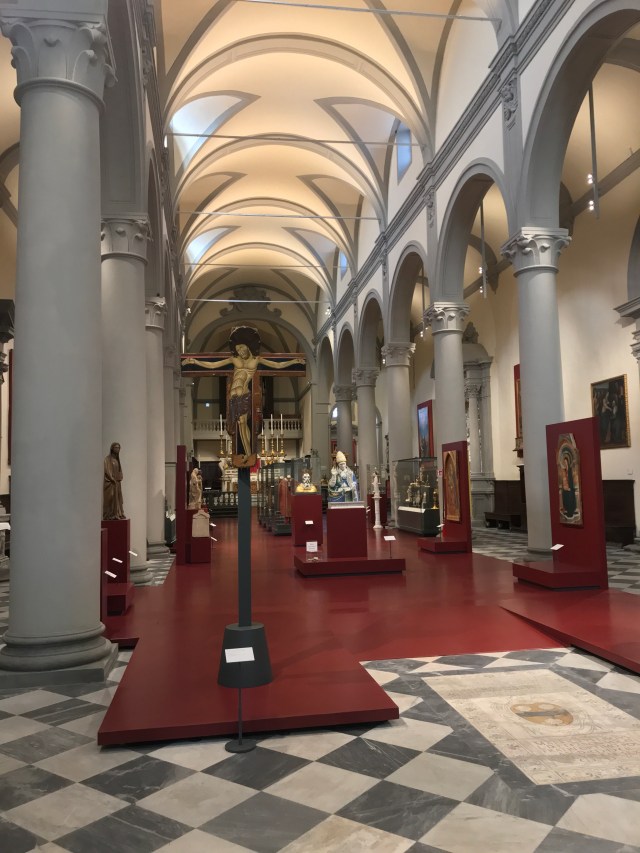
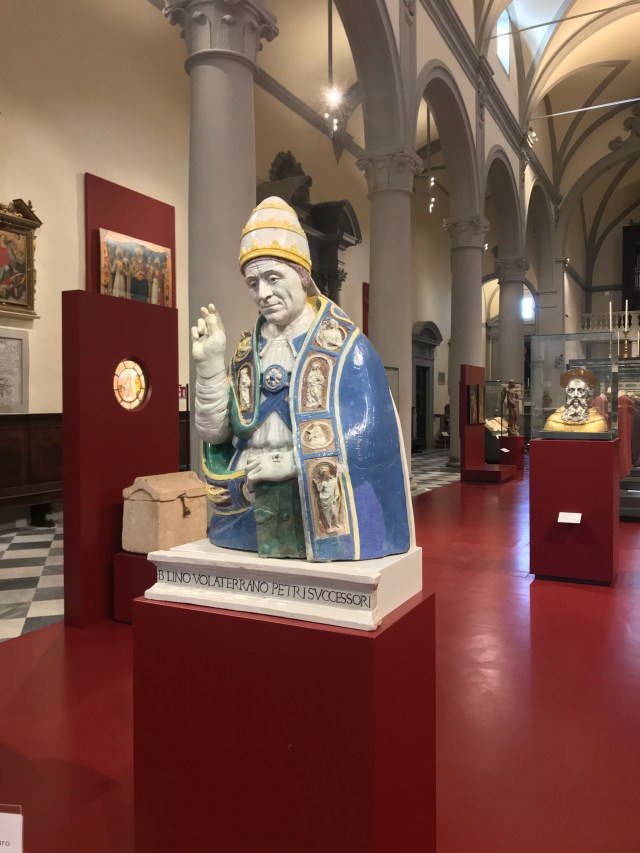
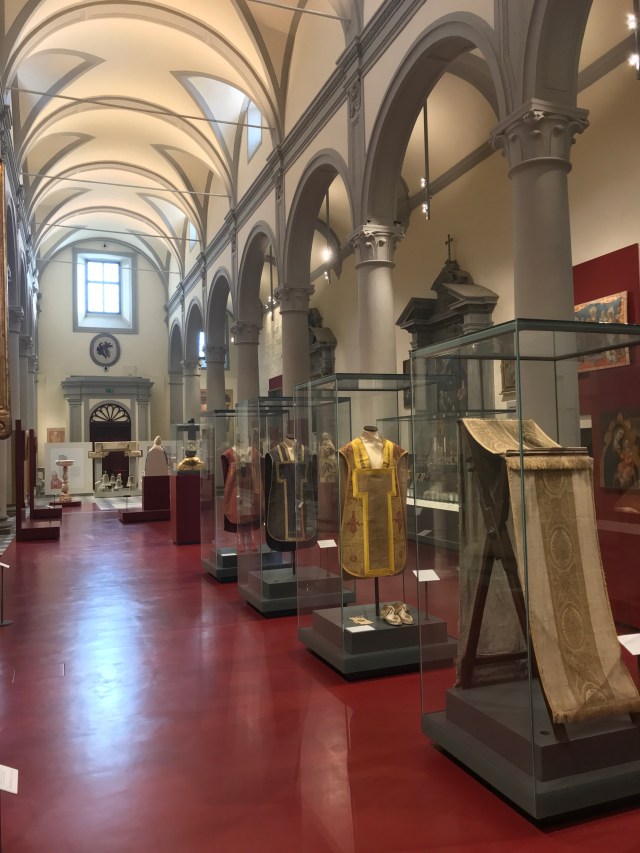
#16: A little beyond the Guarnacci museum, and past Volterra’s library lies the Museum of Sacred Art. It’s worth a quick visit and a stroll around. I have covered this place in another blog post here.
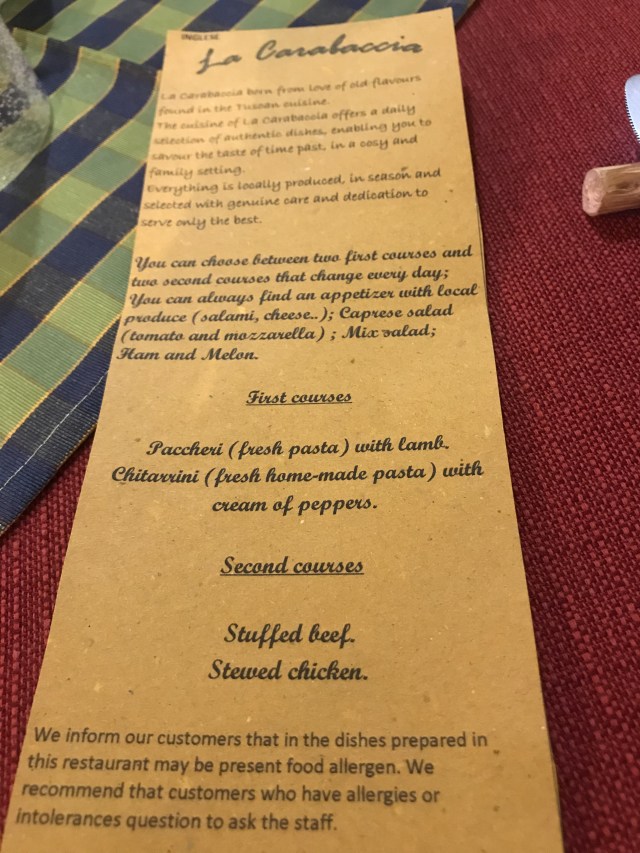
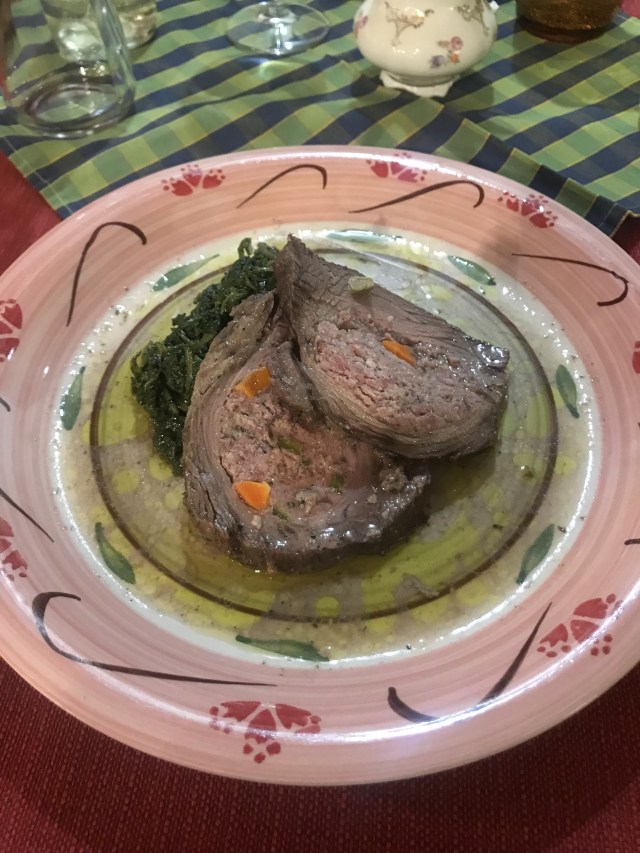
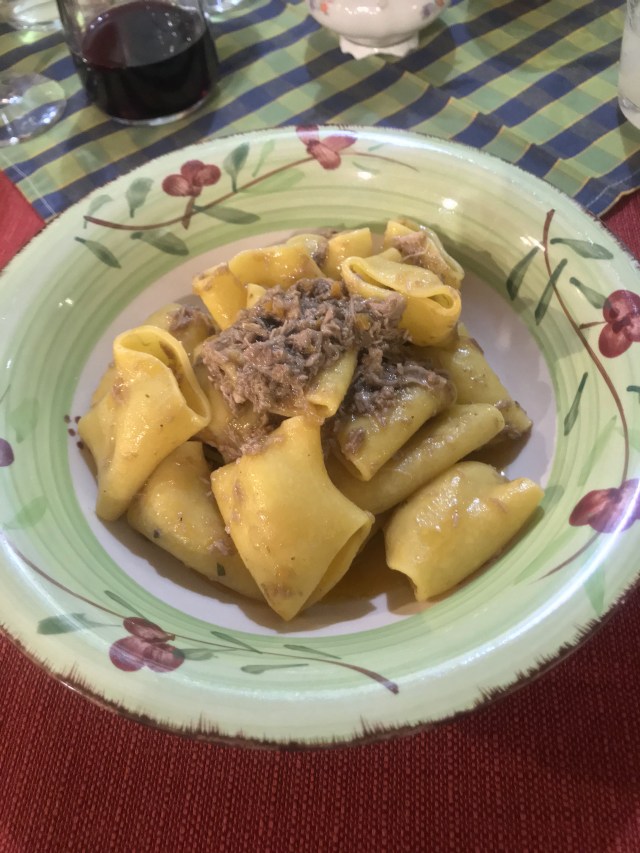
#17: Just as we enter Piazza Settembre XX, we come across another restaurant: La Carabaccia. This place is the very quintessence of the Italian concept of cucina povera (peasant cooking). It is run by three ladies: a woman and her two daughters.
Generally, there is a limited menu of two primi (generally pastas, all homemade) and two secondi (generally meats, but sometimes they have vegetarian options), but they will also put together a lovely antipasto plate for you.
If you can book a table, this is a must-visit. I’ve been dying to try the peposo here (black pepper beef), and I hope to do this on my next visit over. Menus are in English and Italian and change daily.
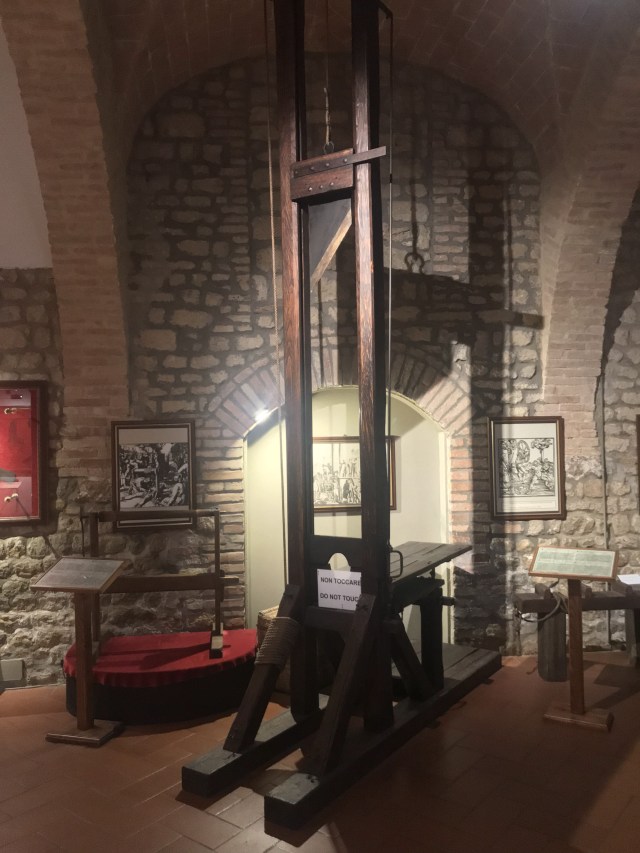
#18: So many towns of decent size in Tuscany seem to have a Torture Museum, and Volterra is no exception. I have visited this place only once, and to be honest, once is enough. It can be draining to see the awful things we used to do to one another in the name of perceived justice.
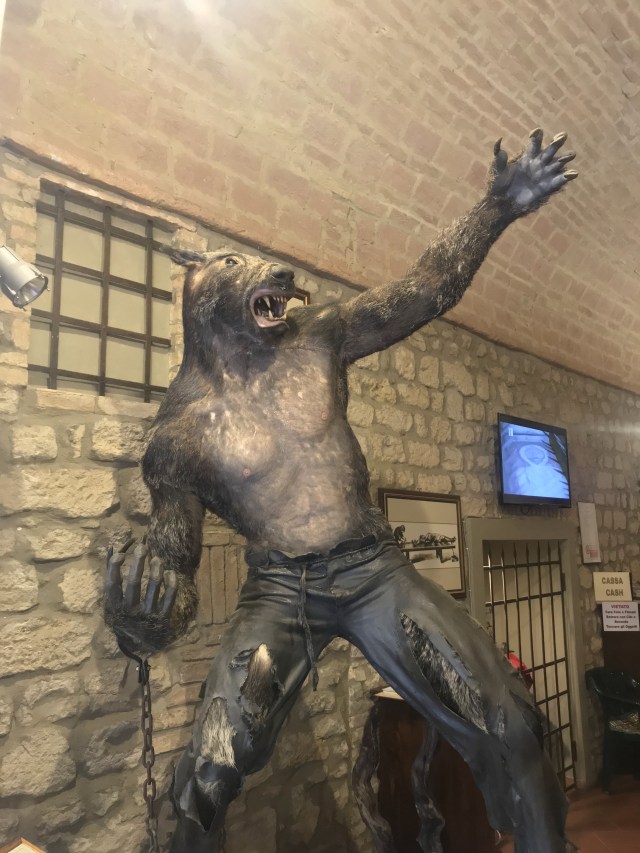
There (inexplicably) is a werewolf model at the front door, and best of all, is a strong message denouncing torture in all its forms. To be sure: this museum does not glorify torture. You may leave shaken and maybe even a little queasy, especially if you have a good imagination.
Tuscany, when it was a state all its own, was always considered somewhat enlightened. In fact, it was the first ever state to abolish capital punishment in 1786. Anyway, give it a visit… but maybe not too close to, or too soon after eating. Note that the displays aren’t especially graphic, but it’s all down to the power of imagination.
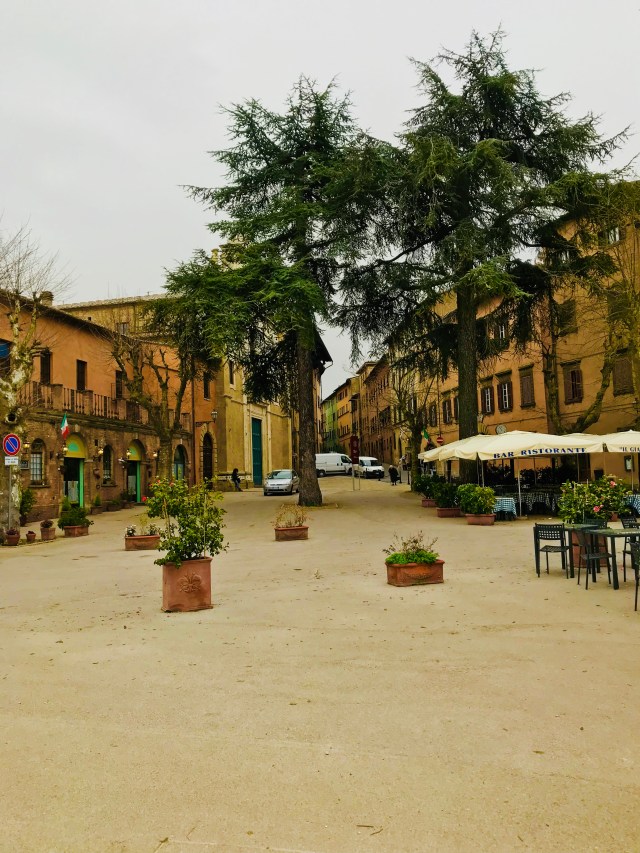
#19: We finish our journey here, in Piazza Settembre XX at the War Memorial and viewpoint. It’s a nice little square, part of which is used to house an ice-rink over the Christmas period. There are some additional restaurants here, but they largely cater to the tourist trade.
There are some lovely views to be seen out over the railing.
Piazza Settembre XX, looking back, taken on a grey morning in April 2018
Thanks a lot for reading this, if you got this far! I hope it has stirred you into thinking about making a visit to Volterra.
I will have a think about the next route I will take!
Today, I thought I’d set out some interesting facts about Volterra itself, before eventually leading into why we chose the town to buy an apartment at a later date.
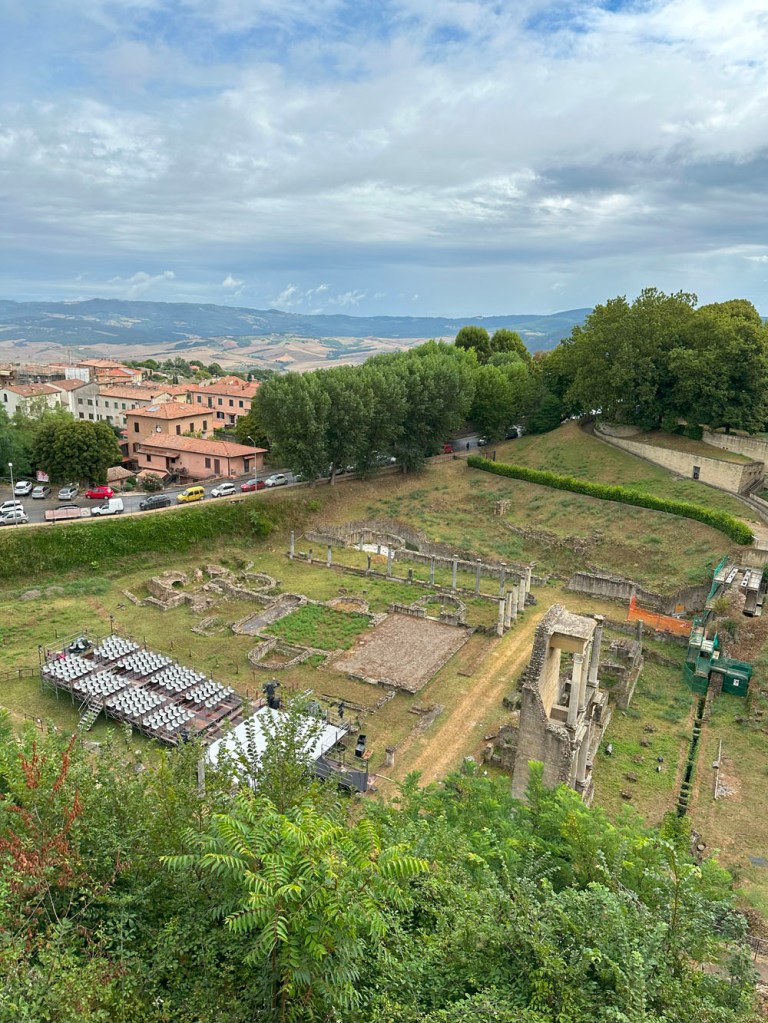
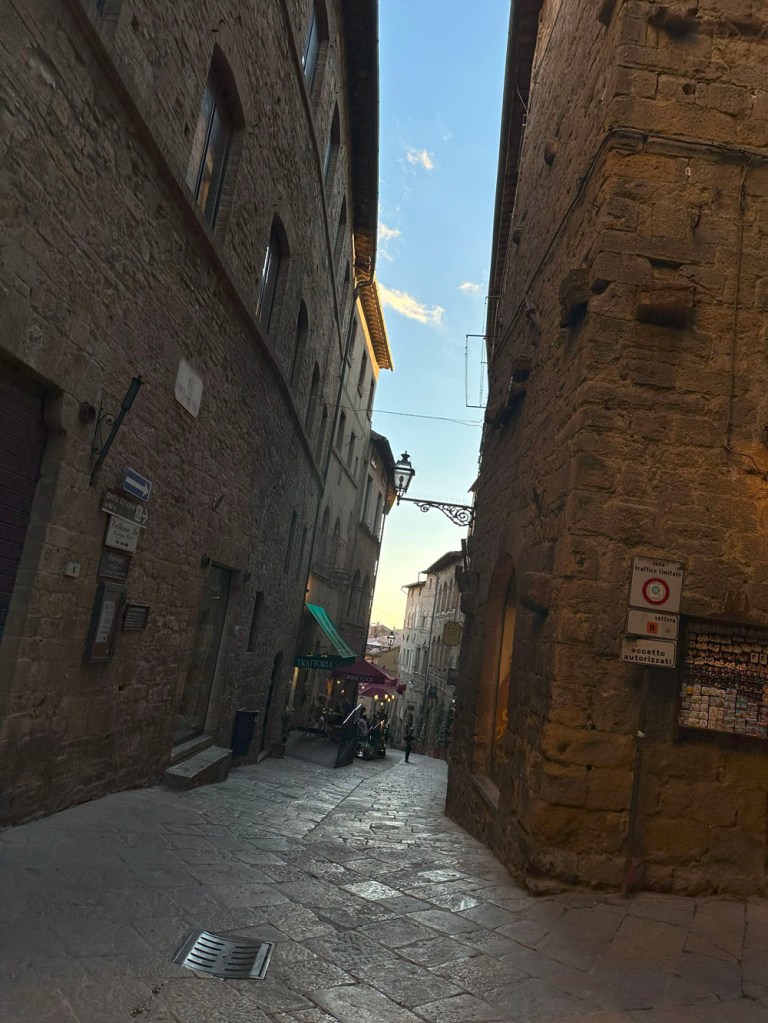
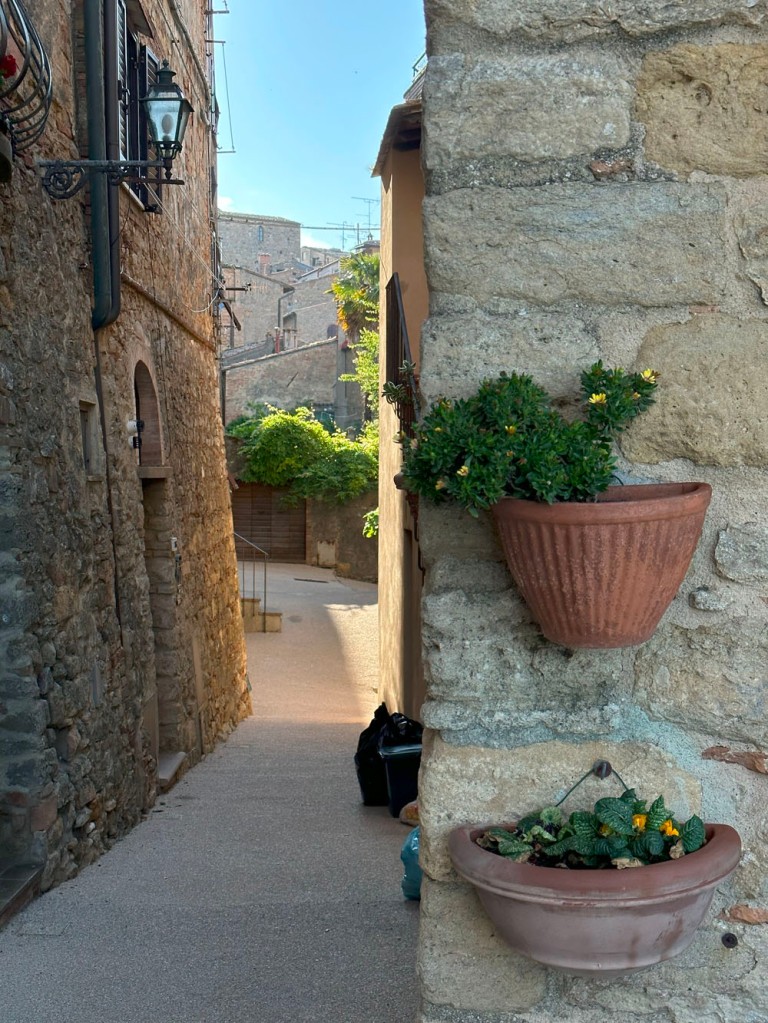
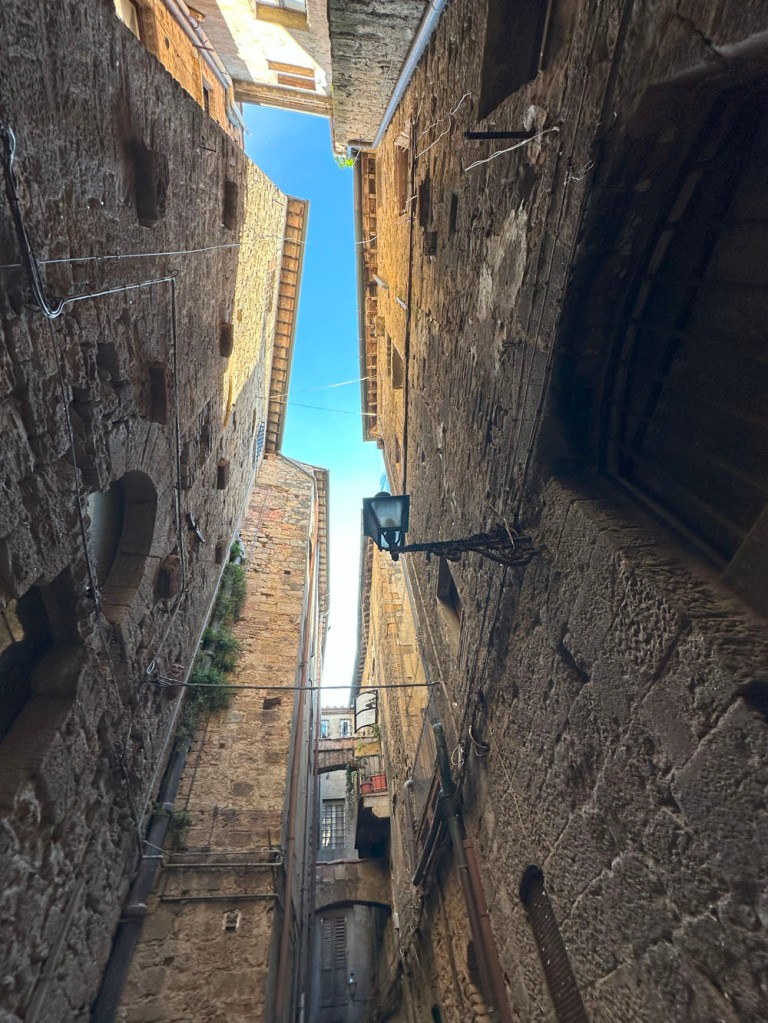
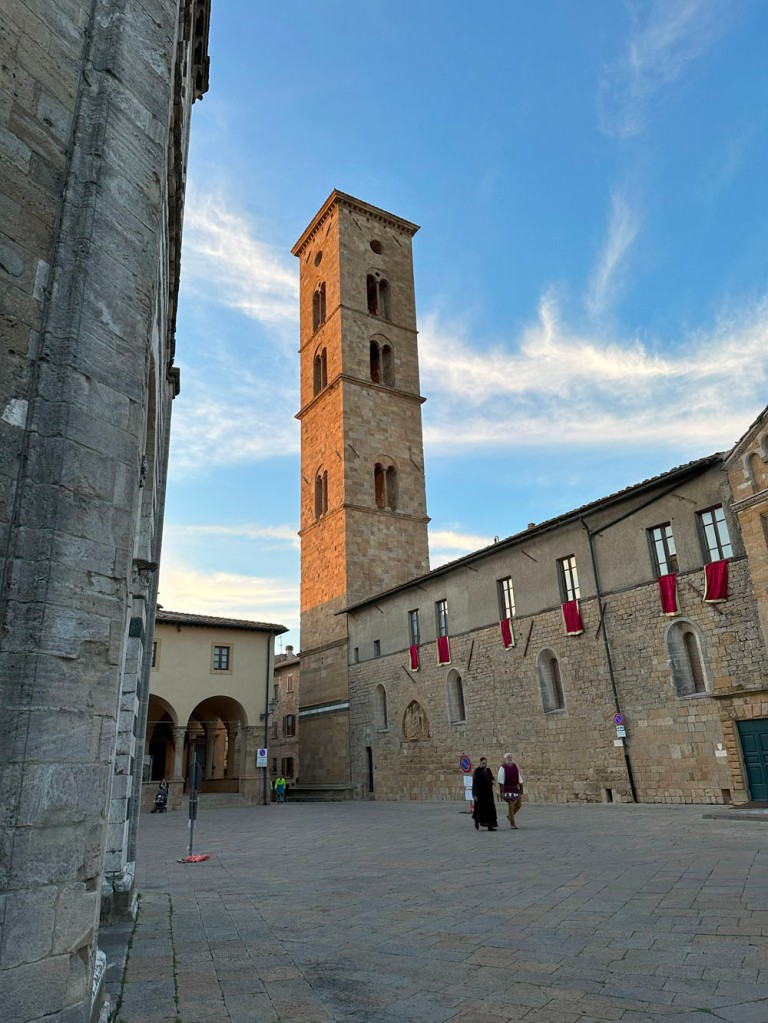
Volterra is the oldest continuously inhabited town in Tuscany. Located on a plateau between about 40km from the Tuscan coast, it lies about halfway between the northern and southern borders of that region. Artefacts dating to the Iron Age have been found there, and subsequent to the Villanovans of that period, one can find constructions by the Etruscans and Romans. However, today the town is largely medieval in layout.
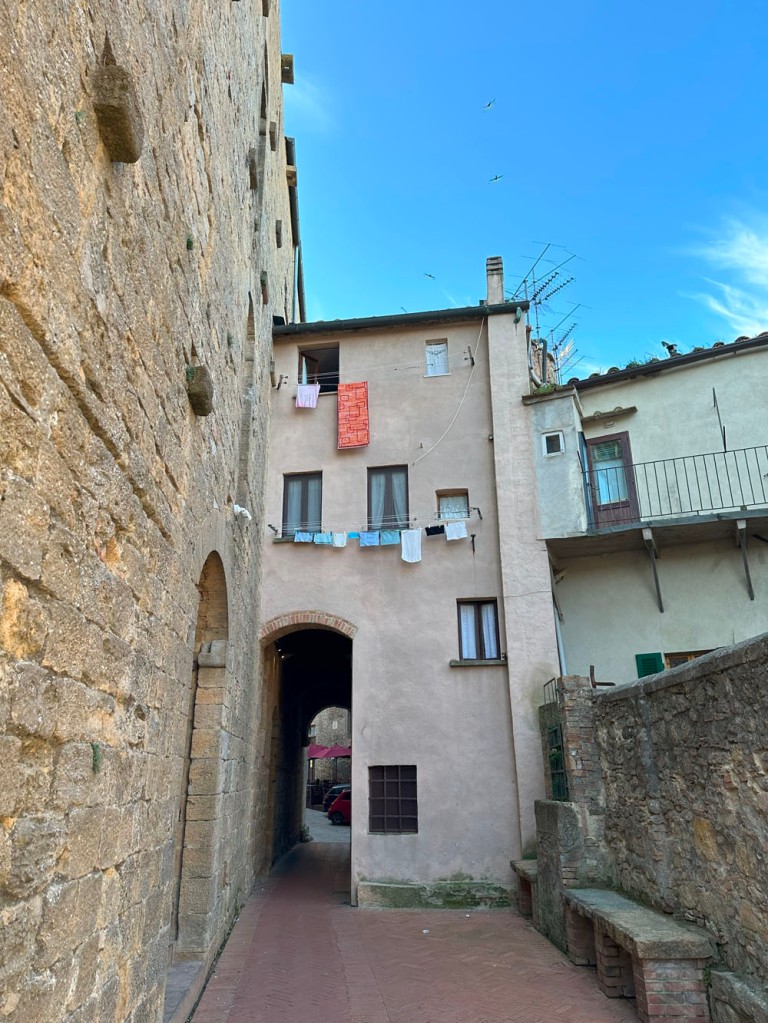
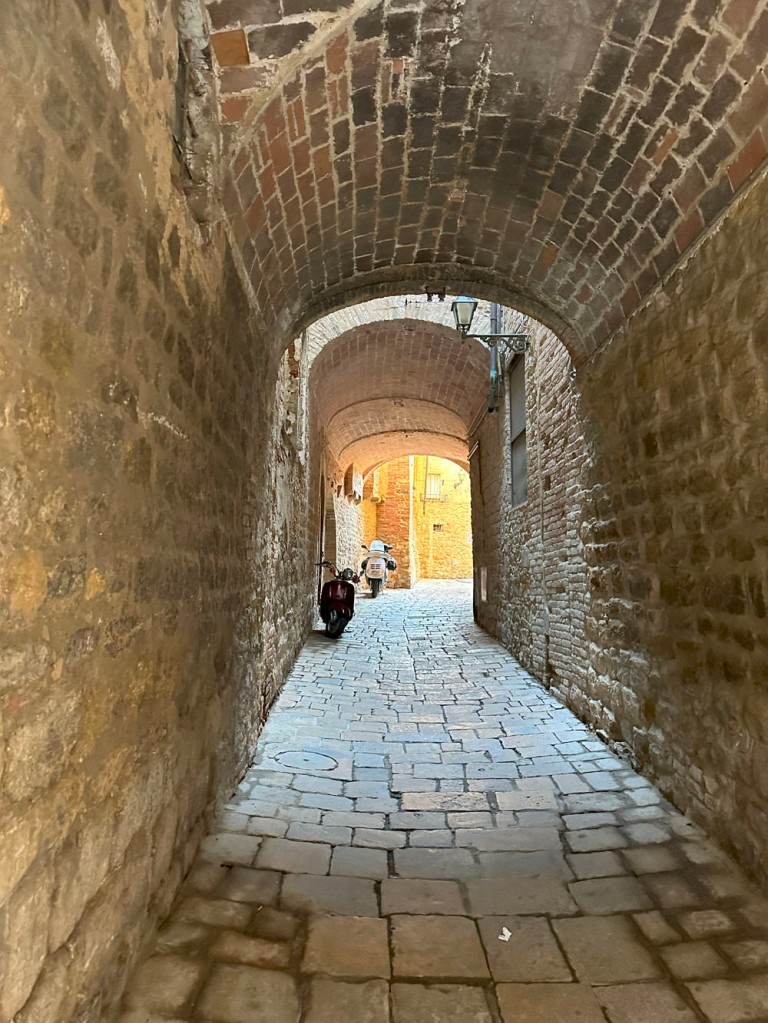
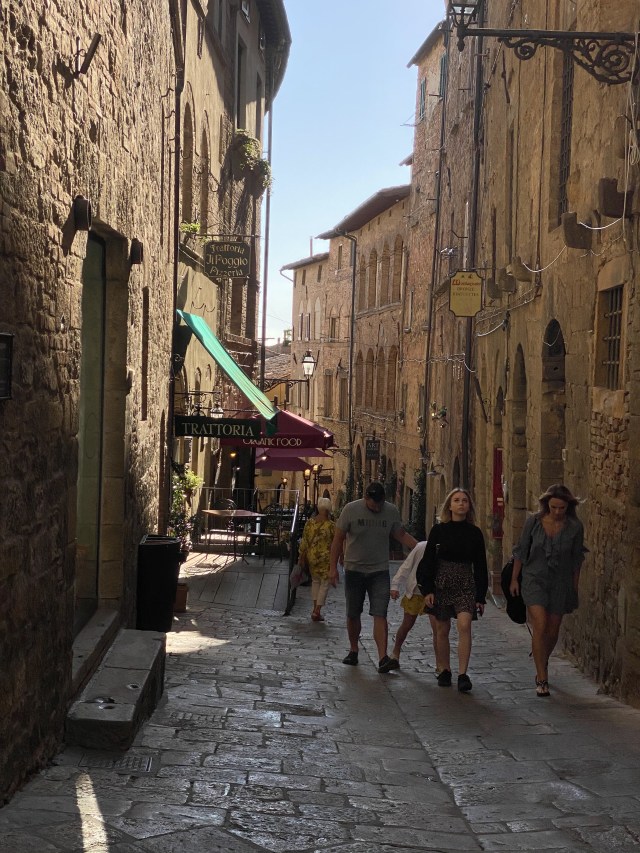
L-R: Porta all’Arco (Etruscan Gate), Roman Amphiteatre and baths, and medieval laneway
Today, although visited by tourists, is a little off the beaten path and much of its charm is derived not only due to its aesthetic qualities, but because it is also a genuine working town. About 6,000 people live within the walls of the Centro Storico (historical town centre), with a further 6,000 in the immediate environs and countryside. Centuries ago, the walls of the town surrounded a larger area, and within about 25,000 were said to have inhabited.
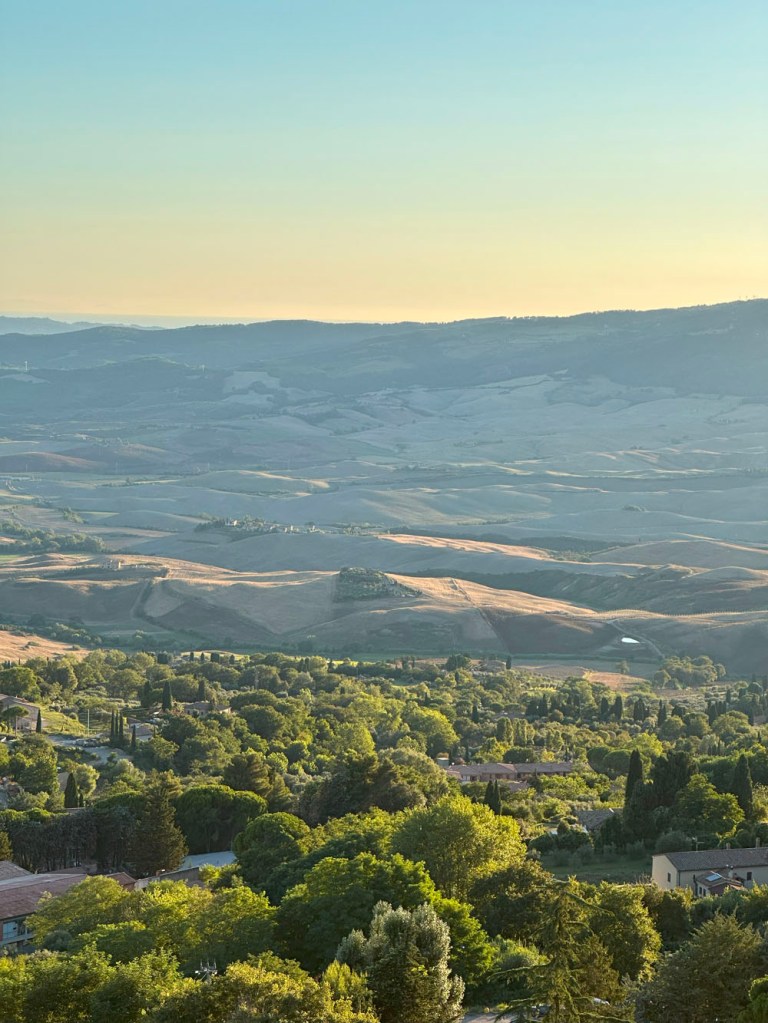
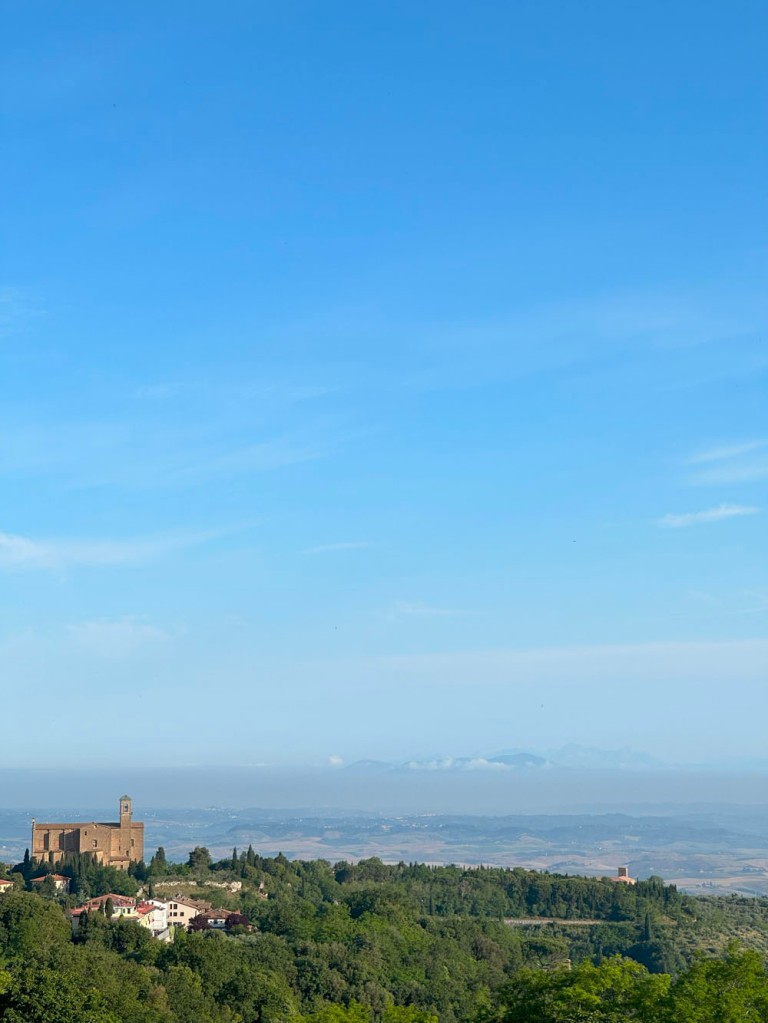
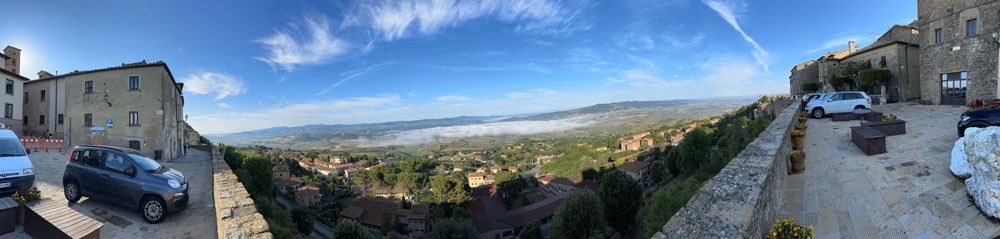
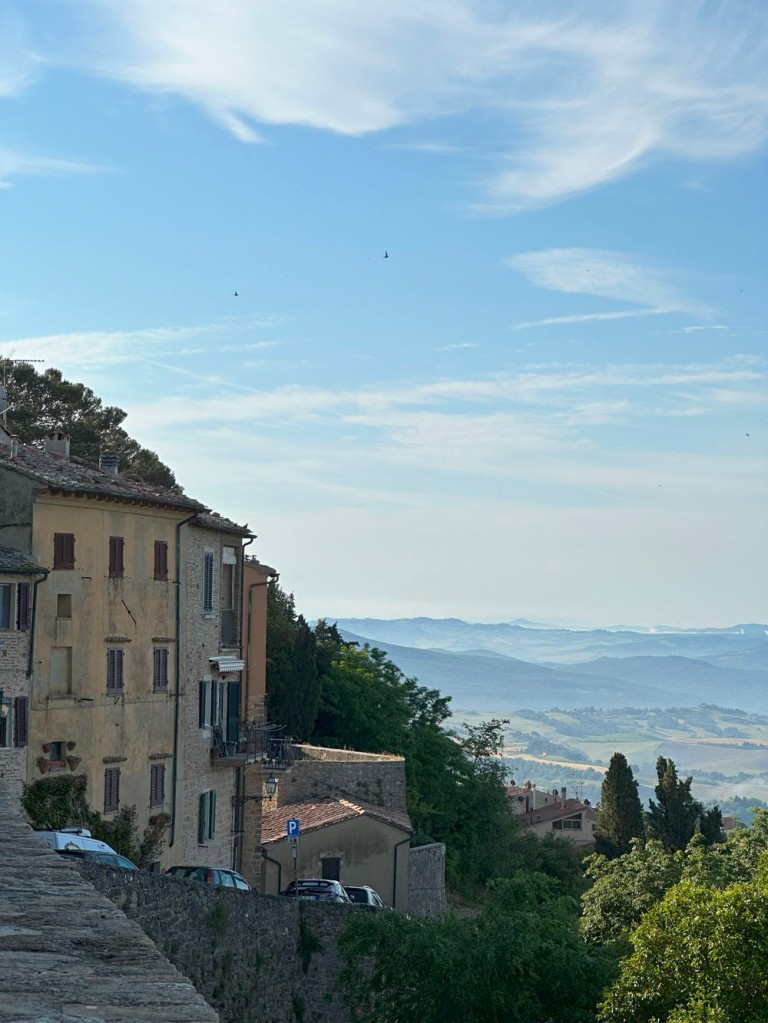
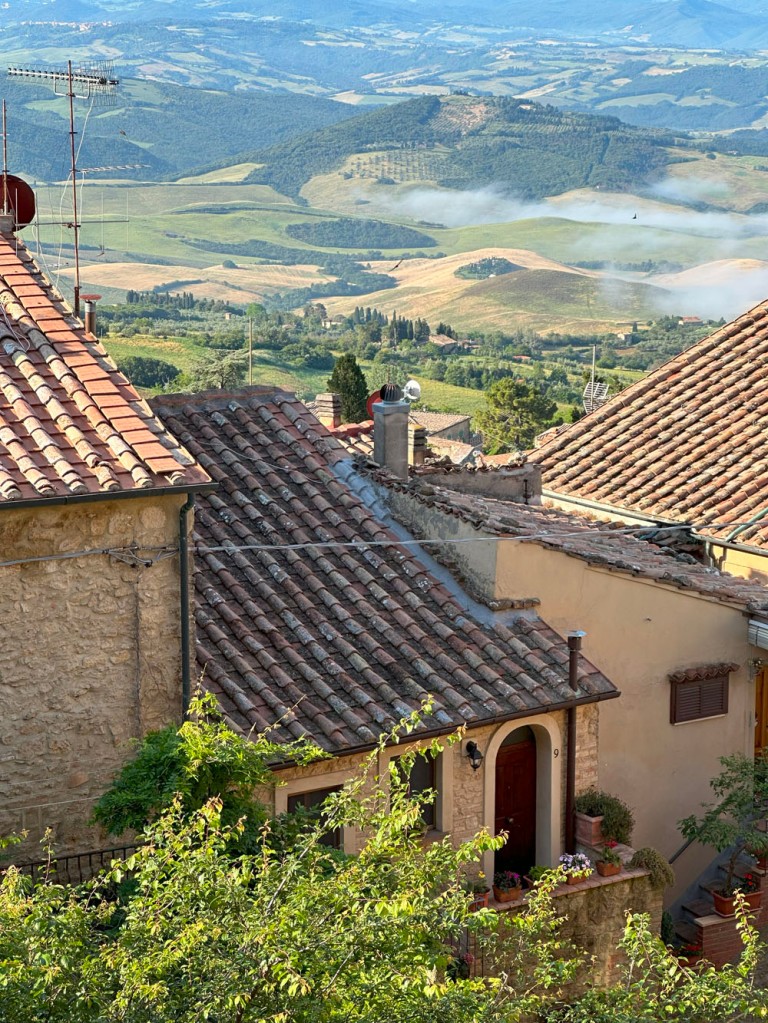
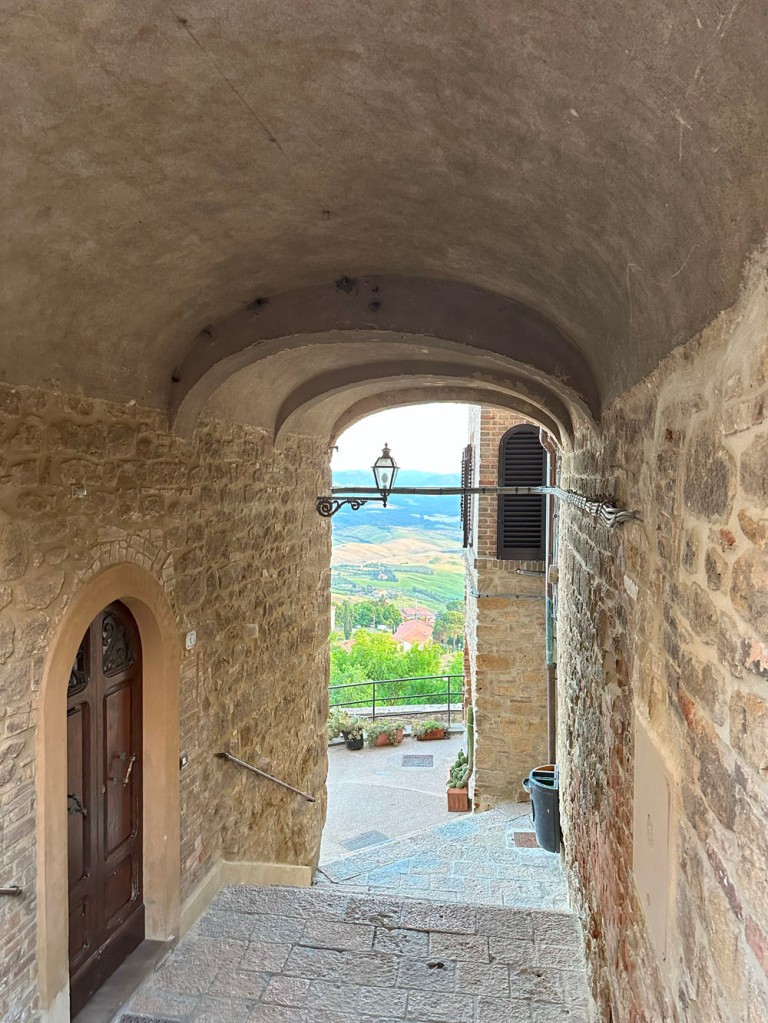
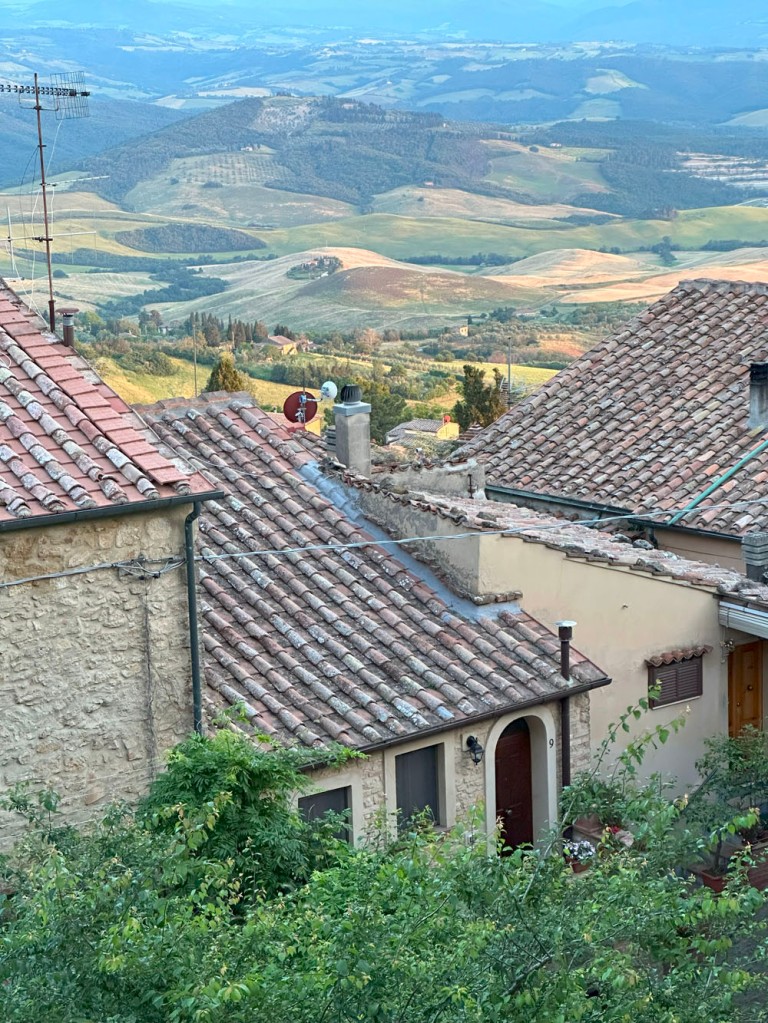
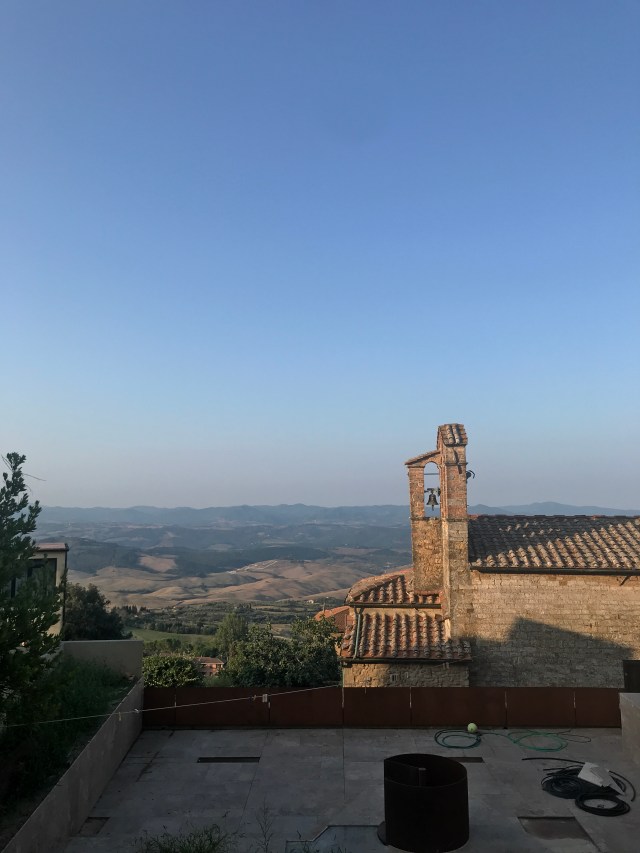
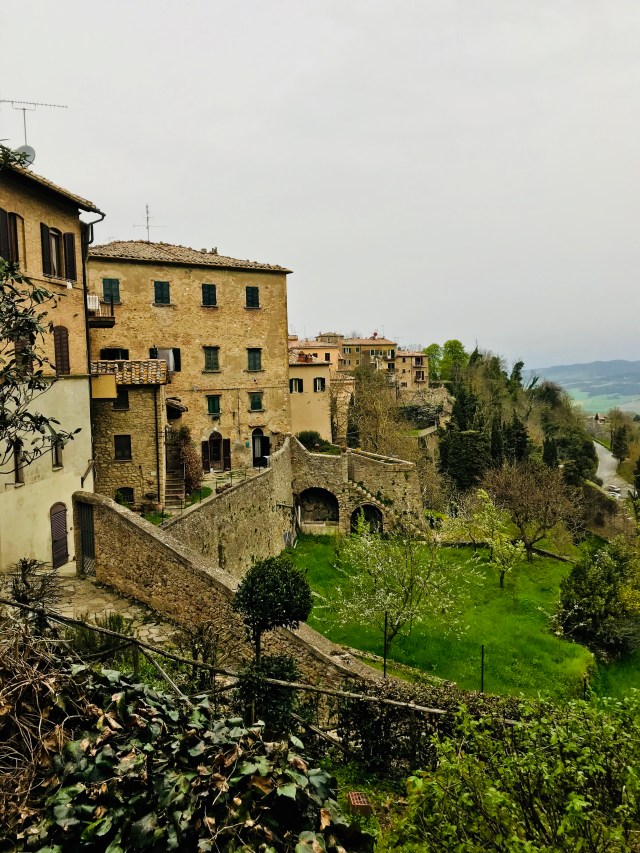
Volterra is also the highest hill-town in Tuscany, and it commands some seriously panoramic views of the countryside, all the way to the Tyrrhenian sea on a clear day. Photos tend not to do it justice, and the vistas from its walls always take my breath away.
We settled upon Volterra immediately after our first visit. The enormous sense of place, the history, the people and the food bring us back again and again – but more on those another time.






































































































 Our Man In Volterra